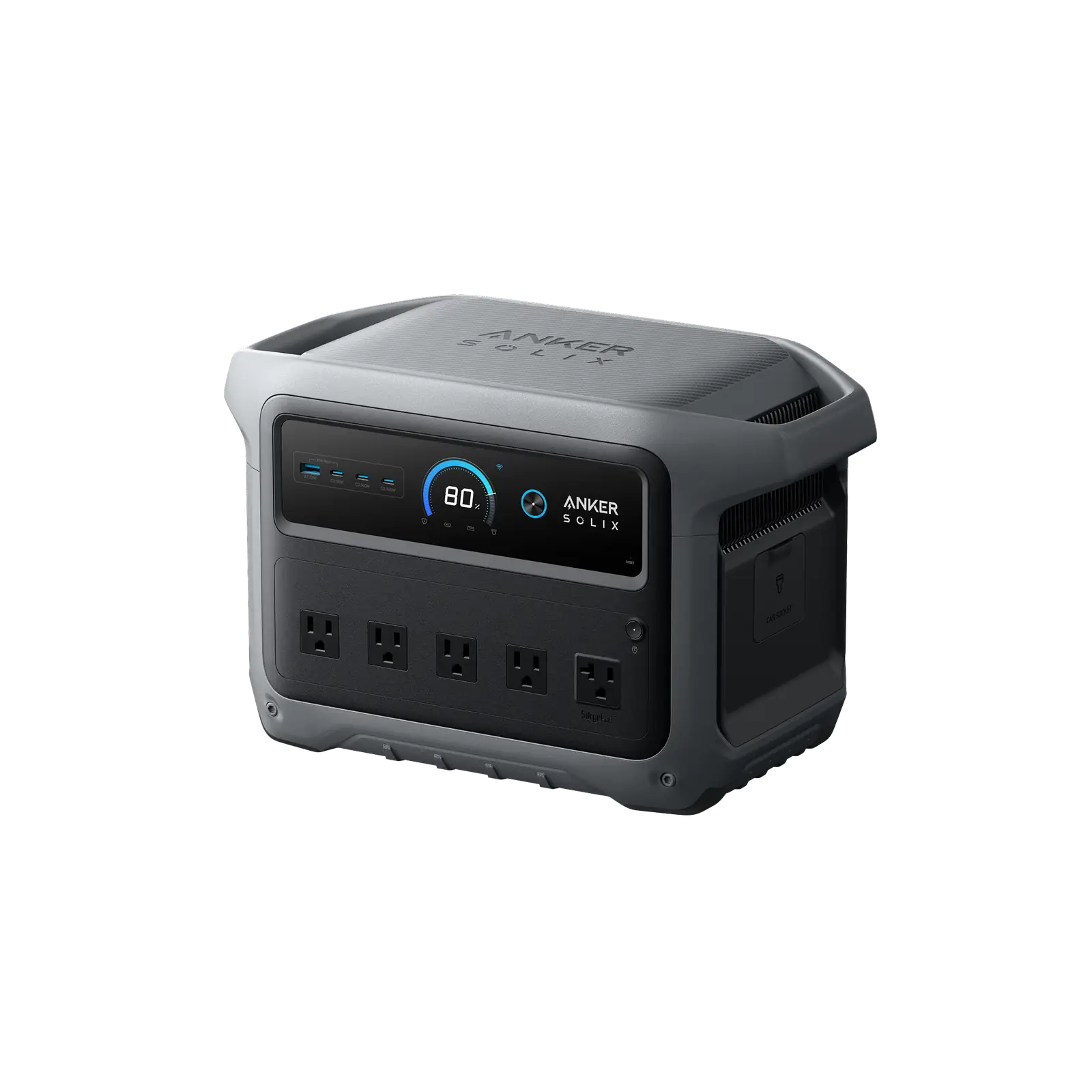
Anker SOLIX C1000 Gen 2 Portable Power Station
By Anker · Portable Power Stations · Audio & Electronics
- 1,024Wh LiFePO4 battery
- 2,000W output, 3,000W peak
- 49-minute full recharge at 1,600W
- 600W max solar input, 1.8-hour recharge
- 10 output ports including 5 AC outlets
Lowest price seen
$499.99
from $499.99 at Anker SOLIX · Checked Oct 8, 2026
- Anker SOLIX $499.99View at Anker SOLIX
- Anker $529.99View at Anker
- SoundcoreView at Soundcore
- eBay (used) eBay: used, open-box, refurbishedView at eBay (used)
- eBayView at eBay
- AmazonView at Amazon
Prices are snapshots. Check the current price with the store.
Summary
A 1,024Wh LiFePO4 power station rated 2,000W continuous with a sub-hour AC recharge, aimed at camping, van life and short home backup. Check which version you are buying before you order: the online C1000 Gen 2 has five AC outlets, while the big-box C1000X has four at the same price.
Strengths
- Sub-hour AC recharge: Anker claims 49 minutes, and independent tests measured about 47 to 56 minutes.
- Measured usable capacity is high: OutdoorGearLab got 890Wh, about 87% of the rating.
- Light and compact for a 1kWh unit at 24.9 lb, with a clean, readable LCD.
- Good port mix on the online model: dual 140W USB-C, a 12V car socket and five AC outlets.
- 5-year warranty, longer than several rivals in its class.
- Strong value when discounted into the roughly $430–500 range.
Weaknesses
- The cooling fan is loud at high output; Notebookcheck measured about 45 dB at 1 m.
- The Gen 2 dropped the original C1000’s LED light bar and its expansion-battery port.
- It lost one AC outlet versus some listings, and capacity slipped from 1,056Wh to 1,024Wh.
- Anker ships two nearly identical versions — five-outlet Gen 2 online, four-outlet C1000X in big-box stores — at the same price.
- The AC outlet spacing on the five-outlet version is cramped.
- The 49-minute recharge needs UltraFast mode and a battery above 68°F (20°C).
Verified specifications
| Capacity | 1,024Wh LiFePO4 (LFP). |
|---|---|
| Rated cycle life | 4,000 cycles to 80% of capacity, marketed as a 10-year life. |
| AC output | 2,000W continuous, 3,000W peak. |
| AC recharge | 1,600W max; 0–100% in 49 minutes with UltraFast Charge enabled in the Anker app. |
| Measured recharge | 56 minutes standard and 49 minutes UltraFast (OutdoorGearLab); just under 55 minutes without boost (Notebookcheck); about 47 minutes (The Solar Lab). |
| Solar input | 600W max via XT60i (60V max); Anker claims a 1.8-hour full solar recharge. |
| UPS switchover | 10 ms; all AC ports support UPS. |
| Ports (US online model) | five AC outlets, three USB-C (two 140W, one 20W shared with USB-A), one USB-A and a 12V/10A car socket. |
| Connectivity | Wi-Fi and Bluetooth app control, plus a time-of-use mode. |
| Operating temperature | discharging -4°F to 104°F; charging 32°F to 104°F. |
| Charging caveat | UltraFast Charging only activates above 68°F (20°C); between 32°F and 68°F charging is significantly slower. |
| Warranty | 5 years. |
| Dimensions | 15.12 × 8.19 × 9.61 in (384 × 208 × 244 mm); 24.9 lb (11.3 kg). |
| In the box | power station, AC charging cable, car charging cable, quick-start guide, safety and warranty card. |
Full research notes and sources
Fast charging and measured performance
Anker rates the AC input at 1,600W and claims a 0–100% recharge in 49 minutes with UltraFast Charge switched on in the app. Independent testing broadly agrees: OutdoorGearLab recorded 56 minutes in standard mode and 49 minutes in UltraFast, Notebookcheck measured just under 55 minutes without boost, and The Solar Lab clocked about 47 minutes. Notebookcheck put AC charging efficiency near 92%, and The Solar Lab near 86%.
Two conditions matter. UltraFast only activates above 68°F (20°C), and between 32°F and 68°F charging slows sharply, so a cold unit will not hit the headline number. The 49-minute figure also needs the app’s boost mode rather than the default charge profile.
Capacity, output and ports
The unit is rated 1,024Wh and 2,000W continuous with a 3,000W peak. OutdoorGearLab measured 890Wh of usable energy, about 87% of the rating, and an average charge rate of 1,097 Wh/hr. Notebookcheck measured about 83% AC discharge efficiency at a 250W load. Idle draw is low: The Solar Lab measured about 13.8W with the inverter on and no load.
Ports on the US online version are five AC outlets, three USB-C (two at 140W, one 20W shared with USB-A), one USB-A and a 12V/10A car socket. All AC ports support the 10 ms UPS switchover, which is useful for short outages. The Solar Lab notes the five-outlet face is cramped, so large plugs can block a neighbour.
What the Gen 2 dropped
Compared with the original 2023 C1000, the Gen 2 loses the built-in LED light bar, the expansion-battery port and one AC outlet on some listings, and capacity slips from 1,056Wh to 1,024Wh. It is still not expandable, so you cannot add a battery later. Anker also sells two nearly identical versions: the online C1000 Gen 2 with five AC outlets and the big-box C1000X with four and a different faceplate, at the same price.
Noise and ownership
Under high load or fast charging the fan is the main complaint. OutdoorGearLab called it frustratingly loud, and Notebookcheck measured about 45 dB at 1 m. Nothing in the sources points to a hardware failure pattern — no reviewer reported a BMS fault, a thermal shutdown or a defect rate, so treat reliability as unproven rather than known-bad.
The battery is LiFePO4, rated 4,000 cycles to 80% of capacity and marketed as a 10-year life, and the app lets you cap charge and discharge to reduce stress. The warranty runs 5 years. No first-party replacement parts or user-serviceable internals were found, and the sealed case and missing expansion port point to limited field service; treat repairability as unknown rather than confirmed unavailable.
Is it worth it?
Anker lists the C1000 Gen 2 at $799, but it sells well below that. At $450 or less it is strong value: measured capacity, sub-hour charging, 2,000W output, a 24.9 lb body and a 5-year warranty all hold up. Around $450–500 it still suits camping, van life and short home backup. From roughly $500 to $650 it is fair, where the EcoFlow Delta 3, Jackery Explorer 1000 v2 and DJI Power 1000 V2 compete on capacity and expandability. Toward the $799 list it is weak, because the fast charge and low weight are widely matched and the missing light and expansion hurt at full price. Anker launched it in August 2025 with a $429 sign-up price, and reviewers have reported street prices of about $449 (The Solar Lab, 2026) and $499.99 (backuppowerhub).
Which model this is
This page covers the Anker SOLIX C1000 Gen 2, a 1,024Wh unit listed on soundcore.com under the name “Soundcore SOLIX C1000 2” — Soundcore is Anker’s audio brand, not a power-station brand. Two US versions look alike: the online C1000 Gen 2 with five AC outlets, and the big-box C1000X with four AC outlets and a different faceplate, at the same price. Don’t confuse either with the original 2023 Anker SOLIX C1000, which is 1,056Wh, 1,800W, expandable and carries an LED light bar.
Sources
Manufacturer:
- Anker SOLIX C1000 Gen 2 (soundcore.com listing)
- Anker SOLIX C1000 Gen 2 - Anker SOLIX CA
- Anker SOLIX C1000 Gen 2 - Anker Support
- Anker SOLIX C1000 Gen 2 - Anker SOLIX EU (FAQ)
- Anker launches SOLIX C1000 Gen 2 (GlobeNewswire)
- Original Anker SOLIX C1000 (Anker SOLIX US)
Independent reviews:
- OutdoorGearLab review and testing
- Notebookcheck review
- The Solar Lab review
- How-To Geek review
- Mashable review
Owner reports:
- No owner-forum threads were captured for this model; the owner-sentiment points here come from professional hands-on reviews.
Parts and stores: