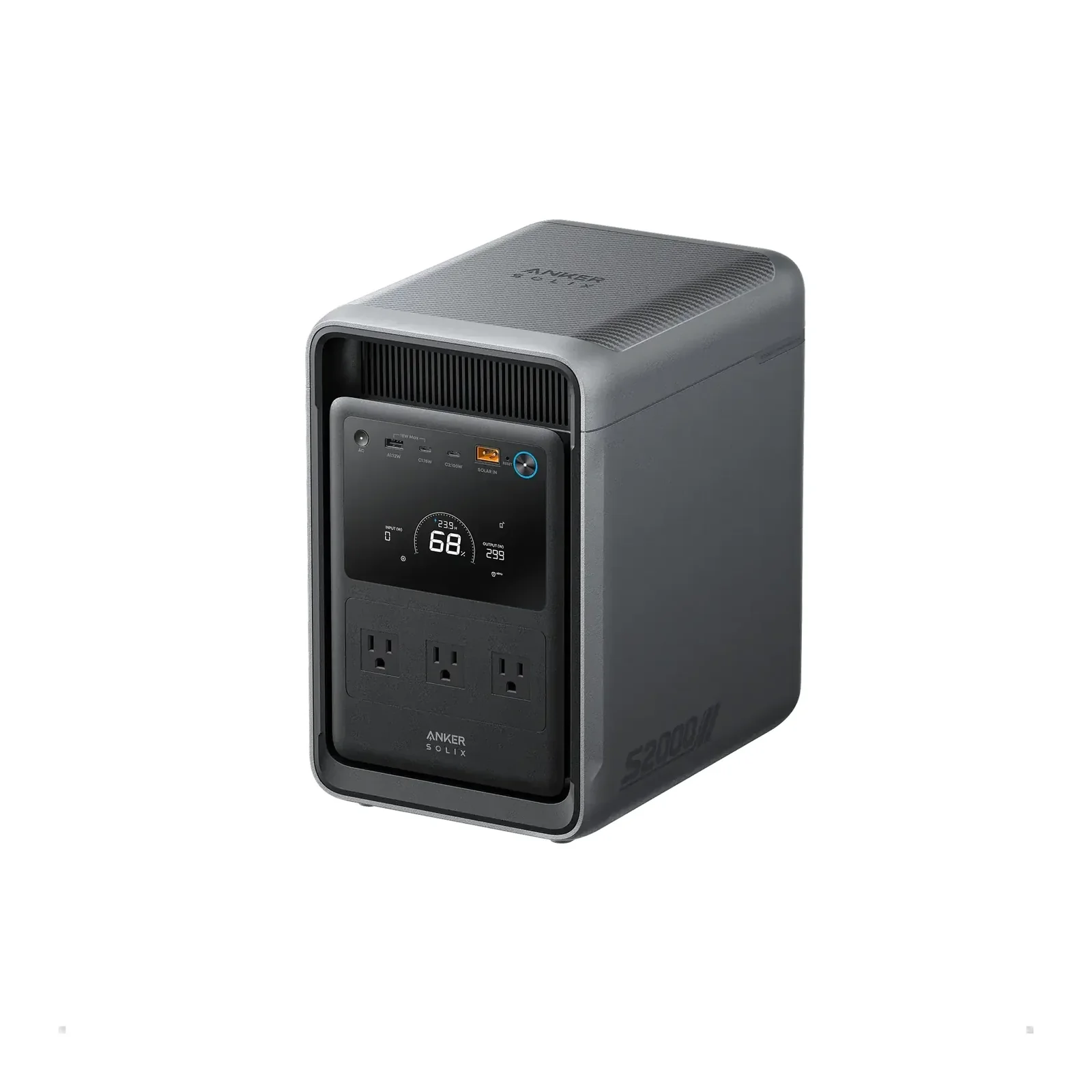
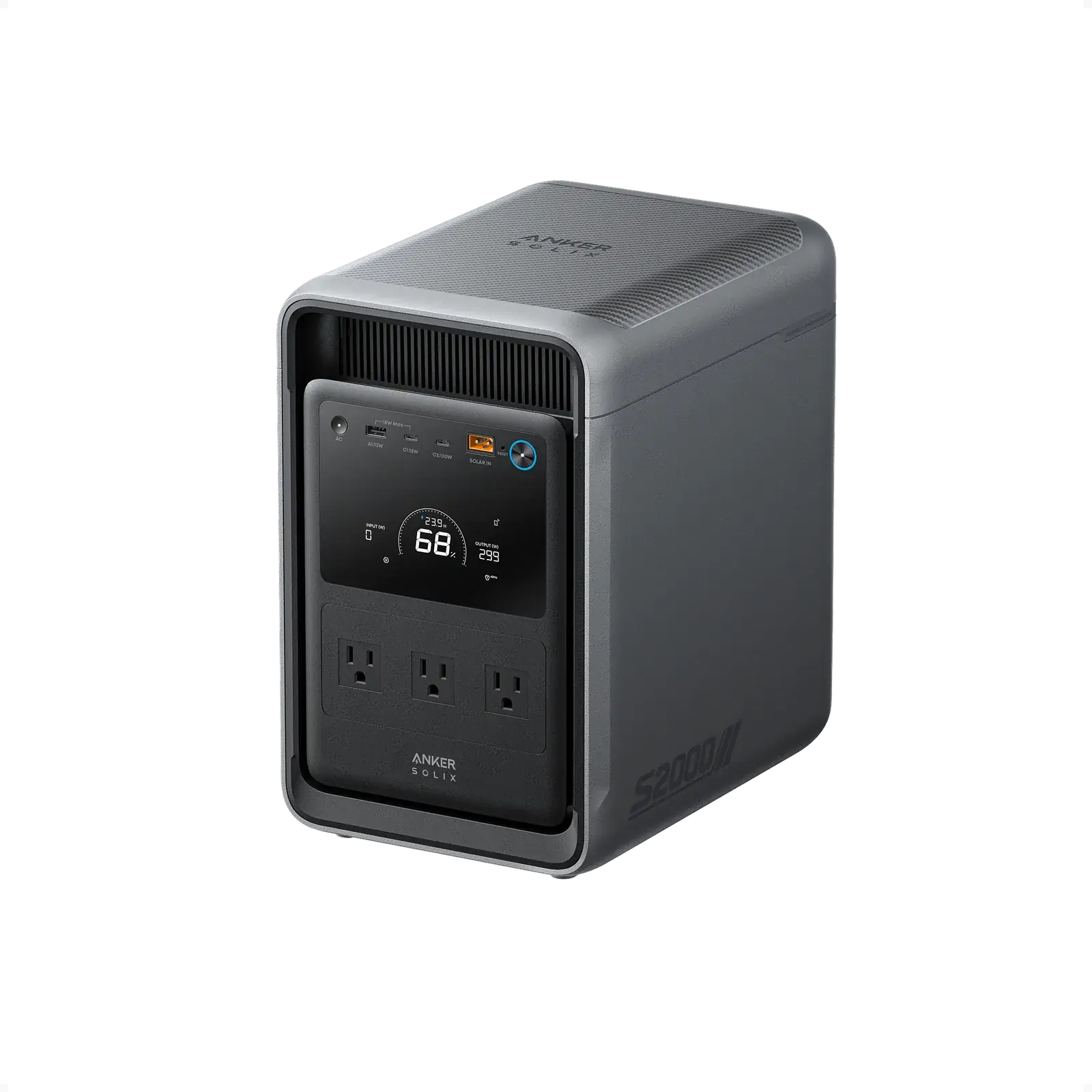
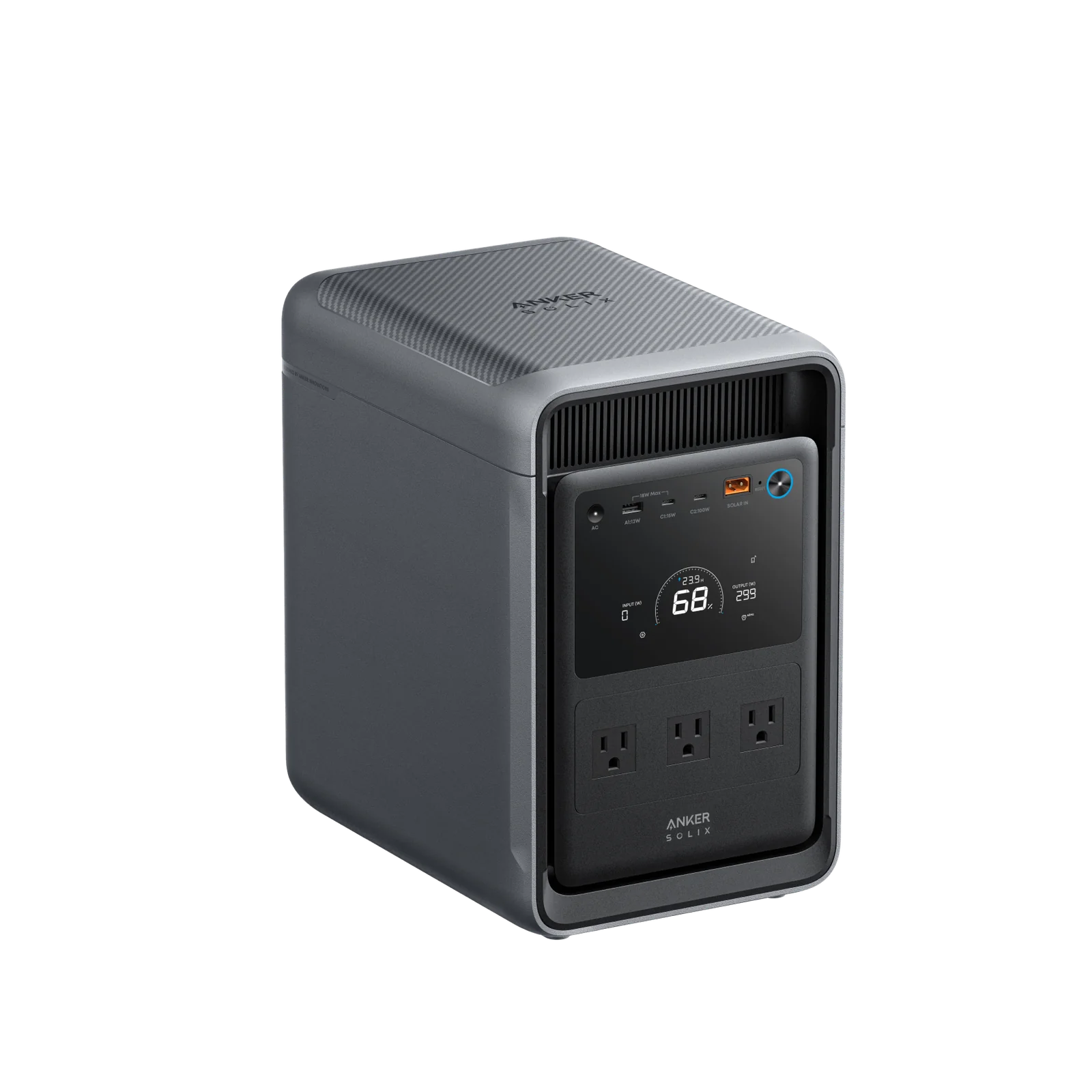
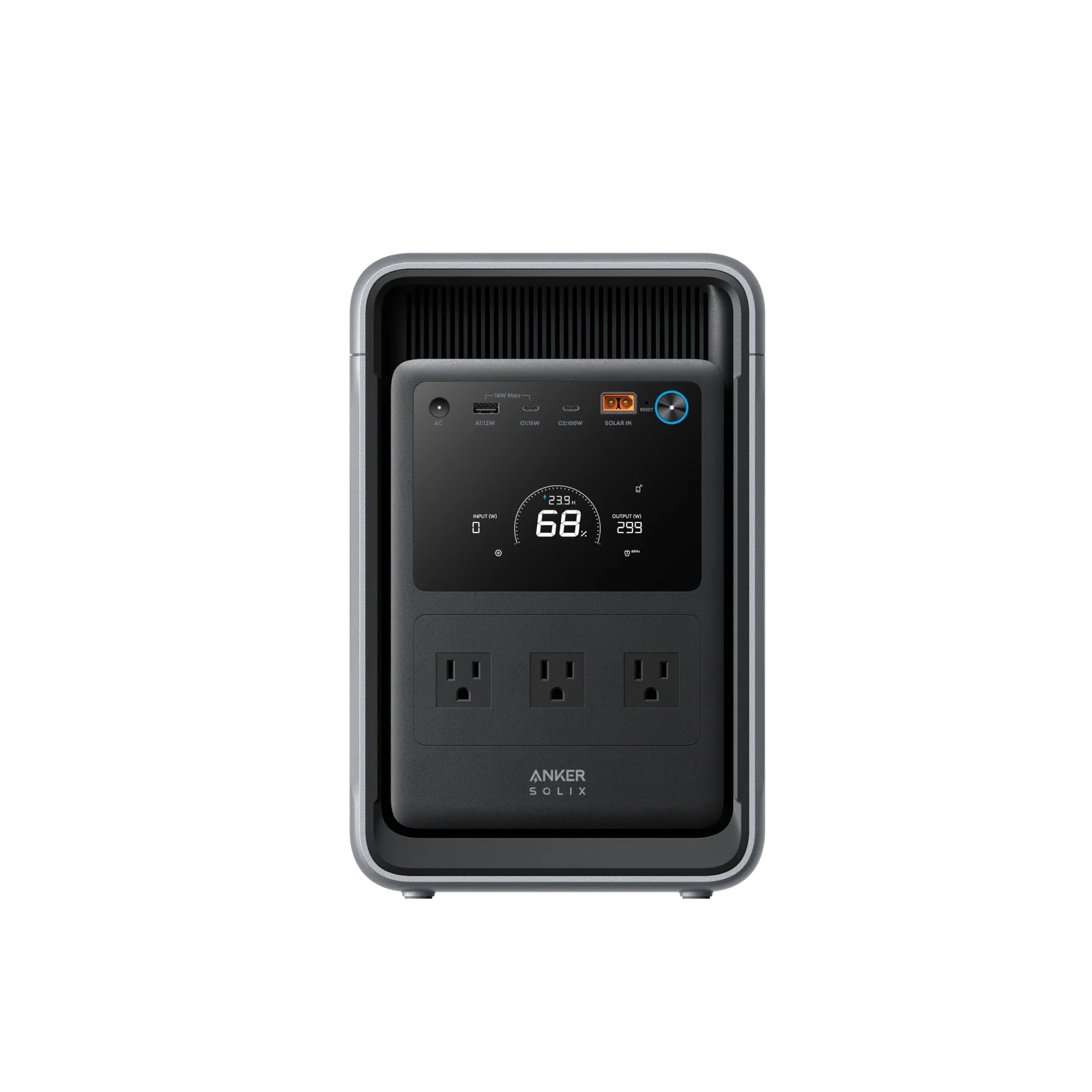
Anker SOLIX S2000
By Anker · Portable Power Stations · Audio & Electronics
- 2,010Wh LFP battery, 10,000-cycle rated lifespan
- 1,500W continuous output, 3,000W peak
- Up to 35 hours of refrigerator backup on one charge
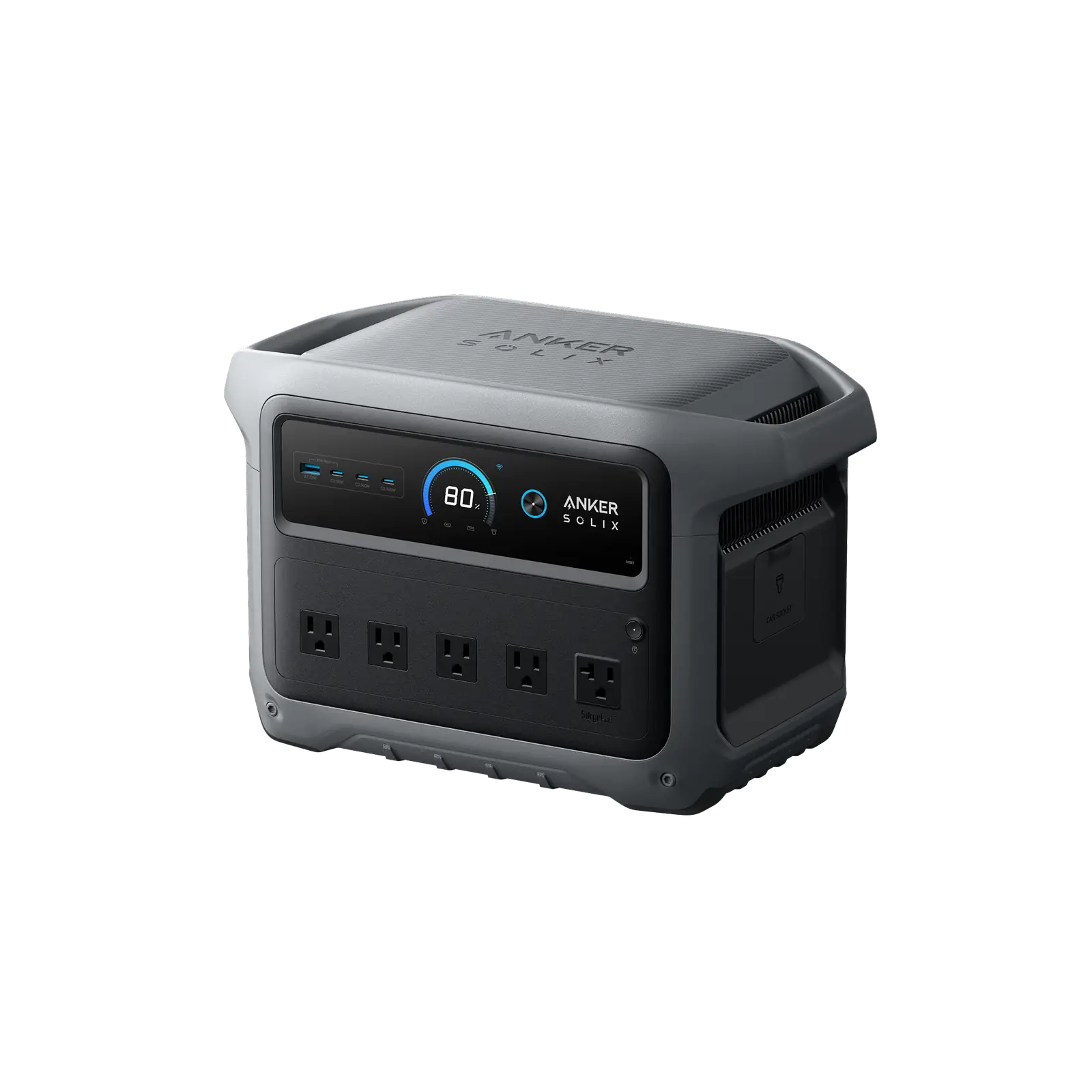
- Compact for its class: 8.2 x 11.1 x 12.7 in, 35.7 lbs
Lowest price seen
$679.99
from $679.99 at Anker (Anker SOLIX D2C) · Checked Sep 28, 2026
- Anker (Anker SOLIX D2C) $679.99View at Anker (Anker SOLIX D2C)
- eBay $949.99View at eBay
- The Home DepotView at The Home Depot
- Best BuyView at Best Buy
- AdoramaView at Adorama
- eBay (used) eBay: used, open-box, refurbishedView at eBay (used)
- AmazonView at Amazon
Prices are snapshots. Check the current price with the store.
Summary
A compact 2 kWh backup battery sized for essentials — a fridge, a router, a home office — with unusually low idle drain and UPS-grade transfer. Check your appliance list before buying: output stops at 1,500 W continuous, solar input at 400 W, and the battery cannot be expanded.
Strengths
- 2 kWh at 35.7 lb is unusually compact, so keeping indoor backup storage is realistic.
- Idle draw of 6 W active and 2 W standby matters when the unit sits plugged in all year.
- The honest endurance figure is 6,000 cycles to 80%, not just the marketable 10,000-to-60% one.
- Transfer in 10 ms or less plus app charge controls make it everyday backup, not just camping gear.
- Independent tests measured about 91% conversion efficiency and ran a refrigerator for 42 hours.
- The US warranty runs five years, matching Anker’s other power stations.
Weaknesses
- 1,500 W continuous is modest for a 2 kWh unit; a four-slice toaster, a space heater or a compressor start can outrun it despite the 3,000 W peak.
- Solar input tops out at 400 W, below the 600–1,000 W common among rivals, so a multi-day outage recharges slowly.
- No expansion battery: 2.01 kWh is the permanent ceiling.
- No 12 V cigarette-lighter output for 12 V gear.
- Only one USB-C port delivers 100 W; the second manages 15 W.
- Fan noise is the dominant owner complaint, loud and growling under fast AC charging, and some owners hear it even at 200–600 W.
Verified specifications
| Capacity | 2,010 Wh from 314 Ah LFP cells. |
|---|---|
| Cycle life | 6,000 cycles to 80% capacity, 10,000 to 60%; Anker markets a 15-year service life under its own assumptions. |
| Output | 1,500 W continuous, 3,000 W peak, pure sine wave; bypass mode handles up to 1,800 W. |
| AC input | up to 1,600 W with UltraFast mode enabled in the app; the default cap is 1,150 W, about 2.3 hours to full. |
| Solar input | XT60i, 400 W maximum, at 11–28 V and 8.2 A or 28–60 V and 12.5 A. |
| UPS transfer | 10 ms or less; 6 W active idle, 2 W system standby. |
| Ports | five AC outlets, one 100 W USB-C, one 15 W USB-C, one 12 W USB-A; the small USB-C and USB-A share an 18 W limit. |
| Not included | no 12 V car-style output and no expansion battery. |
| App | Bluetooth and Wi-Fi, with charge-rate, time-of-use, Storm Guard and state-of-charge controls; settings and firmware need a Wi-Fi connection. |
| Dimensions | 8.2 × 11.1 × 12.7 in (208 × 282 × 323.3 mm); 35.7 lb (16.2 kg). |
| Warranty | five years, with a 30-day money-back return. |
| Fridge runtime | up to 35 hours claimed on a 700 L (24.7 cu ft) refrigerator at 77°F ambient. |
Full research notes and sources
What it is built for
The S2000 gives up inverter muscle and solar intake to stay small and sip power while idle. That trade makes sense for a refrigerator, router, CPAP or home-office load you want covered for hours or days, and for time-of-use shifting, where low idle draw reduces the penalty of leaving the AC outlets live. Anker’s port diagram splits the five AC outlets three front and two rear, so the unit can sit in a corner with the fridge cable hidden around the back. If you need to run heavy heat-producing appliances or recharge fast off panels, this is the wrong architecture.
Fridge backup and runtime
Anker’s claim is up to 35 hours, measured on a 700 L (24.7 cu ft) refrigerator at 77°F ambient with the fridge at 37°F and the freezer at 0°F. Independent tests bracket that number instead of confirming it. Gizmodo ran a refrigerator for 42 hours before the pack hit 5%, while Popular Mechanics measured just over 24 hours in a matched test where a same-capacity Anker C2000 managed 18 hours and a 3,014 Wh Bluetti Elite 300 managed 29. GearJunkie separately recorded 34 hours 15 minutes to 0% on its own refrigerator. The spread is real: refrigerator draw, ambient temperature and how often the door opens move the result more than the sticker does. What is defensible is that the S2000 clearly outlasts a same-capacity Anker C2000 on the same load.
Charging and fan noise
From a wall outlet the unit accepts up to 1,600 W, but the default setting caps charging near 1,150 W; the faster UltraFast mode is an app setting, and a full charge takes about 2.3 hours at the default. The quiet-operation marketing, about 30 dB under specified conditions, does not cover fast charging. Owners describe the fan as unusually loud, with a vibrating or growling tone, especially at high charge rates, and some still hear it between 200 and 600 W. Reviews agree on the pattern: silent in light use, a constant fan under sustained heavy output or fast charging. Firmware updates and lower charge-power limits quieten it on some units but do not fix it for everyone, and an Anker community representative has followed up with affected owners. One long-term owner running two units as UPS replacements rates the efficiency, app and compact footprint highly and says lower charge rates can make it very quiet.
Running costs, repairs and support
Ordinary ownership needs no consumables — no fuel, filters or user-replaceable battery — so the predictable cost is the electricity it loses while armed as backup. At the specified 6 W active idle with the outlets live, that is about 52.56 kWh a year, roughly $9.62 at the July 2026 US residential average of 18.31 cents/kWh (EIA). Left in 2 W standby it is about 17.52 kWh, or roughly $3.21. A full 2,010 Wh of stored energy is about $0.37 before charging losses. The optional 400 W bifacial solar panel and alternator charger are extra, listed at $479.99 and $349.99 (Anker, October 2026).
This platform is new in 2026, so there is no multi-year field history. A review of owner sources found no repeated hard-failure pattern, but early threads describe UPS edge cases — AC output not restoring after grid return, odd wake behavior — plus isolated reports of AC charging failing outright; a later community reply says firmware addressed at least one wake issue. Treat these as caution signals, not a known failure rate. The US warranty is five years with a 30-day money-back return. Before trusting it as backup, update the firmware, then pull the wall plug with your real load connected and watch what comes back.
Is it worth it?
Buy it on sale. Best Buy and Home Depot both listed the standalone unit at $649.99 in October 2026, and Anker’s own store showed $679.99 against a $999.99 reference in the same month. At the launch-time street price of $1,199 the small inverter and 400 W solar ceiling are hard to justify; around $650 the size, weight and idle efficiency are fair compensation. If your backup needs are a refrigerator, router and a few chargers, it is a strong pick. If you need to run heat-producing appliances, recharge quickly from panels or fan noise in a living space is disqualifying, look elsewhere.
Which model this is
This page covers the standalone US Anker SOLIX S2000 power station, ASIN B0GY4TQ2P8. Anker’s internal designation for the model is AS220. The box does not include a solar panel; the XT60i solar cable is also sold separately, and retail bundles pair the station with a folding panel. There is no expansion port, so do not confuse it with Anker’s expandable C2000 platforms.
Sources
Manufacturer:
- Anker SOLIX S2000 product page
- Anker SOLIX S2000 technical page
- Anker SOLIX S2000 user guide (AS220, United States)
- Anker SOLIX portable power station warranty policy (US)
Independent reviews:
- Gizmodo review
- Popular Mechanics fridge test
- CleanTechnica review
- GearJunkie review
- The Solar Lab efficiency test
- ESS News review
- Best Batteries measured review
- Ecoswatt review and test
- Solar-Autark bundle and spec cross-check
Owner reports:
- Long-form S2000 review for UPS use (r/AnkerSOLIXCommunity)
- Fan noise on the S2000 (r/AnkerSOLIXCommunity)
- AC charging stopped after overnight test (r/AnkerSOLIXCommunity)
- UPS output not restoring after grid return (r/AnkerSOLIXCommunity)
- Newest firmware for the S2000 (r/AnkerSOLIXCommunity)
- Wake and deep-sleep behavior (r/AnkerSOLIXCommunity)
- Refrigerator load-shifting use (r/AnkerSOLIXCommunity)
- Case and two-unit UPS ownership (r/AnkerSOLIXCommunity)