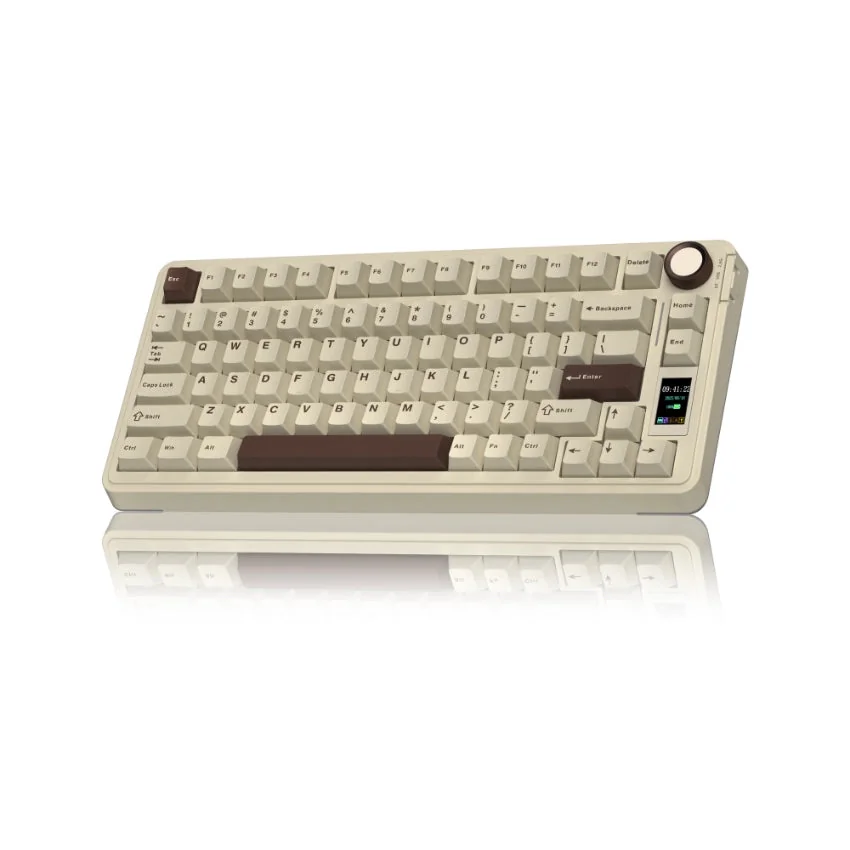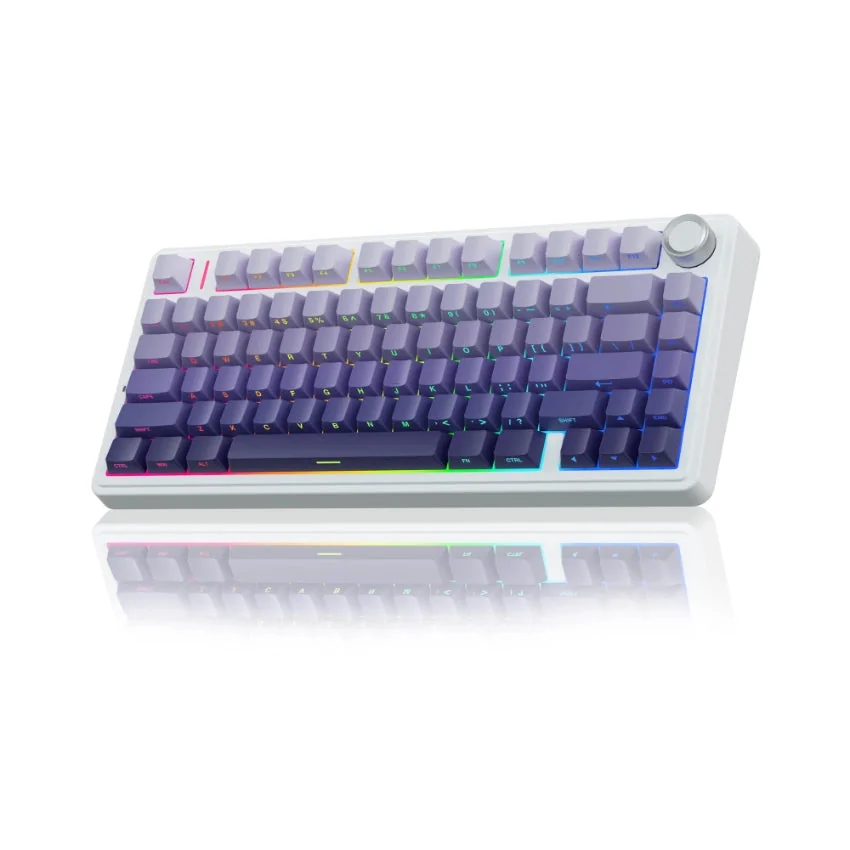
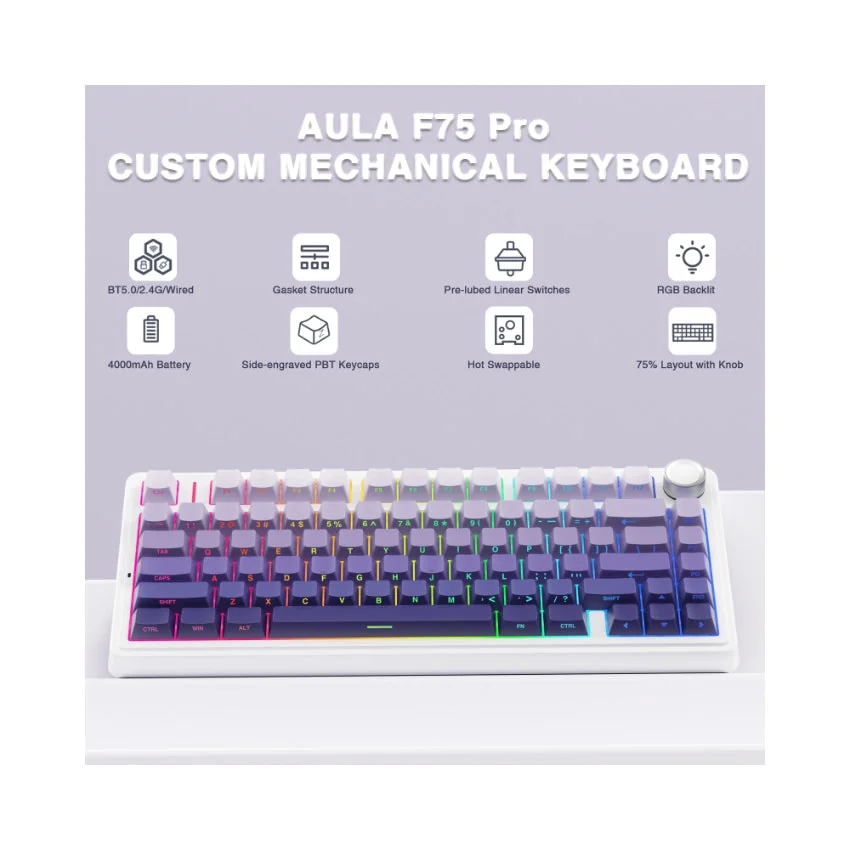
AULA F75 Pro Wireless Mechanical Keyboard
By AULA · Mechanical Keyboards · Home & Workspace
- 75% hot-swappable mechanical layout
- Pre-lubed Reaper switches, PBT keycaps, rotary knob
- Tri-mode connectivity: wired, 2.4GHz and Bluetooth
Lowest price seen
~$68.99 (approx.)
from $68.99 at Amazon
- Amazon ~$68.99 (approx.)View at Amazon
- AULA official D2C (aulagaming.com)View at AULA official D2C (aulagaming.com)
- eBayView at eBay
- AULA Keyboards (brand US store)View at AULA Keyboards (brand US store)
- Best BuyView at Best Buy
- WalmartView at Walmart
- NeweggView at Newegg
- eBay (used) eBay: used, open-box, refurbishedView at eBay (used)
Prices are snapshots. Check the current price with the store.
Summary
A 75% gasket-mount mechanical keyboard with pre-lubed LEOBOG Reaper linear switches, side-printed PBT caps, a metal knob, RGB and a 4000mAh battery, sold wired, over a 2.4GHz receiver or on Bluetooth. It suits people who want a loud, well-damped board as their first enthusiast keyboard or as a work board; check the switch and keycap variant at checkout, because AULA mixes base, Pro, Max and HE versions and its own pages disagree on the key count.
Strengths
- Owners repeatedly praise the stock Reaper switches and pre-lubed stabilizers for a creamy, thocky sound with no modding.
- Gasket mount and layered damping make a plastic case feel far softer than the price suggests.
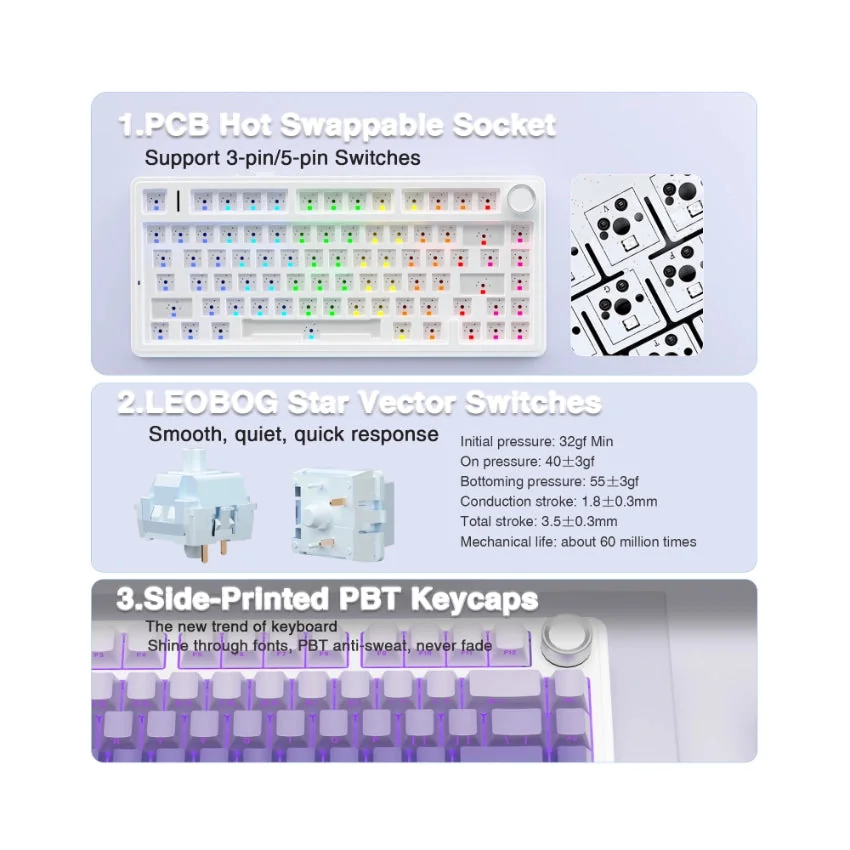
- Hot-swap 3-pin and 5-pin sockets let you replace a failed switch without soldering.
- Tri-mode connectivity and a 4000mAh battery make it usable as a first enthusiast board and a work keyboard.
- 1000Hz polling on wired and 2.4GHz, with latency RTINGS calls impressive and free of a stated bottleneck.
- Knob, RGB and PBT caps all ship assembled, with nothing to tune before the first session.
Weaknesses
- The proprietary driver replaces QMK and VIA. Owners and RTINGS both call it confusing, and some report the software failing to detect the board at all.
- RTINGS found the plastic case and deck flex, and calls the build merely decent rather than premium.
- A minority of exact-Pro owners and reviewers report double letters, misfires, spacebar trouble or keys that stop registering.
- Lighting dominates battery life: published figures are about 17.5 hours with default RGB against 266.5 hours with lights off.
- Bluetooth polling drops to 125Hz, which makes it the mode for typing rather than fast play.
- Reaper is a very light linear, and some owners report accidental presses.
Verified specifications
| Layout | 75%. AULA’s own pages conflict on80 versus 81 keys. |
|---|---|
| Connectivity | USB-C wired, 2.4GHz receiver, Bluetooth 5.0; the manufacturer claims up to five paired devices. |
| Battery | 4000mAh rechargeable lithium, nominal 3.7V. |
| Polling | 1000Hz wired and 2.4GHz, 125Hz over Bluetooth, per retailer technical documentation; RTINGS independently confirms 1000Hz on this platform. |
| Switches | LEOBOG Reaper, pre-lubed linear, hot-swappable in 3-pin and 5-pin sockets. |
| Reaper switch figures | about 45±3gf actuation, 55±3gf bottom-out, 1.8±0.3mm actuation, 3.6±0.3mm total travel. Some listings instead state 3.5mm total travel. |
| Keycaps | side-printed PBT. |
| RGB | south-facing, 16.8M colors, 16 onboard effects; the driver adds 10 music-rhythm effects. |
| NKRO anti-ghosting and Win-lock supported. | |
| Structure | gasket mount, slotted 1.2mm PCB, polycarbonate plate and a multi-layer IXPE, Poron and silicone-style damping stack. |
| Dimensions | 322.7 × 143.2 × 43.1 mm (12.7 × 5.64 × 1.70 in). This is a conventional high-profile board, not a low-profile one. |
| Weight | about 975g bare, 1023g with cable and receiver in detailed retail specs. |
| Charging | 5V/700mA per one detailed listing; about 230mA draw with default lighting, about 15mA with lights off. |
| Cable | USB-C, commonly listed as 1.8m. |
| In the box | keyboard, USB-C cable, combined keycap and switch puller, two spare switches, dust cover and manual. Some retailer packing lists omit the dust cover. |
Full research notes and sources
Sound, feel and build
RTINGS, testing the F99/F75 platform and explicitly listing F75 Pro variants with identical internals, calls the typing experience excellent: soft gasket mount, smooth pre-lubed switches and well-damped stabilizers. Owners in r/keyboards and r/BudgetKeebs describe the same thing, including a Budget Keebs owner running an F75 Pro with stock Reapers at work. That test also corrects an older claim: current RTINGS text praises latency and 1000Hz performance and calls the platform fit for competitive gaming, not slow.
The build is the compromise. The case and deck are plastic and flex under pressure, which RTINGS confirms independently, and the whole board weighs about a kilo. It does not feel fragile, but it is nowhere near an aluminum chassis. This is a conventional high-profile board, not a low-profile one, and RTINGS also flags AULA’s inconsistent documentation and specifications, which is why official pages here contradict themselves on key count.
Software and remapping
The driver is the most consistent complaint. AULA does not support QMK or VIA, and both independent testing and multiple owner threads describe a rough interface, confusing model lists, limited customization and software that sometimes will not see the keyboard at all. Basic functions work without it. The knob is more capable than most: a long press switches it between game and office modes, office mode handles volume and mute, game mode handles lighting.
If open remapping, layers and macros matter to you, the software is the reason to look elsewhere. A Keychron V1 Max in the same wireless75% class adds mature QMK/VIA programmability for a higher outlay.
Battery life and lighting
The 4000mAh cell is generous on paper, but lighting decides everything: roughly 17.5 hours with default RGB and about 266.5 hours with the lights off. Those are vendor and retailer figures, not an independent endurance test, and the charging numbers tell the same story, with about 230mA drawn under default lighting against about 15mA when it is off. Turn the RGB down or off and treat the board as a desk keyboard; leave it bright and expect to charge it every few days.
Is it worth it?
At the low end of its street range this is excellent value and hard to match on stock sound and features. Near list price, start comparing: the saving over an aluminum, QMK-capable board comes from plastic construction, rough software and inconsistent QC, not from a shorter feature list. Two more buying notes. Hot-swappable sockets mean an individual bad switch is a cheap, solder-free swap, keycaps are standard parts, and the internal battery is not advertised as a user-service item with no US spare-parts catalog to turn to. AULAGAMING’s official store states a one-year warranty and a 30-day money-back guarantee, both tied to its own orders, so other sellers carry different terms. Buy from somewhere returns are easy, because key-registration and dead-key reports exist even though nobody has published a failure rate.
Which model this is
This page covers the US 75% tri-mode F75 Pro with side-printed PBT keycaps and pre-lubed LEOBOG Reaper linear switches, black SKU F75P-GS-R, listed by Best Buy as model F75-GS-R. The Amazon listing is ASIN B0D14N2QZF. AULA’s family naming is a mess, and the base F75, F75 Pro, F75 Max, S75 Pro and F75 HE are different boards with different internals and keycap styles, so confirm the switch and keycap variant before you order.
Sources
Manufacturer:
- AULAGAMING — F75 Pro product page, warranty and store terms
- AULAGAMING — F75 Pro detailed specifications
- AULA US distributor — F75 Pro side-printed GS-R page
Independent reviews:
- RTINGS — AULA F99/F75 keyboard review, typing, latency, build and software
- RTINGS — Royal Kludge RK61 vs AULA F99/F75 comparison
- GadgetZon — AULA F75 Pro mechanical keyboard review
- ClackPicks — AULA F75 Pro wireless review
- Keychron — V1 Max QMK/VIA wireless custom mechanical keyboard
Retail listings:
- Best Buy — AULA F75 Pro 81-key wireless hot-swappable keyboard
- Newegg — AULA F75 Pro side-printed keycap listing
- Walmart — AULA F75 Pro listing
Owner reports:
- F75 Pro ownership and software thread (r/keyboards)
- Driver and remapping complaints (r/keyboards)
- F75 Pro owner discussion (r/keyboards)
- First mechanical keyboard, F75 Pro build (r/keyboards)
- F75 Pro with stock Reapers used at work (r/BudgetKeebs)
- Keyboard recommendations and driver discussion (r/PHMechanicalKeyboard)