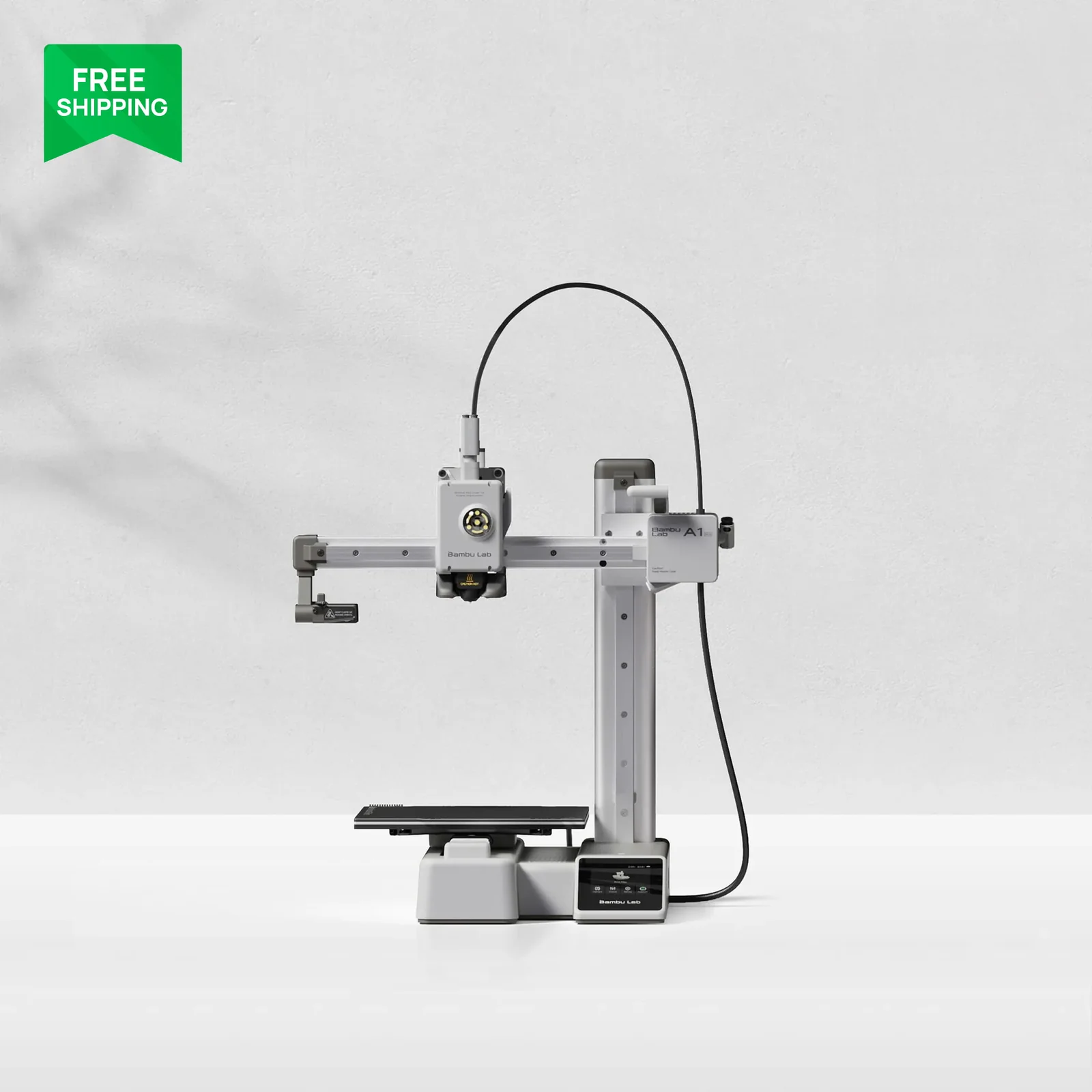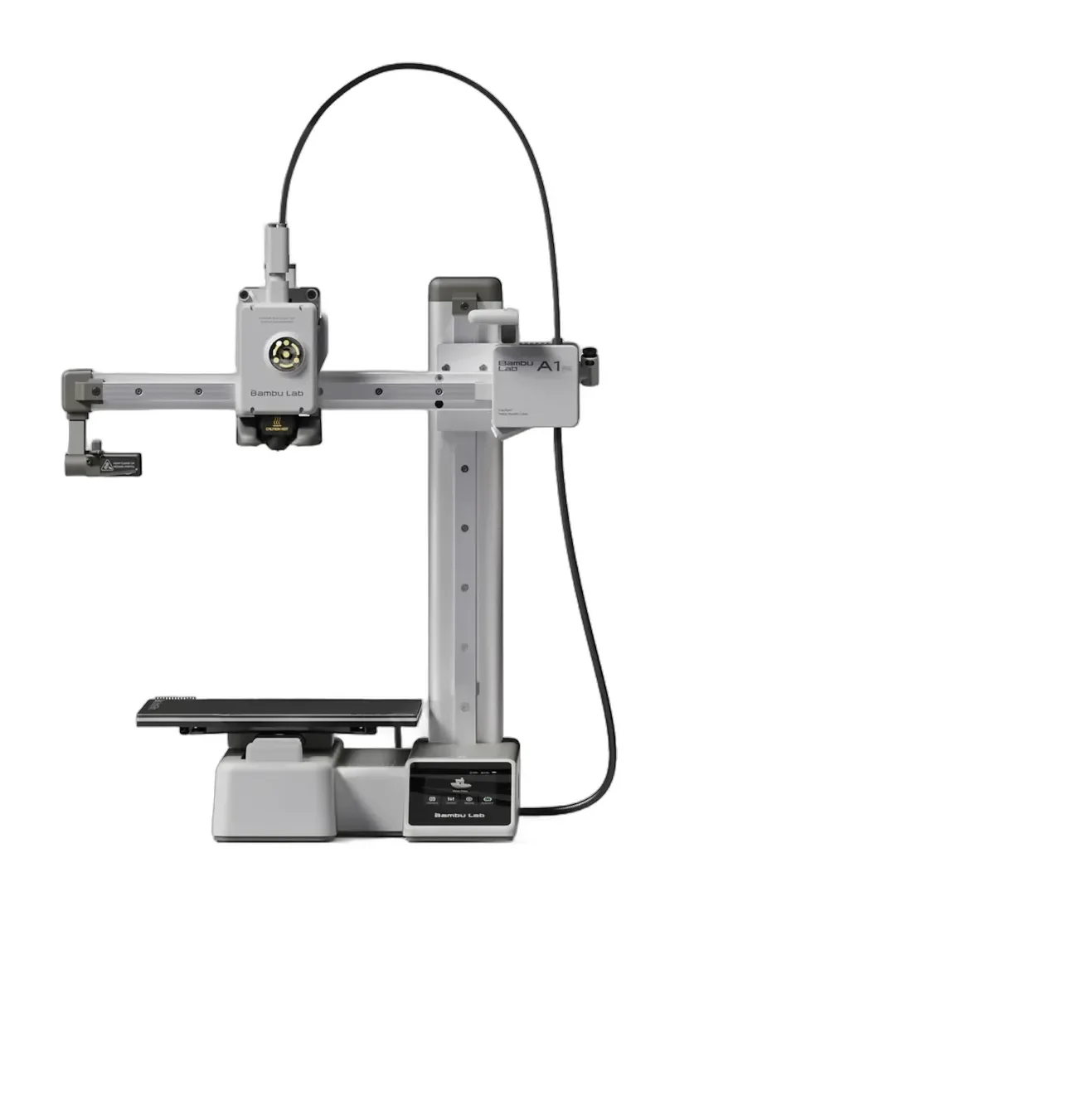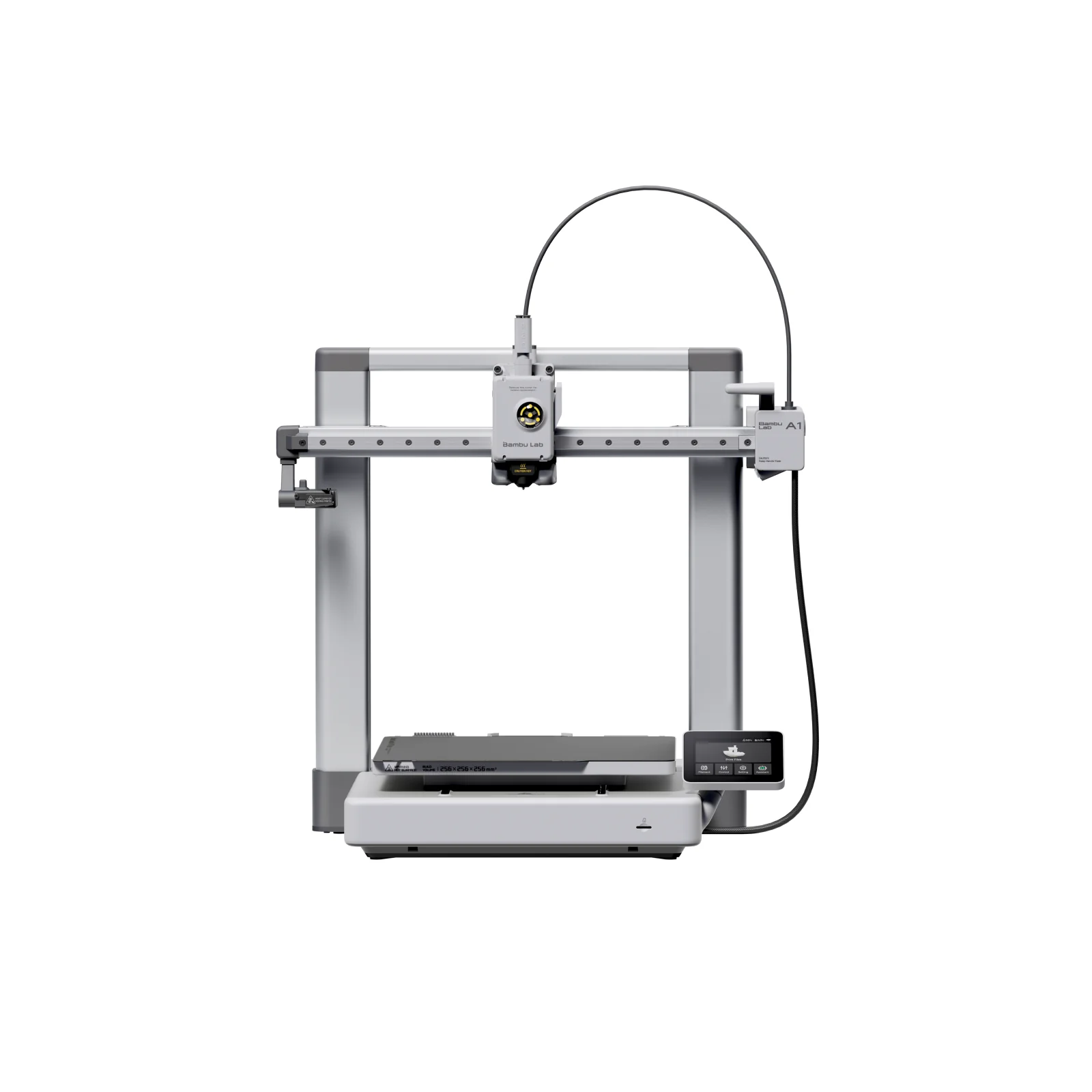
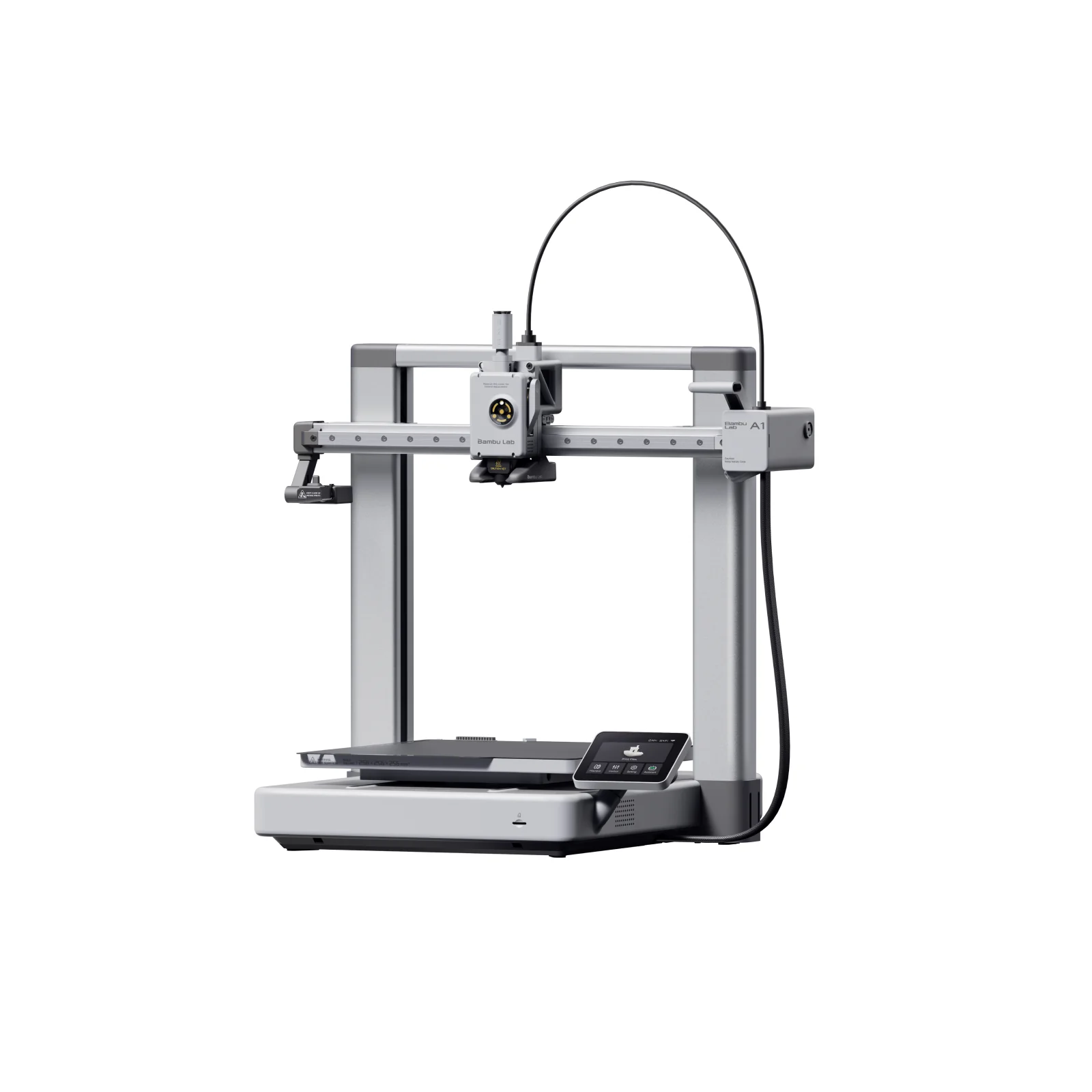
Bambu Lab A1
By Bambu Lab · Budget 3D Printers · 3D Printing
- Open-frame FDM bed-slinger, fully automatic calibration
- 256 x 256 x 256 mm build volume, up to 500 mm/s and 10,000 mm/s²
- Active flow rate compensation for consistent extrusion
- Optional AMS lite adds four-color printing
Lowest price seen
$299.00
from $299.00 at West3D · Checked Oct 5, 2026
- West3D $299.00View at West3D
- Bambu Lab (official US store) $399.00View at Bambu Lab (official US store)
- eBay $425.09View at eBay
- eBay (used) eBay: used, open-box, refurbishedView at eBay (used)
- AmazonView at Amazon
Prices are snapshots. Check the current price with the store.
Summary
An open-frame 256 mm-cube FDM printer with full automatic calibration, a fast direct-drive toolhead and a 300 °C hotend, sold on its own or as the A1 Combo with the AMS lite four-spool feeder. Buy the printer on the strength of three independent reviews, but treat the AMS lite as a separate purchase: its purge waste, print-time penalty and feeder faults are well documented.
Strengths
- PCMag, CNET and Tom’s Hardware all rated the printer highly, with Editors’ Choice awards from PCMag and Tom’s Hardware.
- Bed leveling, nozzle-probed Z offset and X/Y resonance tuning run automatically before every print.
- The quick-swap nozzle is held by a magnet and buckle, so it changes without screws or thermal paste.
- PCMag measured 24.5/30 on the Kickstarter-Autodesk dimensional-accuracy protocol and called output very good.
- Direct drive plus a 300 °C hotend covers PLA, PETG, TPU and PVA.
- There is no proprietary filament lock-in, and LAN-only mode is available.
Weaknesses
- The 500 mm/s headline is not a printing speed; CNET put the practical ceiling near 300 mm/s and the quality sweet spot near 200 mm/s.
- ABS, ASA, PC, PA and PET are listed as not recommended despite the 300 °C hotend.
- CNET found the AMS lite waste cutter clears the nozzle only about 60% of the time.
- Multi-color purge waste is heavy: one 250 g four-color model consumed roughly 2 kg of filament.
- Chronic AMS lite “failure to feed” faults appear across Bambu’s own forum and Reddit.
- Files move only over Wi-Fi or microSD, and there is no USB port or Ethernet.
Verified specifications
| Model | Bambu Lab A1, Cartesian bed-slinger FDM printer. |
|---|---|
| Build volume | 256 × 256 × 256 mm (10 × 10 × 10 in). |
| Frame | open design, rigid steel and extruded aluminum with dual Z rods. |
| Hotend | all-metal, up to 300 °C (572 °F). |
| Nozzle | 0.4 mm stainless steel included; 0.2 / 0.6 / 0.8 mm optional. |
| Toolhead | direct drive, 500 mm/s maximum speed, 10,000 mm/s² acceleration. |
| Maximum hotend flow | 28 mm³/s. |
| Build plate | up to 100 °C; Bambu Textured PEI plate included. |
| Filament | 1.75 mm with an integrated cutter; PLA, PETG, TPU and PVA are supported. |
| Screen | 3.5-inch 320 × 240 IPS touchscreen. |
| Sensors | 1080P chamber camera with timelapse, filament run-out, odometry and tangle detection, power-loss recovery. |
| Connectivity | Wi-Fi, Bambu-Bus and microSD; no USB port or Ethernet. |
| Power | 100-240 VAC, 50/60 Hz; 1300 W at 220 V, 350 W at 110 V. |
| Dimensions | 465 × 410 × 430 mm; net weight 8.3 kg (18.3 lb). |
| AMS lite (optional) | four spools per unit; 397 × 208 × 342 mm, 1.6 kg. |
| In the box | printer, purge wiper, spool holder, pre-installed nozzle, PTFE tube, 20 g filament sample. |
Full research notes and sources
Real-world speed and materials
Bambu advertises 500 mm/s and a 14-minute Benchy, but the machine does not print at that speed. CNET measured the fastest setting that holds quality at around 300 mm/s and a sweet spot near 200 mm/s; Tom’s Hardware puts the default slicer range at 200-300 mm/s and measured a speed Benchy at 19 minutes 15 seconds. The 300 °C all-metal hotend does not unlock stiff materials either: Bambu lists ABS, ASA, PC, PA and PET as not recommended, so an enclosed printer remains the answer for those.
Multicolor and the AMS lite
The AMS lite is the machine’s weak point. Four-color printing works, but it costs time and material: the same model took 2 h 40 m in one color and 6 h 46 m in three colors in Tom’s Hardware’s test, and CNET burned roughly 2 kg of filament to produce one 250 g four-color model. The waste cutter that flings purge aside works about 60% of the time per CNET, with the rest sticking to the nozzle, the purge tower or the print. Owners report a chronic “failure to feed” class localized to individual AMS slots and feeder units, a hub Bowden connector that fails to return to its lowered position, false stuck-filament alarms after firmware 1.04.00.00, and a damaged AMS communication cable. Bambu shipped a replacement feeder unit in at least one case. No failure rate has been published, so treat these as a known maintenance item rather than a defect everyone hits.
Setup and assembly
The A1 ships about 95% assembled and needs a handful of screws plus the filament wiper and spool holder, or bolting the base to the gantry depending on the account. A tool kit is included, and the microSD card holds pre-sliced starter models that run from the touch screen without a slicer. Kit contents vary by batch, so do not count on a specific accessory.
Warranty and the recall
Bambu’s US store lists a 1-year warranty for the A1, not the 2 years shown for the A1 mini on the same site. The first production batch was recalled over a heatbed cable fault that could short and cause a fire; Bambu offered a repair kit or a return, and printers sold after January 30, 2024 already carry the fix. A used A1’s build date is worth checking.
Which model this is
This page covers the Bambu Lab A1, the 256 mm-cube bed-slinger, not the smaller 180 mm A1 mini and not the enclosed CoreXY P1 or X1 line. The US listing is ASIN B0D17TMWFB. The A1 Combo adds the AMS lite, a four-spool feeder shared with the A1 mini.
Sources
Manufacturer:
- Bambu Lab A1 technical specifications
- Bambu Lab A1 product page
- Bambu Lab A1 US store product page
- Bambu Lab AMS lite US store page
- Bambu Lab A1 store collections page
- Bambu Lab A1 mini product page
Independent reviews:
- PCMag Bambu Lab A1 review
- Tom’s Hardware Bambu Lab A1 review
- CNET Bambu Lab A1 review
- CNET Bambu Lab A1 mini review
- Wirecutter best 3D printers
Owner reports:
- Chronic AMS lite failure to feed (r/BambuLab)
- A1 AMS lite woes (r/BambuLab)
- Is the A1 still worth getting? (r/BambuLabA1)
- Temperamental AMS feeding (Bambu Lab forum)
- AMS lite failing to feed into the tube (Bambu Lab forum)
- Firmware update problems on A1 and AMS lite (Bambu Lab forum)
- A1 and AMS lite communication issue (Bambu Lab forum)
- AMS A1 series filament hub (Bambu Lab forum)
- Problem using AMS lite (r/BambuLab)