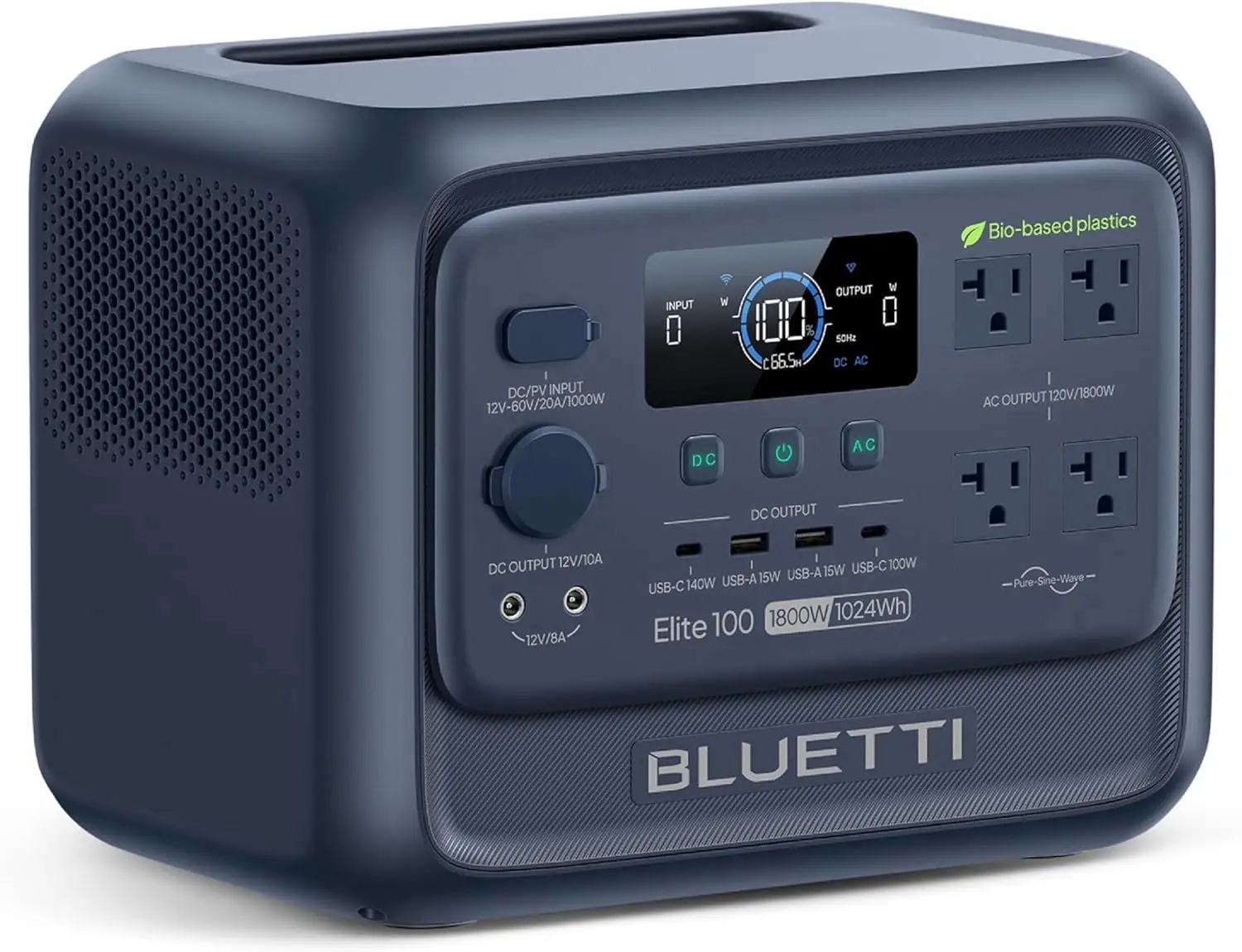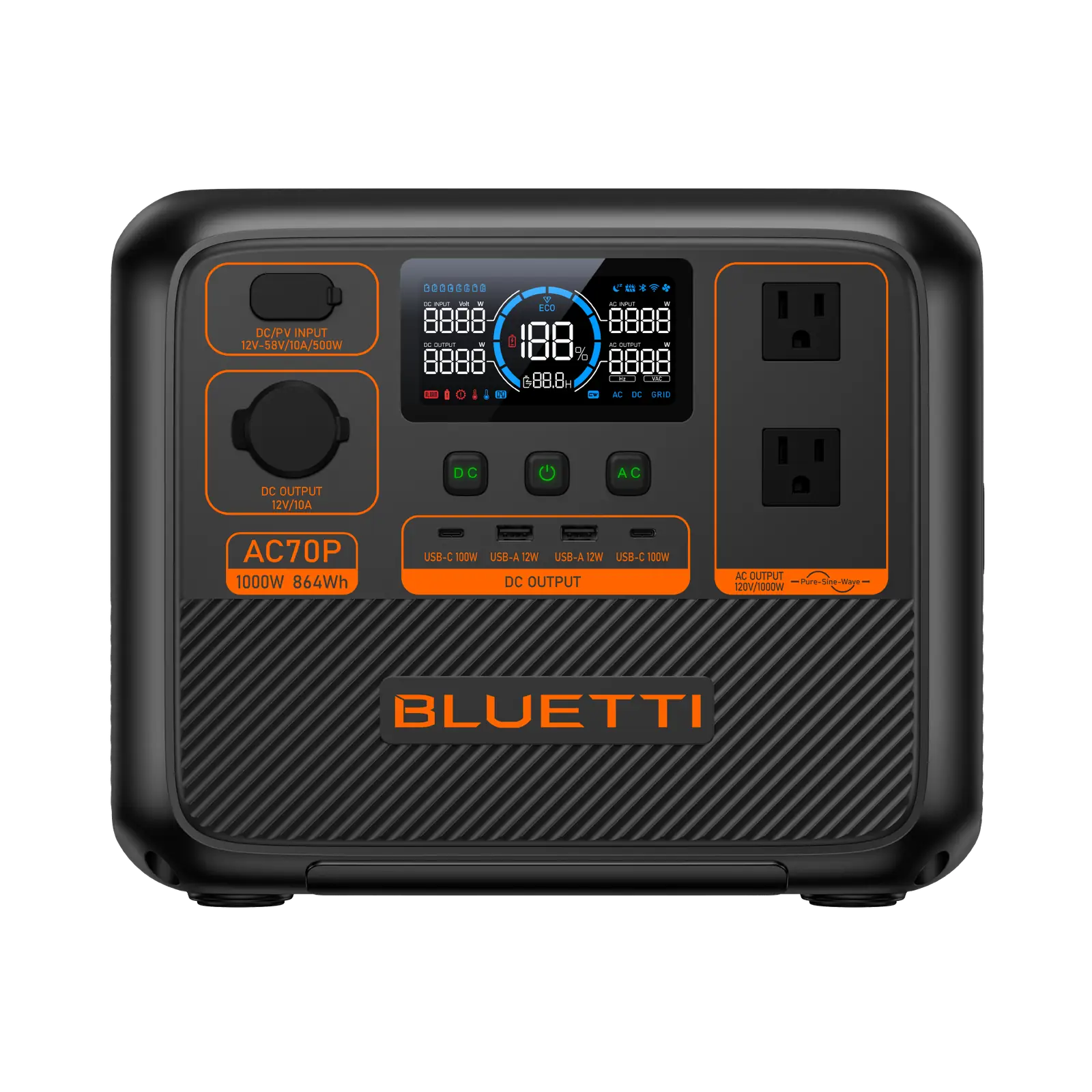
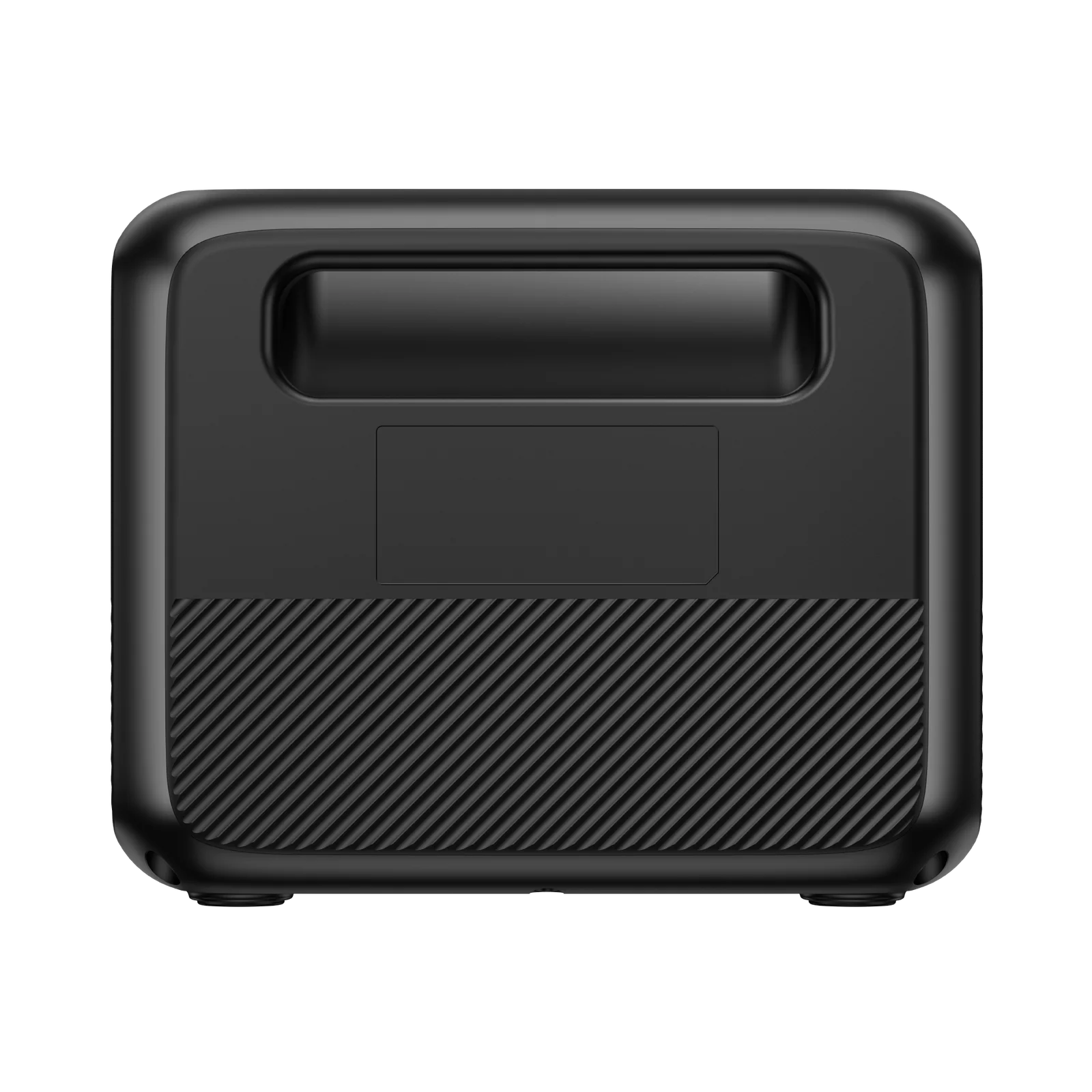
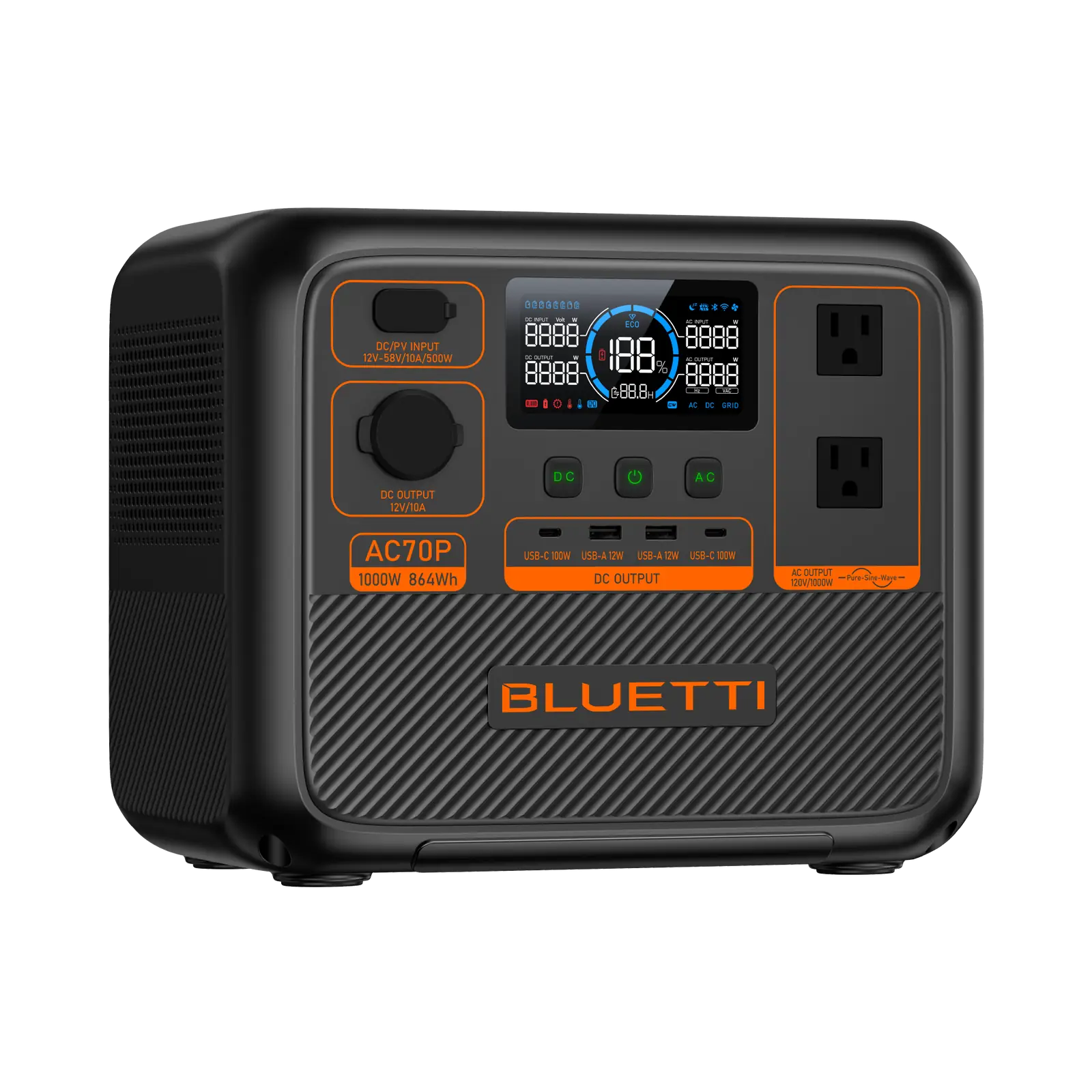
BLUETTI AC70P Portable Power Station
By BLUETTI · Portable Power Stations · Audio & Electronics
- 864Wh LiFePO4 battery (3,000+ cycles to 80%)
- 1,000W continuous AC output with 2,000W Power Lifting mode for high-draw loads
- Turbo charging: ~80% in 45 minutes, full charge in about 1 hour from AC
- Multiple outlets incl. 100W USB-C and wireless charging pad
Lowest price seen
~$499.00 (approx.)
from $499.00 at Amazon
- Amazon ~$499.00 (approx.)View at Amazon
- BLUETTIView at BLUETTI
- WalmartView at Walmart
- The Home DepotView at The Home Depot
- eBayView at eBay
- eBay (used) eBay: used, open-box, refurbishedView at eBay (used)
Prices are snapshots. Check the current price with the store.
Summary
An 864 Wh LiFePO4 portable power station with a 1,000 W pure sine wave inverter, quick wall charging and a five-year warranty, light enough to carry in one hand. Check your load list before you buy: 1,000 W continuous means one high-wattage appliance at a time, and the advertised 2,000 W is a resistive-load lifting mode, not a genuine surge rating.
Strengths
- Wall recharge is the standout: 0–80 % in 45 minutes and full in about 1.5 hours.
- Five-year warranty, long for the class, with a 90-day express replacement in the US and Canada.
- Eight outputs including a working 15 W wireless pad and two 100 W USB-C ports.
- 90 % depth of discharge and over 85 % inverter efficiency are better than typical for the size.
- Expansion to 3,936 Wh with a B80P, B230 or B300, and idle draw of about 6 W makes it cheap to leave plugged in as a backup.
- Owner reviews single out the quiet charging and the clear front display.
Weaknesses
- A 1,000 W continuous ceiling means one high-wattage load at a time; a heater and a kettle cannot be stacked, and overload produces a clean shutdown.
- Power Lifting Mode is resistive-only, off by default, and scales the load down to fit the inverter instead of bursting.
- BLUETTI explicitly warns against air conditioners and washing machines, whose motors and compressors surge 2–4× rated power.
- No IP rating, which the one full exact-model review called the only real drawback of a unit marketed as outdoor equipment.
- BLUETTI’s own documentation says not to use the UPS for servers, workstations or medical equipment.
- Bluetooth only with no Wi-Fi; the app can power the unit down but not back on, and one long-term owner reported an account disconnect that blocked control and updates.
Verified specifications
| Capacity | 864 Wh lithium iron phosphate (LiFePO4). |
|---|---|
| Inverter | 1,000 W continuous, pure sine wave, 2 AC outlets at 120 VAC / 8.3 A in the US. |
| Power Lifting Mode | 2,000 W, off by default, resistive loads of 1,000–2,000 W, switched on from the app. |
| USB-C | 2 ports, up to 100 W each. |
| USB-A | 2 ports, 5 V / 2.4 A each. |
| Car outlet | 12 VDC / 10 A, regulated. |
| Wireless charging pad | up to 15 W. |
| Outputs in total | |
| AC input | 950 W max in the US, 900 W max in Japan. |
| Wall recharge | 0–80 % in 45 minutes at 25 °C, full in about 1.5 hours. |
| Solar input | 500 W max, 12–58 VDC, 10 A max, XT60PM-M connector. |
| UPS | switchover of 20 ms or less; pass-through charging works while it charges and discharges at the same time. |
| App control | Bluetooth only, no Wi-Fi. |
| Depth of discharge | 90 %, chosen for pack life. Inverter efficiency: typically over 85 %. |
| Self-consumption | about 15 W. |
| Cycle life | 3,000+ cycles to 80 % of original capacity (BLUETTI’s figure). |
| Temperature | charge at 0–40 °C, discharge at −20–40 °C, store at −20–40 °C. |
| Storage upkeep | recharge to 40–60 % every 3–6 months. |
| Noise | under 45 dB while charging. |
| Dimensions | 12.4 × 8.2 × 10.1 in (314 × 209.5 × 255.8 mm); 22.5 lb (10.2 kg). |
| Expansion | B80P (806 Wh), B230 (2,048 Wh) or B300 (3,072 Wh), up to 3,936 Wh in Power Bank Mode. |
| Warranty | 5 years (60 months), with a 90-day express replacement service in the US and Canada. |
| Weather rating | none. There is no IP rating. |
| In the box | AC charging cable, car charging cable, solar charging cable. |
| Error codes | published, including E001 inverter overload, E002 temperature protection, E003 inverter short circuit and E016 fan failure. |
Full research notes and sources
Power ceiling and lifting mode
The 1,000 W number is the one that matters. Both AC outlets share it, so only one heavy appliance runs at a time, and going past it throws a clean overload error that shuts the inverter down instead of damaging it.
The 2,000 W figure is Power Lifting Mode. It ships disabled, you switch it on in the app, and BLUETTI limits it to resistive loads between 1,000 W and 2,000 W. It scales the load down to fit the inverter rather than delivering a true burst, so a 1,000 W kettle already sits at the top of the usable envelope rather than above it. Motors and compressors are explicitly out of scope, and BLUETTI’s EU spec block elsewhere lists a 1,500 W surge figure for this model. Treat all of it as marketing wrapped around a 1,000 W inverter.
Runtime, solar and expansion
Owner-measured figures reported for the AC70P are respectable and entirely load-dependent: a full breakfast of grill, kettle and coffee costs about 20 % of capacity, a 60 W TV runs roughly 8–10 hours, a car fridge about 9 hours, a laptop gets about 8 full charges, and a 350 W space heater drains the pack in under two hours. BLUETTI’s own manual model — capacity × depth of discharge × efficiency, divided by load plus self-consumption — gives about 12 hours for a 40 W refrigerator. CGMagazine ran a work laptop two and a half days, about 20 hours, while charging a phone and Bluetooth speakers, and got over six hours from a 43-inch TV plus an Xbox.
Nobody has published a measured watt-hour capacity test of this exact model. The closest instrumented drain test is on the 768 Wh AC70, where a 136 W incandescent load ran 4 hours 58 minutes for 730.59 Wh, or 95 % of rated. Plan runtime from your load, not from the 864 Wh headline: one buyer’s model puts usable energy at roughly 510–565 Wh on CPAP-class low draws and 735–790 Wh at mid-to-high AC loads, with more available from the DC ports because they bypass the inverter.
Solar input is 500 W max at 12–58 V through the XT60PM-M connector. Below 32 V the charge controller caps current at 8 A, so wire two 200 W panels in series rather than parallel or you leave output unused, and the controller holds current to 10 A no matter how many panels you hang on it.
Expansion works through Power Bank Mode with the B80P, B230 or B300, up to 3,936 Wh. Understand what that means: the expansion battery charges the AC70P’s internal pack through a cable, extending runtime without turning the unit into a continuous high-capacity source.
UPS behaviour, standby draw and warranty
The 20 ms switchover is a best case, and it degrades when the unit sits at full charge — exactly the state a backup device idles in. One AC70P owner running a Plex server saw a detectable power blip on roughly 20 % of outages. CGMagazine’s pass-through test found no interruption at all when house breakers were thrown while it powered a gaming PC, which is the everyday case working properly. BLUETTI’s documentation warns against servers, workstations and medical equipment, and a dealer FAQ repeats the medical point. A 20 ms dip is enough to drop a network rack, so do not hang one of these off a home lab.
Standby draw is where this beats an old UPS. Expect roughly 6 W in network or low-power mode and roughly 10–15 W with the inverter on, against the manual’s stated self-consumption of about 15 W; owners replacing APC SUA1000 units measured about 100 W on the APC. Long-press the unit to a full power-down before storing it.
Warranty is 5 years, listed as 60 months on BLUETTI’s own table. Claims go through BLUETTI’s service centre, which either repairs the unit or swaps it for one of equivalent specification, and that replacement may be a refurbished unit of equal value. Delivery is arranged within 7 business days after the warehouse confirms it has the defective item, and the swap carries the remainder of the original warranty or 30 days, whichever is longer. Coverage is void if the battery model on the certificate does not match the unit, and buying from an unauthorized reseller is an exclusion, which matters here: BLUETTI’s US page for this model would not load during this research, so confirm the warranty channel before you pay. Expansion batteries are warranted for 72 months, panels and generic accessories for 12.
The internal pack is not user-replaceable and there is no AC70P parts catalogue, so repair-or-swap is the practical service path. Keep the vents clear, charge between 0 and 40 °C, do not discharge below −20 °C, and know that E016 means the fan has failed. BLUETTI’s own line about after-sales is worth reading: in r/bluetti owners describe discontinued models losing their solar cable, a non-standard Weipu 4-pin connector blocking third-party replacement, support pressing for PayPal payment without an invoice, a $50 coupon that needs $1,000 of spend, and two-way shipping charged on a return. Against that, other people report a same-day refund and replacement of a faulty unit inside about a week, and support fixing a fault on an AC180 more than a year old. Those are single accounts, not a failure rate, but they are the shape of the risk.
Is it worth it?
At or below about $500 the AC70P is defensible: the extra 96 Wh, the second 100 W USB-C port and the wireless pad are cheap add-ons rather than a premium. From roughly $500 to $600 it is fair, and past $600 you are paying for a mid-class 1,000 W inverter and 864 Wh.
The price is where this unit is weak. CGMagazine put the MSRP at $699 in 2024, which works out at $0.81 per Wh against $0.454 for the 768 Wh AC70, and at that money the argument is that you should be comparing 1,000–1,070 Wh units with 1,500–2,000 W inverters and 10 ms switchover. Other storefronts sit elsewhere: E-catalog listed $561.67, BLUETTI EU sells it at €599 against a €750 compare-at, BLUETTI Canada lists C$999 and BLUETTI AU A$1,149. BLUETTI’s US store has the sibling AC70 at $359.
Availability is the bigger question. offsetsolar flags the AC70P as out of stock and possibly end-of-life, with thin field data, which makes long-term parts and support an open question rather than a settled one. Confirm stock, price and the warranty channel at the seller before buying.
Which model this is
This page covers the AC70P: 864 Wh, 1,000 W, with the 15 W wireless pad and the second 100 W USB-C port the smaller AC70 lacks. The US retail SKU is AC70P-US-GY-BL-THDUS, denoting 120 V gray/black, and the same body is sold in JP, EU/UK/AU, CN and SA regional versions with different AC output currents. The Amazon listing is ASIN B0FJXJF6DH. Do not merge the numbers with the AC70, with the AC60P below it, or with BLUETTI’s newer 716 Wh AC70 page, which is a different product with no lifting power and no app. One Home Depot review of the bundle listing claims a unit that will not charge from the OEM 110 V cable; that is a single unverified report, so confirm charging works as soon as it arrives rather than treating it as a defect.
Sources
Manufacturer:
- BLUETTI AC70P user manual (PDF)
- BLUETTI AC70P specifications (PDF)
- BLUETTI AC70P product flyer (PDF)
- BLUETTI AC70P product page — BLUETTI EU
- BLUETTI AC70P product page — BLUETTI Canada
- BLUETTI AC70P product page — BLUETTI AU
- Refurbished AC70P FAQ and box contents — BLUETTI Canada
- BLUETTI product warranty periods
- BLUETTI warranty and return policy
- AC70P listing at The Home Depot
Independent reviews:
- BLUETTI AC70P power station review — CGMagazine
- AC70P review and owner results — OffsetSolar
- AC70 vs AC70P comparison and end-of-life flag — OffsetSolar
- AC70 drain test results — APH Networks
- AC70P specification database entry — Pwpdb
- BLUETTI AC70P facts and highlights — Versus
Owner reports:
- Do not buy Bluetti — r/bluetti
- Disappointed by quality and customer service — r/bluetti
- Bluetti has the worst customer support — r/bluetti
- Difficulties with the return process — r/bluetti
- Replacing APC UPS units with AC70P units — r/bluetti
- AC70P owner reviews at The Home Depot
- AC70P owner reviews and street prices — E-Catalog