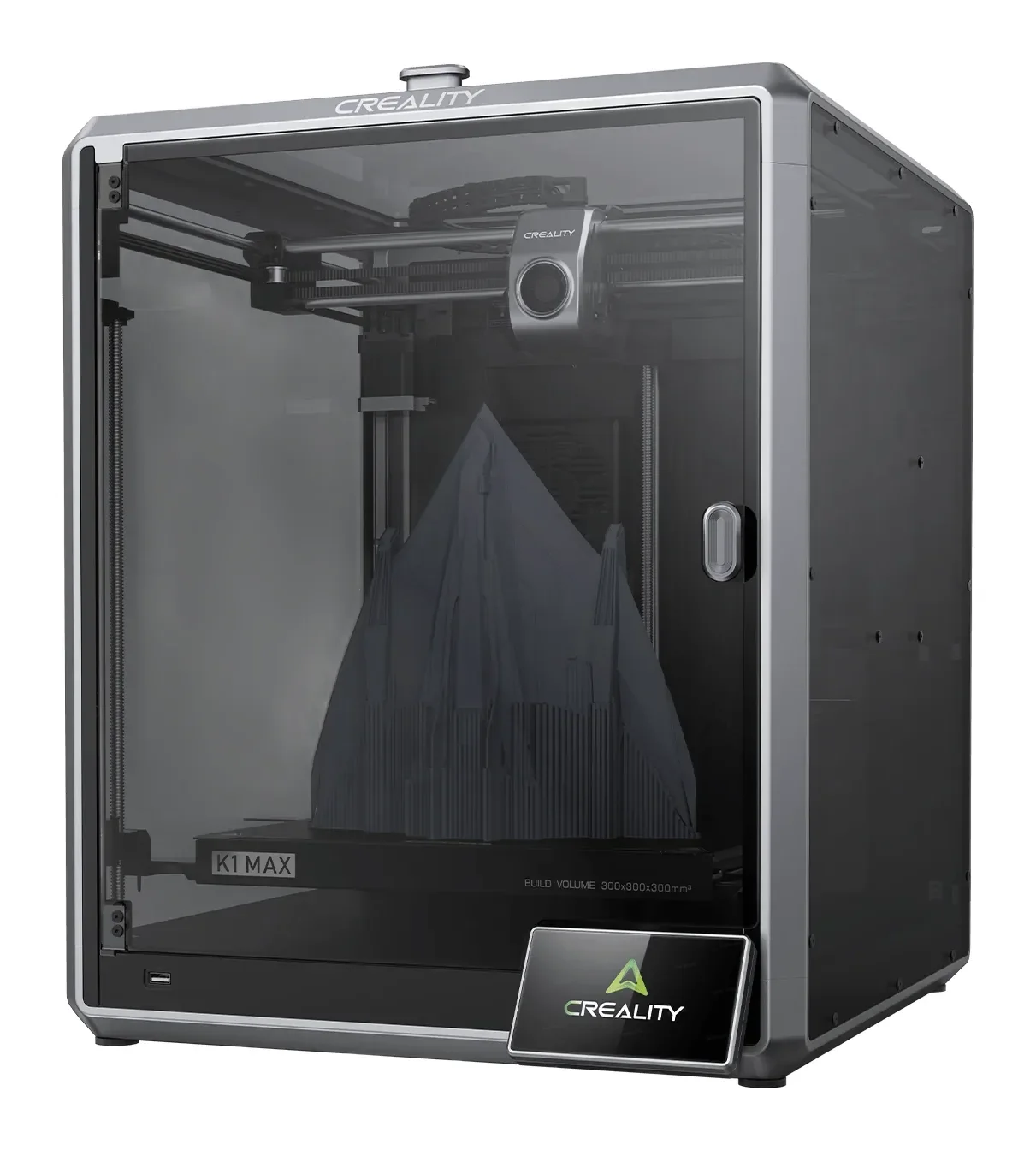
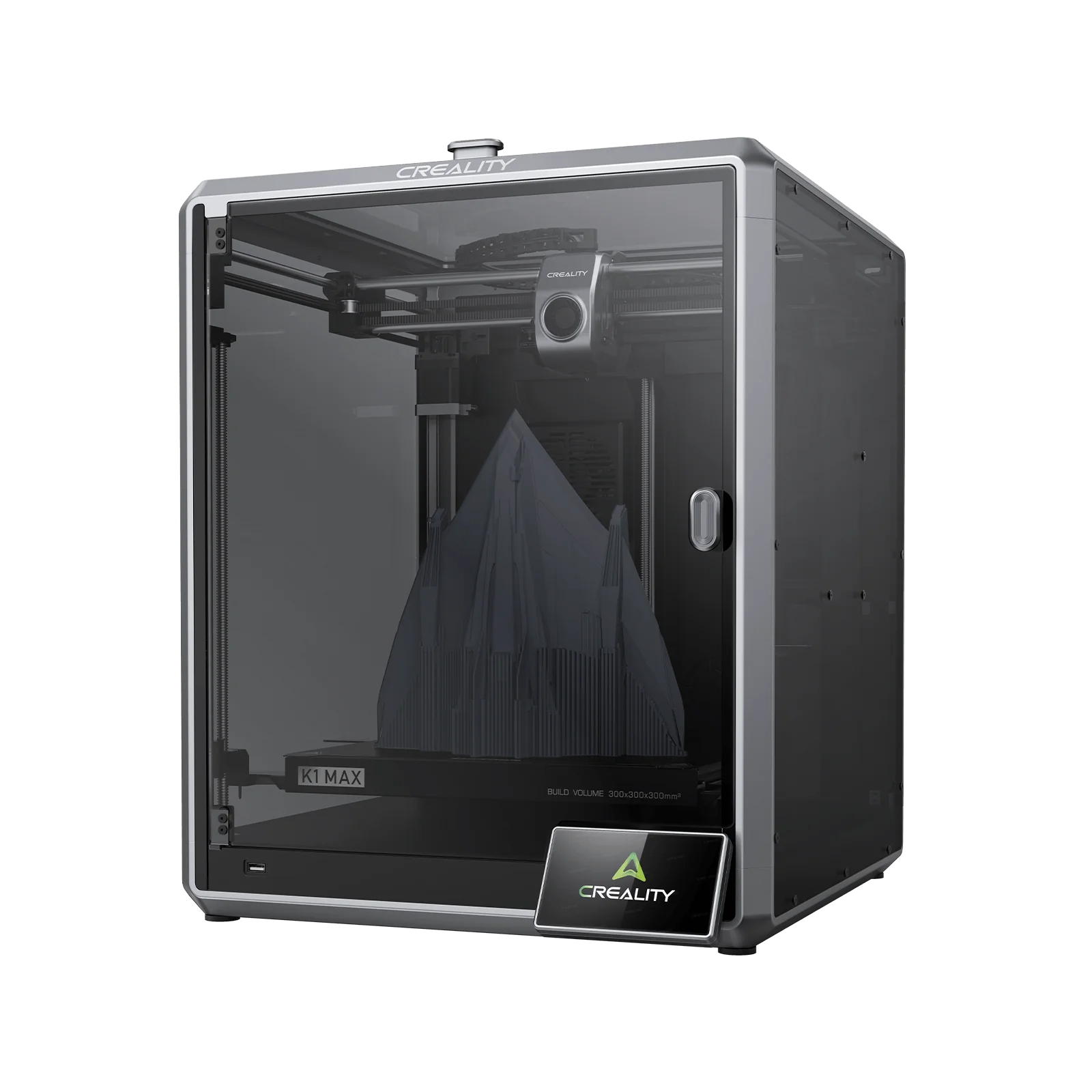
Creality K1 Max
By Creality · 3D Printers · 3D Printing
- Build volume 300 x 300 x 300 mm (enclosed Core XY, single toolhead)
- Hotend max 300 C, heats to 200 C in 40 s
Lowest price seen
~$549.00 (approx.)
from $549.00 at Amazon
- Amazon ~$549.00 (approx.)View at Amazon
- CrealityView at Creality
- WalmartView at Walmart
- Micro CenterView at Micro Center
- Best BuyView at Best Buy
- B&H PhotoView at B&H Photo
- AdoramaView at Adorama
- JaspertronicsView at Jaspertronics
- eBayView at eBay
- eBay (used) eBay: used, open-box, refurbishedView at eBay (used)
Prices are snapshots. Check the current price with the store.
Summary
The Creality K1 Max is a large enclosed Core XY FDM printer with a 300 x 300 x 300 mm build volume, a 1 μm LiDAR first-layer scanner and an AI failure-detection camera. Check the speed claim and the evidence gap: the 600 mm/s headline is a lab figure whose everyday ceiling Creality states as 300 mm/s, and no independent test or owner history for this exact model was obtained.
Strengths
- A large 300 x 300 x 300 mm build volume in an enclosed Core XY chassis with a rigid die-cast aluminium alloy frame.
- Manufacturer-stated top speed of 600 mm/s at 20000 mm/s² acceleration, reaching 600 mm/s in 0.03 s.
- A 32 mm³/s maximum hotend flow and a 300 °C hotend that reaches 200 °C in 40 s via a ceramic heater that encircles the hotend.
- Automated first-layer checking through a 1 μm LiDAR, plus an AI camera for spaghetti and foreign-object detection, real-time monitoring and time-lapse.
- Network control over WiFi or RJ45 Ethernet with clustering, Creality OS, OTA firmware updates and 8 GB of storage for up to 400 model files.
- Ships assembled and calibrated, with dual hands-free auto leveling, input shaping and a flexible build plate.
Weaknesses
- The 600 mm/s headline is a lab figure in Surface Mode at 0.1 mm layer height; Creality’s own stated typical speed is 300 mm/s.
- No independent test of the exact model was found, and no exact-model owner evidence was gathered.
- Machine dimensions, weight and input power were not established from any first-party page.
- No warranty term was read, and no heated-chamber specification is published despite the 300 °C hotend.
- The published printing accuracy of 100 ± 0.1 mm is anomalous and unusable as an accuracy specification.
- Slicer support and model-year naming are unresolved, including whether a distinct 2025 revision exists.
Verified specifications
| Technology | FDM, single toolhead, enclosed Core XY. |
|---|---|
| Build volume | 300 x 300 x 300 mm. |
| Stated maximum printing speed | up to 600 mm/s, with stated acceleration up to 20000 mm/s². |
| Speed conditions | 600 mm/s achieved at Creality Lab in Surface Mode at 0.1 mm layer height; typical speed 300 mm/s; travel speed 800 mm/s; time to reach 600 mm/s is 0.03 s. |
| Stated maximum flow | 32 mm³/s. |
| Hotend | dual-gear direct extruder, titanium-alloy heatbreak and hardened steel nozzle, maximum 300 °C, reaching 200 °C in 40 s from a ceramic heater that encircles the hotend. |
| Nozzle | 0.4 mm, swappable with 0.6 mm and 0.8 mm. |
| Filament | 1.75 mm diameter; layer height 0.1–0.35 mm. |
| Heatbed maximum temperature | 120 °C; flexible build plate; dual hands-free auto leveling using strain sensors. |
| Printhead weight | 190 g. |
| Motion | Core XY with a rigid die-cast aluminium alloy frame. |
| Cooling | large printhead fan with air ducts plus an 18 W auxiliary fan in the chamber. |
| Input shaping and motion advance | G-sensor measures resonance to suppress ringing; motion advance reduces blobs and oozing. |
| LiDAR | 1 μm resolution first-layer scanning that pauses the print and notifies the user on a detected problem. |
| AI camera | failure (spaghetti) detection, foreign-object detection, real-time monitoring and time-lapse filming. |
| Display | 4.3-inch colour touchscreen. |
| Electronics | dual-core 1.2 GHz CPU, 8 GB ROM holding up to 400 model files, Creality OS. |
| Connectivity | WiFi or RJ45 Ethernet, remote monitoring and control via Creality Print or Creality Cloud, clustering of multiple units, USB transfer, cloud printing and OTA firmware updates. |
| Current official firmware at check time | V1.1.0.27, dated Mar 11, 2026. |
| Factory state | assembled and calibrated before shipment, with a one-tap self-test and quick-heating heatbed. |
Full research notes and sources
Speed claims and their conditions
On paper the core numbers are strong, but the headline needs its asterisk. Creality states up to 600 mm/s print speed at 20000 mm/s² acceleration, reaching 600 mm/s in 0.03 s, yet its own footnote restricts that figure to Creality Lab in Surface Mode at 0.1 mm layer height, and it separately states a typical speed of 300 mm/s and a travel speed of 800 mm/s. The honest reading is that 600 mm/s is a best-case lab number and 300 mm/s is the everyday ceiling Creality itself quotes; seller copy that drops the asterisk misrepresents the machine. The 32 mm³/s maximum flow is likewise a maximum tied to the fitted 0.4 mm nozzle, and although the nozzle can be swapped for 0.6 mm or 0.8 mm, no per-nozzle flow table was published. The 300 °C hotend ceiling enables ABS, ASA and PC-class filaments, but no heated-chamber specification appears on the pages read, and an enclosed chamber that is not actively heated is a materially different proposition.
Automation and hardware
The genuinely differentiating feature is the automation. A 1 μm resolution LiDAR scans the first layer on its own and pauses the print to alert the user if something is wrong. Separately, an AI camera watches for spaghetti failures and foreign objects and also handles real-time monitoring and time-lapse recording. Creality publishes no accuracy or false-positive figures for either, so these should be treated as conveniences of unknown reliability rather than proven failure prevention. The rest of the hardware list is more interesting than the speed number: a ceramic heater that encircles the entire hotend reaches 200 °C in 40 s, the extruder is a dual-gear direct drive, the printhead weighs 190 g and rides a Core XY gantry, a G-sensor drives input shaping, and a motion-advance function aims to reduce blobs and oozing. Cooling is a large printhead fan with air ducts plus an 18 W auxiliary chamber fan. The heatbed tops out at 120 °C and leveling is fully automatic using strain sensors in the bed. The machine runs Creality OS on a dual-core 1.2 GHz CPU with 8 GB of storage for up to 400 model files, connects over WiFi or RJ45 Ethernet with clustering for volume production, and ships assembled and calibrated. A built-in air filter is described only as purifying unhealthy compounds, with no filtration specification or replacement interval found.
Evidence gap and unknowns
The significant problem with this assessment is that it rests almost entirely on the manufacturer’s own claims. Independent instrumented testing of the exact K1 Max was not obtained, and neither was any exact-model owner history, because search access to the test outlets and to forum sources was rate-limited for the whole pass. This is a material gap for a machine in the several-hundred class, where buyers normally expect published independent testing, and it should be read as unresolved rather than as evidence of poor performance. Creality’s own figures are also internally loose in places: the shop spec table publishes a printing accuracy of 100 ± 0.1 mm, which is not a usable accuracy specification and is reproduced only because it is printed, and the slicer list differs between the shop page, which adds PrusaSlicer, and the support page, which does not. Machine exterior dimensions, weight, input power and full box contents were not established. Warranty terms were not read and should not be stated. Maintenance intervals, spare-parts availability and repairability were not assessed, though OTA updates are supported.
Which model this is
This page covers the Creality K1 Max, a single-toolhead enclosed Core XY FDM printer with a 300 x 300 x 300 mm build volume, sold in the US through Creality’s own store as part of its flagship K Series line, with Black as the manufacturer colour. The listing this page covers is ASIN B0F5WJPPTT. Do not merge it with the smaller K1, or with the K1C, K2, K2 Pro or Ender-5 Max, which have different build volumes, or with the CFS-C multicolour upgrade kit. Creality’s US store also references a K1 Max 2025 AI Fast 3D Printer, and whether that is a hardware revision or a bundle and marketing refresh was not established, nor was which variant that ASIN maps to.
Sources
Manufacturer:
- Creality K1 Max official product page
- Creality K1 Max shop product and spec page
- Creality K1 Max official support page
- Creality blog: K1 Max, the best 3D printer at home
Retailer:
Independent reviews:
- No instrumented independent test of the exact K1 Max was found; search access to the established test outlets was rate-limited.
Owner reports:
- No exact-model owner evidence was gathered; Reddit, forum and retailer question-and-answer sources were not reached.