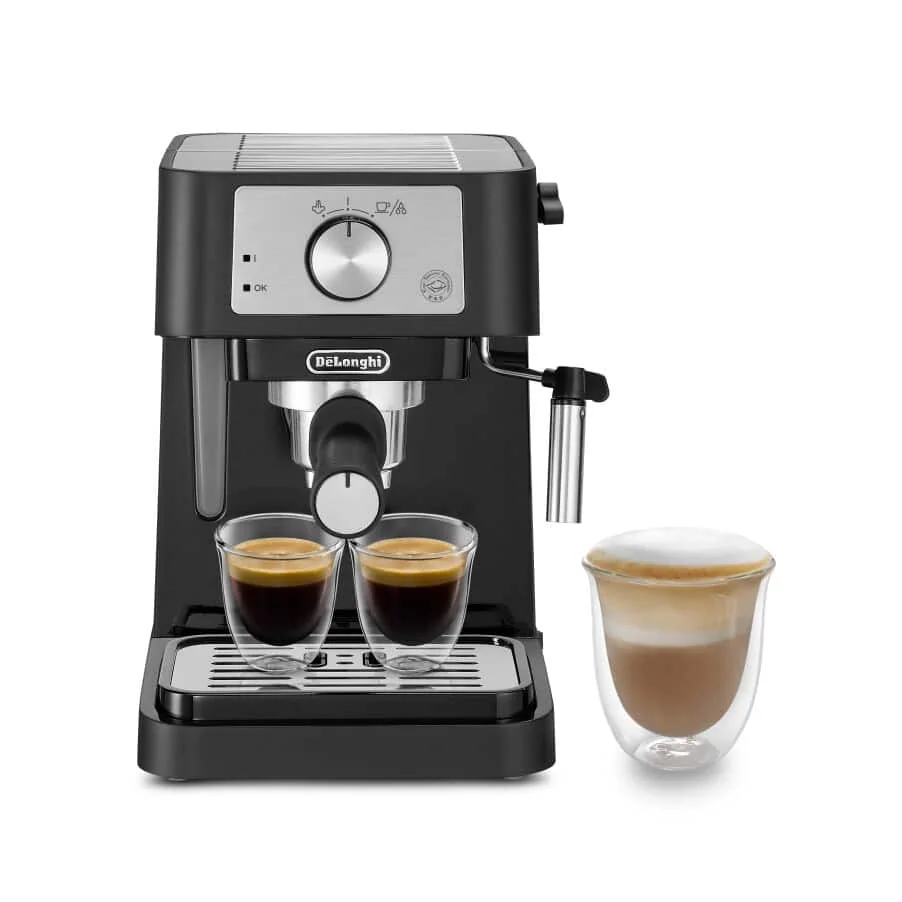
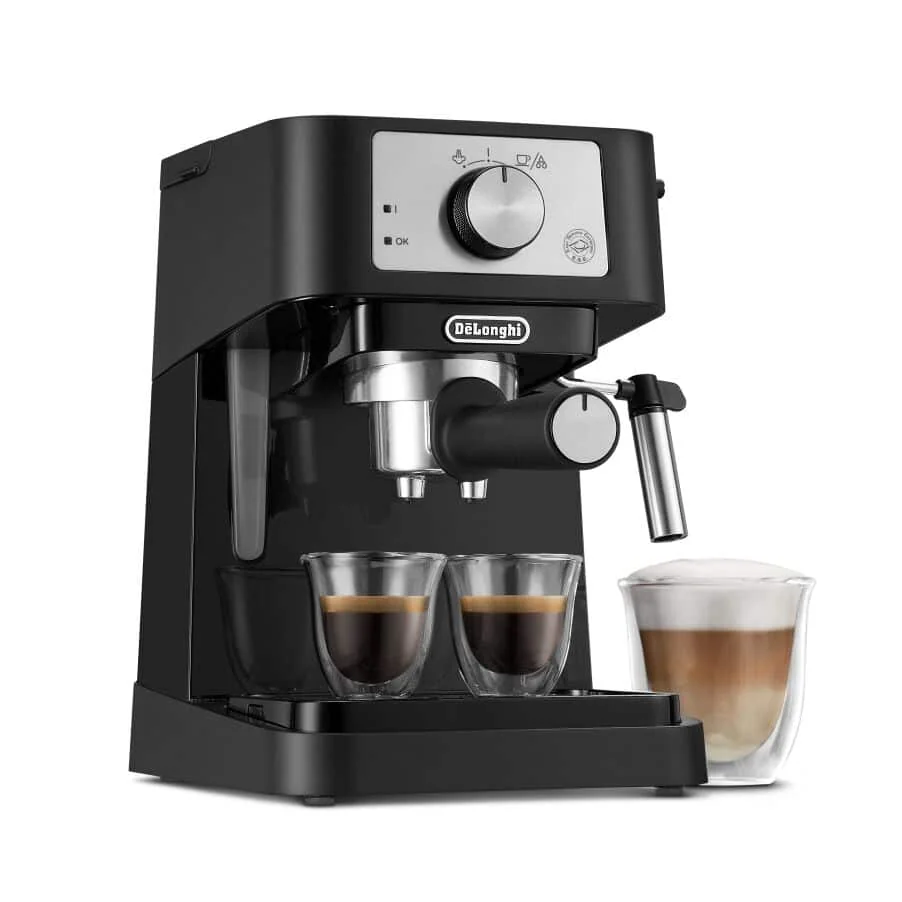
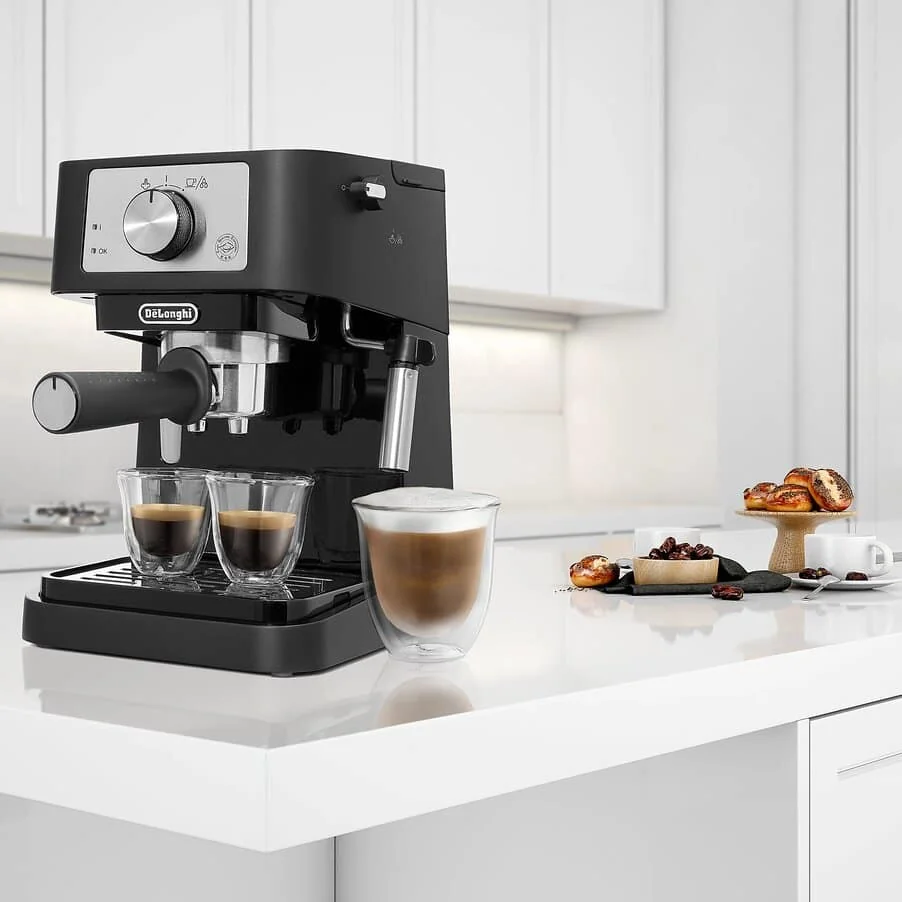
De'Longhi Stilosa Compact Manual Espresso Machine, Manual Milk Frother
By De'Longhi · Espresso Machines · Kitchen & Cooking
- Compact manual espresso machine
- Manual milk frother included
- Listed at 4.1 stars across 11,084 ratings
Lowest price seen
$99.95
from $99.95 at De'Longhi (D2C) · Checked Sep 28, 2026
- De'Longhi (D2C) $99.95View at De'Longhi (D2C)
- P.C. Richard & Son $99.95View at P.C. Richard & Son
- Target $149.99View at Target
- eBayView at eBay
- Macy'sView at Macy's
- eBay (used) eBay: used, open-box, refurbishedView at eBay (used)
- AmazonView at Amazon
Prices are snapshots. Check the current price with the store.
Summary
A small manual espresso machine — 15-bar pump, stainless-steel boiler, a real steam wand, and it takes ground coffee or ESE pods — aimed at beginners who want a cheap way to test the ritual. Before you buy, read up on leaks: owners of this exact model keep reporting water escaping from the group head, the internal hoses and the reservoir seat.
Strengths
- Small footprint and a straightforward dial-and-lever workflow that owners describe as easy to pick up.
- A real steam wand with hot-water delivery, not just a frother button.
- Works with pre-ground coffee or ESE pods, so you can start without buying a grinder.
- Stainless-steel boiler and a removable tank at a price a beginner can justify.
- One owner reports a December 2022 unit still performing like new in April 2025 on daily latte use.
Weaknesses
- Water leakage is the most common owner complaint on this exact model, from the group head, internal hoses, the reservoir seat and the frother/brew circuit.
- Owners also report pump and no-flow failures, a dead ready light, and one cracked reservoir seat.
- TechGearLab’s Stilosa test measured 11.8% extraction yield against its own 18–22% target and scored espresso quality 4.0 out of 10.
- Milk steams hot but inconsistently for fine microfoam, and there is no automatic texture setting to lean on.
- No pre-infusion, pressure adjustment or temperature control, and the stock basket tops out around 15 g of coffee.
- The included tamper is basic plastic, and neither a grinder nor a milk pitcher comes in the box.
Verified specifications
| Pump | 15 bar. That is the pump rating, not a promise of 15 bar at the coffee puck. |
|---|---|
| Boiler | stainless steel. |
| Power | 1100 W, 120 V, 60 Hz. |
| Water tank | 33.81 fl oz (about 1.0 L), removable. |
| Maximum cup height | 4.29 in. |
| Dimensions | 13.5 × 8.07 × 11.22 in (De’Longhi prints no axis labels; retailer descriptions put the machine at roughly 8.1 in wide). 8.61 lb. |
| Body | plastic, with stainless-steel elements and a stainless-steel boiler. |
| Controls | manual dial, no display, no user temperature or milk-texture settings. You start and stop the shot yourself. |
| Coffee | ground coffee or ESE pods. |
| Milk | Manual Cappuccino System frother, plus hot-water delivery. |
| Filters | single and double supplied, two doses at a time. |
| In the box | machine, portafilter, spoon/tamper, single filter, double filter, instruction manual and quick-start guide. No grinder and no milk pitcher. |
Full research notes and sources
Shots and what the tests measured
TechGearLab’s 2024 Stilosa test scored the machine 44 out of 100, with 4.0 out of 10 for espresso and 4.0 out of 10 for milk. A refractometer reading came back at 11.8% extraction yield against the review’s own 18–22% target, and the lab blamed a small stock basket — roughly 15 g of ground coffee is the practical ceiling — plus uneven water distribution for shots that came out watery and sometimes bitter. That test never prints the EC260BK model number in the visible text, so read it as the closest thing to instrumented testing available rather than a verified measurement of your exact unit.
The machine gives you nothing to correct extraction with: no pre-infusion, no pressure adjustment, no temperature setting, no display. You pull the lever and judge the shot by eye.
One EC260 review from The Coffee Locator reports 9–11 bar at the puck, about 3:45 from cold to first shot, and temperature staying within roughly 8°F. Those figures are not corroborated elsewhere, and the same review calls the heating system a thermoblock while De’Longhi specifies a stainless-steel boiler, so do not plan a brew schedule around them.
Tom’s Guide reviewed the Stilosa family but tested the EC230, a sibling model, and liked the taste and value while disliking the plastic tamper and portafilter. Retailer owners split on shot quality: many are happy, some describe weak coffee. That spread is what you would expect from a machine that ships with a forgiving stock filter and no grinder.
Steam and milk
The Manual Cappuccino System wand steams by hand, and the same unit delivers hot water. TechGearLab found the steam hot enough but inconsistent for fine microfoam, and one owner reports the steam valve leaking. Tom’s Guide found the wand on the EC230 sibling forceful. Exact EC260BK owner evidence is mixed, so plan on practicing rather than pushing a button.
Leaks, upkeep and repairs
Water is the honest weak spot. Exact-model reports on Reddit and at the retailers describe leaking around the group head, from internal silicone hoses, from the reservoir seat, and cross-leakage between the frother and the brew circuit after about nine months of ownership. One 2025 thread reports a leak that survived a gasket replacement; a 2024 r/DeLonghi owner traced bottom leakage to a damaged internal hose and replaced it. Keep the receipt and register the machine.
Upkeep is simple but not free. Rinse the filters after each use, clean the basket perforations, purge and wipe the milk parts promptly, and descale roughly every 200 coffees with De’Longhi descaler, which you buy separately. The manual itself lists gasket elasticity, clogged filter spouts, limescale, tank seating and air in the tank as the usual causes of leaks and low flow, so most complaints land inside a documented troubleshooting list.
Warranty terms are worded two ways: De’Longhi lists one year plus an extra year with product registration, while the same product page also renders a two-year warranty label. Purchases from De’Longhi.com are registered automatically according to the warranty page. Repairs are plausible rather than casual — owners have swapped hoses and gaskets, and De’Longhi says parts and service information stay available for a reasonable period — but anything inside the case is not normal user maintenance.
Is it worth it?
At De’Longhi’s direct store it listed at $99.95 in October 2026, down from a $149.95 list; Best Buy showed $119.99 clearance and Target $149.99. Around the bottom of that range it is the cheapest convincing way to find out whether manual espresso is for you, and the small body suits a first attempt. Retailer owners rate it well above four out of five, naming ease of use, the footprint and espresso quality for the money as the reasons.
Toward the top of the range the compromises bite. A small basket, no temperature control and the leak history are much harder to accept at $149.99 than at $99.95, and the grinder, the milk pitcher and a decent tamper are not in the box — for a first-time buyer those extras can add up to more than the machine itself. Above $150 new, its one advantage, price, is gone, and saving toward something like Breville’s Bambino, listed at $299.95 (Breville, 2026), becomes the more rational move. If you already own a grinder and a pitcher, or you are content with pre-ground coffee or ESE pods, the machine price matters much less. Buy it on sale, register it, and check the store panel above for current prices.
Which model this is
This page covers the black Stilosa sold in the US as EC260BK, part number 0132104209, 120 V / 60 Hz. The Amazon listing is ASIN B08C96BG9H. Do not confuse it with the EC230, a different machine and the one Tom’s Guide tested, or with the EC260 in other colors and plug versions.
Sources
Manufacturer:
- De’Longhi — Stilosa EC260BK product page
- De’Longhi — EC260BK support center
- De’Longhi — US warranty information
- De’Longhi — support and official spare-parts channel
- Manualslib — Stilosa EC260/EC265 espresso maker manual
- Manualslib — De’Longhi EC260BK manual
Independent reviews:
- TechGearLab — Stilosa espresso machine test
- Tom’s Guide — Stilosa review, tested the EC230 sibling model
- The Coffee Locator — Stilosa EC260 review
Retailer listings and owner reviews:
- Best Buy — owner reviews of the EC260BK
- Lowe’s — owner reviews of the EC260BK
- Lowe’s — De’Longhi Stilosa product page
- Target — EC260BK listing and reviews
- P.C. Richard — Stilosa EC260BK listing and reviews
- Canadian Tire — EC260 pump espresso maker listing and reviews
- Breville — Bambino BES450 product page
Owner reports: