DJI Power 1000 V2
By DJI · Portable Power Stations · Audio & Electronics
- 1,024Wh LFP battery
- 2,600W continuous AC output, 4,400W peak
- 0-80% in 37 minutes and 0-100% in 56 minutes on up to 1,440W AC input
- Net weight approx. 14.2 kg (31.3 lbs)
Lowest price seen
$399.98
from $399.98 at DJI USA (djiusa.com) · Checked Oct 5, 2026
- DJI USA (djiusa.com) $399.98View at DJI USA (djiusa.com)
- eBay $580.00View at eBay
- volatusdrones $699.00View at volatusdrones
- DJIView at DJI
- B&H PhotoView at B&H Photo
- eBay (used) eBay: used, open-box, refurbishedView at eBay (used)
- AmazonView at Amazon
Prices are snapshots. Check the current price with the store.
Summary
A 1024 Wh LFP portable power station with a marketed 2,600 W of continuous AC output, four outlets on the US-region model and a 37-minute charge to 80%, aimed at people who fly DJI drones or need quiet backup power for a router, CPAP or desk. Check the ports before you buy: there is no native solar input and no 12 V car socket, so both arrive through adapters you pay for separately.
Strengths
- Wall recharge is quick: DJI claims 37 minutes to 80% and 56 minutes to full, and GearLab measured 0.9 hours.
- Quiet for its size: 26 dB claimed while charging, and testers found the fan barely audible at 1,400-1,450 W from the wall.
- Measured output holds up: 880 Wh delivered, 86% of the rated 1024 Wh, and a 2,735 W peak from a kettle, laptop and phone without overload.
- Four AC outlets on the US-region model, twice the two on the original Power 1000.
- The app shows port state, draw, battery health and temperature, and supported DJI drone packs charge from 10% to 95% in about 30 minutes.
- Expansion to 11,264 Wh, which GearLab calls an outlier for a unit this size.
Weaknesses
- No solar input, no 12 V car socket and no barrel DC output; solar and car charging both need paid SDC adapters.
- Only two SDC ports, shared between expansion batteries, fast chargers and drone charging.
- 14.2 kg, heavier than the 13 kg original, with side handles and no centre handle.
- The mains cable is a proprietary C19 rather than a C13, so a household IEC cable will not fit and the right one is easy to lose; there is no built-in light.
- GearLab scored power output at 5.7, the lowest of the five units it tested together, and said the adapters make this one of the least value-oriented in its class.
- DJI’s own US product site does not list the model, so confirm who services the warranty before you buy.
Verified specifications
| Models | DYM1000V2L (100-120 V, max 20 A) and DYM1000V2H (220-240 V, max 10.9 A). |
|---|---|
| Cell chemistry | LFP (lithium ferrophosphate). |
| Capacity | 1024 Wh. |
| Cycle life | over 80% of capacity after 4,000 cycles, measured at 25 °C in Standard Mode and discharged at 1000 W. |
| Net weight | approx. 14.2 kg; GearLab measured 14.3 kg / 31.5 lb. |
| Dimensions | 17.6 × 8.9 × 9 in (448 × 225 × 230 mm). |
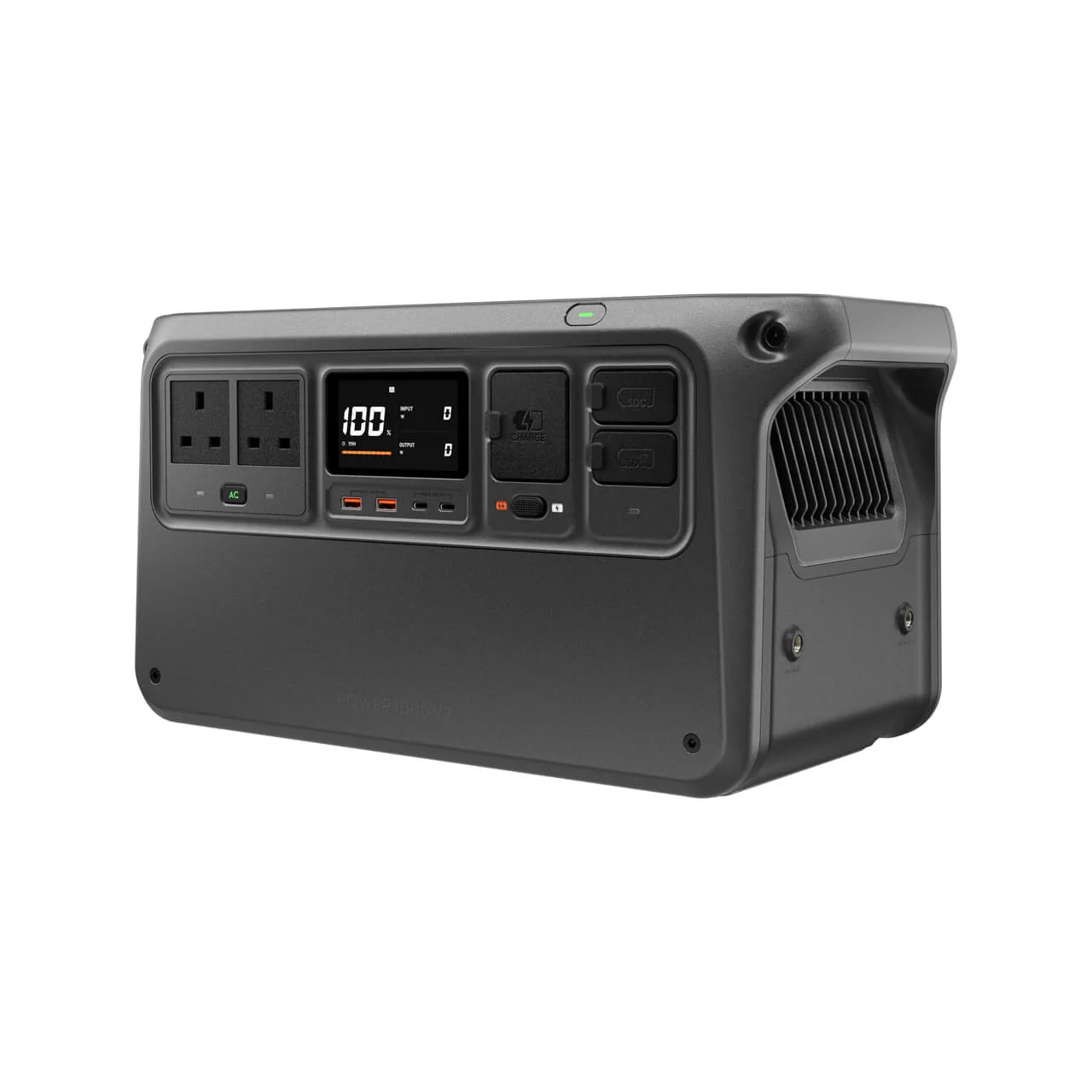
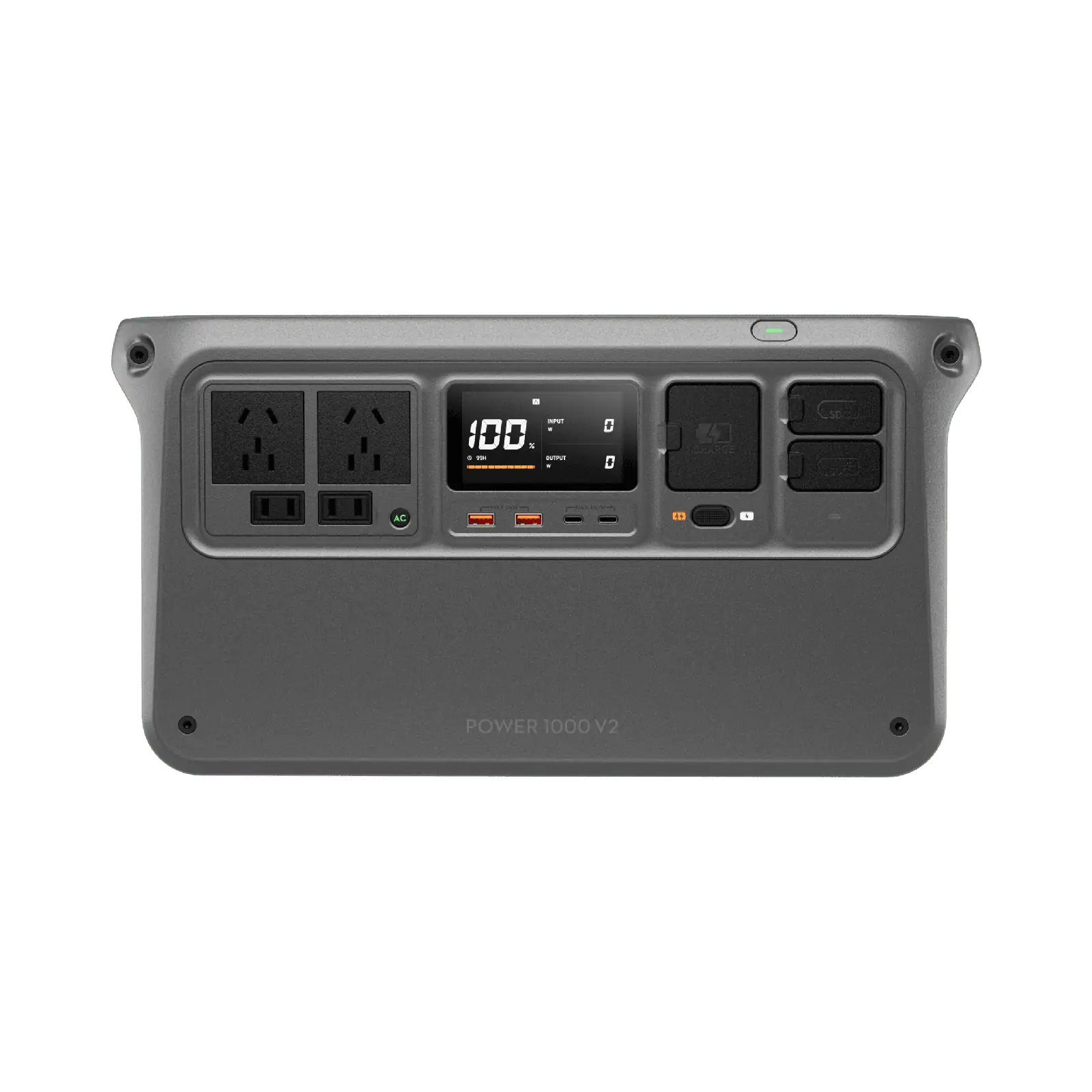
| Outlets and ports on CN/US/JP models | AC ×4, USB-C ×2, USB-A ×2, SDC ×1, SDC Lite ×1, AC input ×1. |
| USB-C | up to 140 W per channel; needs PD 3.1 and an EPR-spec cable. |
| AC output as marketed | 2,600 W continuous and 4,400 W peak; the 120 V spec sheet lists 20 A maximum current. |
| Grid input | up to 1,440 W, and only with the battery at 60% or higher and the room at 20-35 °C; the spec sheet lists 13 A. |
| Recharge | 0-80% in 37 minutes and 0-100% in 56 minutes, measured at 25 °C in a laboratory; GearLab measured 0.9 hours. |
| Noise | 26 dB claimed while charging. |
| UPS | 10 ms switchover, which the manual describes as a basic UPS with no 0 ms switching. |
| Operating altitude | 5000 m, up from 3000 m on the original Power 1000. |
| Temperatures | recharging 0 to 45 °C; power supply and storage -10 to 45 °C. |
| Connectivity | Wi-Fi 802.11 b/g/n and Bluetooth 5.0 built in; no DJI Power Dongle support. |
| Expansion | up to five DJI Power Expansion Battery 2000 packs for 11,264 Wh total, through the SDC port only. |
| Warranty | DJI states five years with some accessories excluded; GearLab’s spec table lists three years. |
Full research notes and sources
Solar, car charging and the adapters
DJI left the conventional ports off this machine. There is no solar input, no 12 V car socket and no barrel DC output, so each of those arrives through an SDC adapter you buy on top. Four reviews make the same point, and GearLab’s verdict is blunt: the adapters quickly make the unit one of the least value-oriented in its class.
The published numbers also need untangling. DJI’s FAQ caps the Solar Panel Adapter Module (MPPT) at 400 W; the 1,800 W solar figure belongs to the separate DJI Power 1.8kW Solar/Car Super Fast Charger, which can also take 600 W from a car socket. The specs page for the 120 V model states 20 A maximum AC current, which is 2,400 W, next to the marketed 2,600 W continuous and 4,400 W peak. Grid input has a condition attached: 1,440 W only when the battery is at 60% or higher and the ambient temperature is 20-35 °C, and 13 A on the spec sheet. The manual adds an app-enabled “Super Recharging” mode of roughly 1800 W.
With two SDC ports, expansion batteries, fast chargers and drone charging compete for the same two connectors, so a heavily configured setup runs out of ports. Add the accessory cost when you budget: Mashable priced the Solar Panel Adapter Module at $59, a DJI Power fast-charge cable at about $20 and the Expansion Battery 2000 at $899.
UPS and backup power
Leave it plugged in and it works as a basic UPS. DJI says connected devices start within 0.01 s, and DroneXL measured a 10 ms transfer, twice as fast as the original Power 1000. Read the manual’s caveats first: it is not a 0 ms unit, DJI excludes medical equipment, several devices connected at once can trip the overload protection, and output power may be reduced in UPS mode. That makes it credible for a home office, a router or a CPAP, and a poor match for anything where a reboot costs money.
The headroom is real. T3 measured a 2,735 W peak from a kettle, laptop and phone together with no overload, and Mashable ran the unit as the sole supply for a household through a winter outage. DJI’s runtime claims run about 9 hours for a fan, 20 hours for a fridge, 40 minutes for a power saw and about 1.3 hours for a microwave. DroneXL ran two full discharges at about 195 W output, a shade over four hours each, and called the resulting efficiency around 80% typical rather than class-leading, with a noticeable idle draw just to keep AC output alive.
Charge time, runtime and upkeep
Wall charging is the strongest number in the class for this capacity. GearLab measured 0.9 hours at a 1,041 Wh per hour charging rate, and DroneXL pulled 1,400-1,450 W from the socket. Fast Recharge is a physical toggle on the unit; after five consecutive fast cycles it drops itself into the quieter Standard mode, which DJI recommends for cell life, and the app can push roughly 1800 W.
Noise matters more than the wattage for indoor use. DJI claims 26 dB while charging, GearLab ran the unit near maximum output for months without intolerable fan noise, and T3 found it effectively silent under light load. Android Authority and T3 both noticed a faint warm plasticky smell on a new unit and each attributed it to normal break-in rather than a fault; neither says it came back.
Stored long-term, it wants attention. DJI says not to leave it fully discharged, to hold it at 50-70% (ideally around 60%), to check it every 3-4 months, and roughly every six months to discharge it below 15%, power off, wait two hours or more, then recharge to 100% in Standard Recharge Mode. The claim of over 80% capacity after 4,000 cycles is a 25 °C laboratory figure discharged at 1000 W. Repairs are closed: DJI publishes user guides for its accessories, not for the station, and the inverter, battery pack and battery management system are not sold as parts. DJI states a five-year warranty with some accessories excluded, while GearLab’s spec table lists three.
Is it worth it?
Under about $450 the package makes sense if you charge from the wall, already own DJI drones, or want silent backup for a CPAP, router or workstation. Between $450 and $600 it is fair, and the adapters belong in the comparison. At the $699 list price that GearLab, Android Authority and Mashable all quote, you are paying for DJI drone battery fast charging, the app, quiet running and the expansion path. If none of those apply, the same money buys units with native solar input and 12 V sockets, which is the comparison GearLab recommends; it names the Jackery Explorer 2000 v2 for off-grid capacity and the Anker Solix C1000 Gen 2 for lower weight. UK pricing has been £799.
One caveat for US shoppers. DJI’s US product site does not list this model, a July 2025 trade report said it was not being sold to US buyers, and one DJI USA storefront page lists it at $419 against a $699 regular price, though that page was only readable as a search snippet. Confirm which US seller honours the warranty before you buy, because that, not the spec sheet, is the open question.
Which model this is
This page covers the second-generation Power 1000: model DYM1000V2L for 100-120 V markets and DYM1000V2H for 220-240 V. It keeps the same 1024 Wh LFP pack as the original Power 1000 (DYM1000L / DYM1000H) and adds 2,600 W of continuous output, four AC outlets on US-region units and a 5000 m altitude rating. Do not confuse it with the original Power 1000, the smaller Power 500, the Power 1000 Mini or the 2,048 Wh Power 2000.
The regional split matters if you shop in the US. DJI says models for regions using CN, US and JP standards have four AC output ports while models for other countries have two, because the port sizes differ; every other published specification is the same. Reviews of non-US units describe a two-outlet machine, and T3 tested exactly that variant, so read a two-outlet listing as the wrong SKU rather than a different machine. The listing this page is built from is ASIN B0H2MFBDZL; no DJI page confirms that code, so match on DYM1000V2L and the four-outlet layout.
Sources
Manufacturer:
- DJI Power 1000 V2 specifications
- DJI Power 1000 V2 product page
- DJI Power 1000 V2 FAQ
- DJI Power 1000 V2 user manual v1.0 (PDF)
- DJI Power 1000 V2 downloads and firmware notes
Independent reviews:
- GearLab instrumented test: delivered energy, charge time and scores
- Android Authority review: cable, weight and app telemetry
- Mashable review of a month of use including a winter outage
- DroneXL review: wall draw, efficiency and 10 ms UPS (2,600W output in a quiet package)
- T3 test of the two-outlet regional variant
Availability:
- DJI USA portable power station collection
- Coptrz UK listing: £799 and stated box contents
- DroneDJ launch report on US availability
No owner forum threads specific to this model were found, so the hands-on experience here comes from reviewers rather than forum posts.