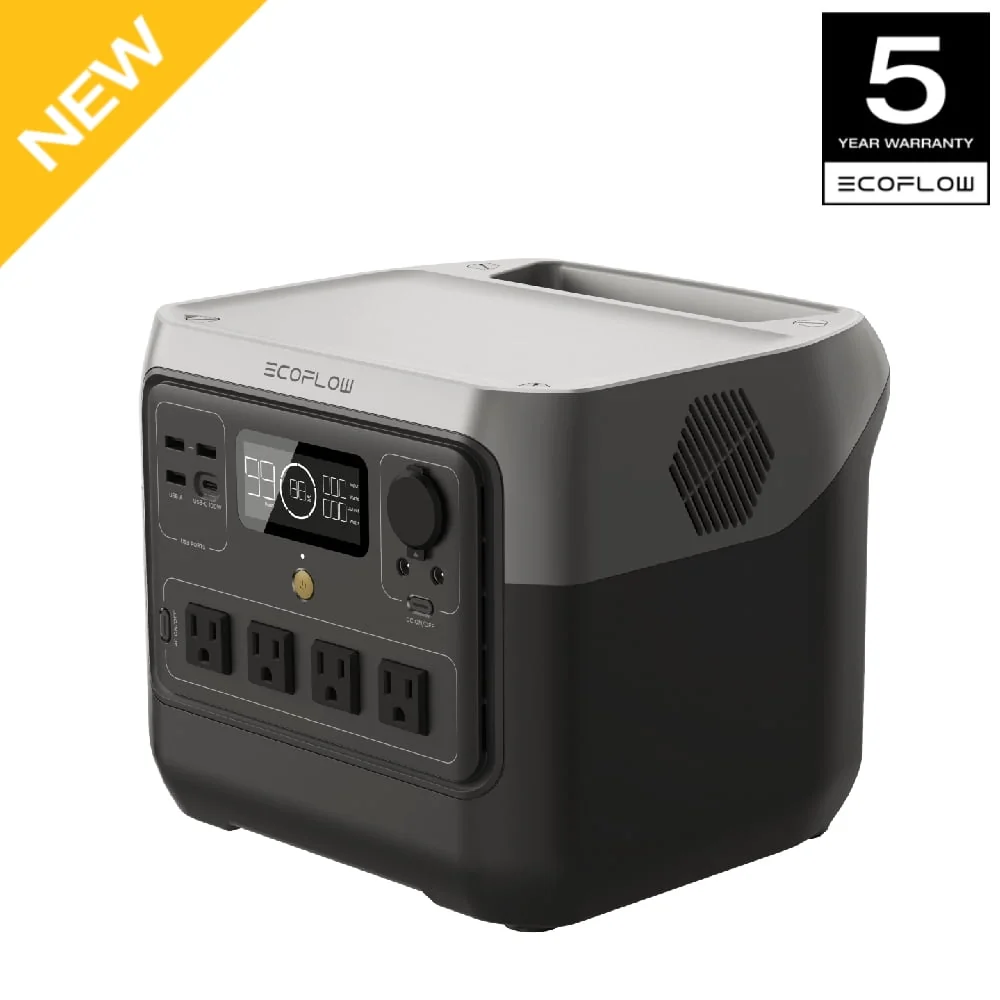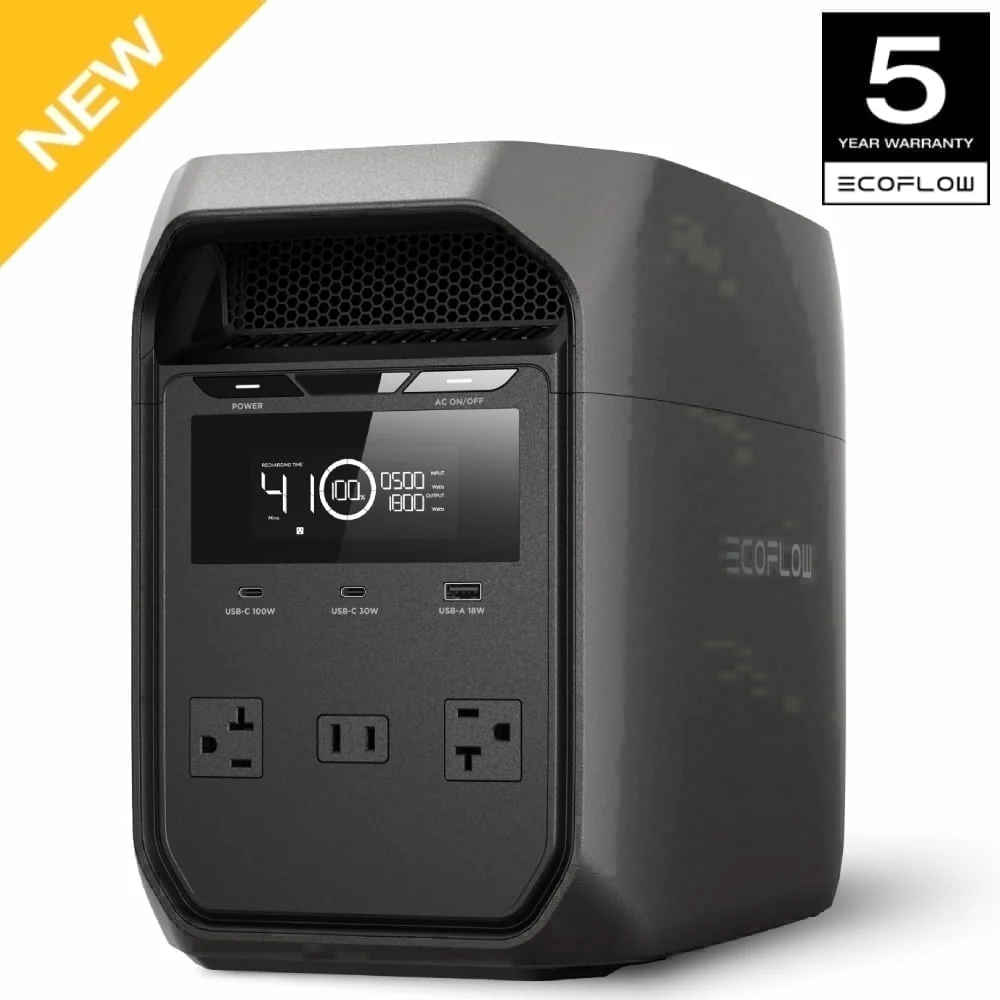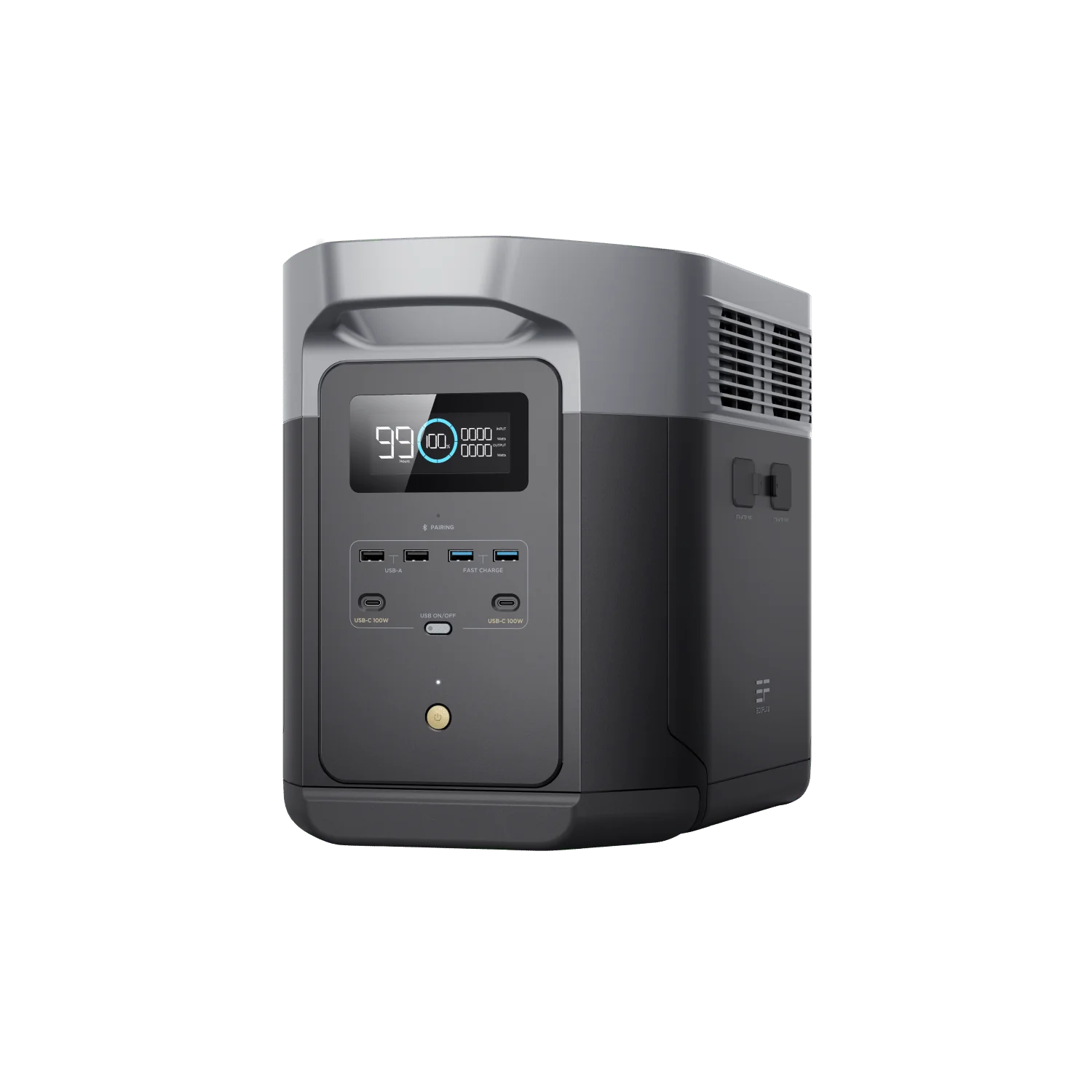
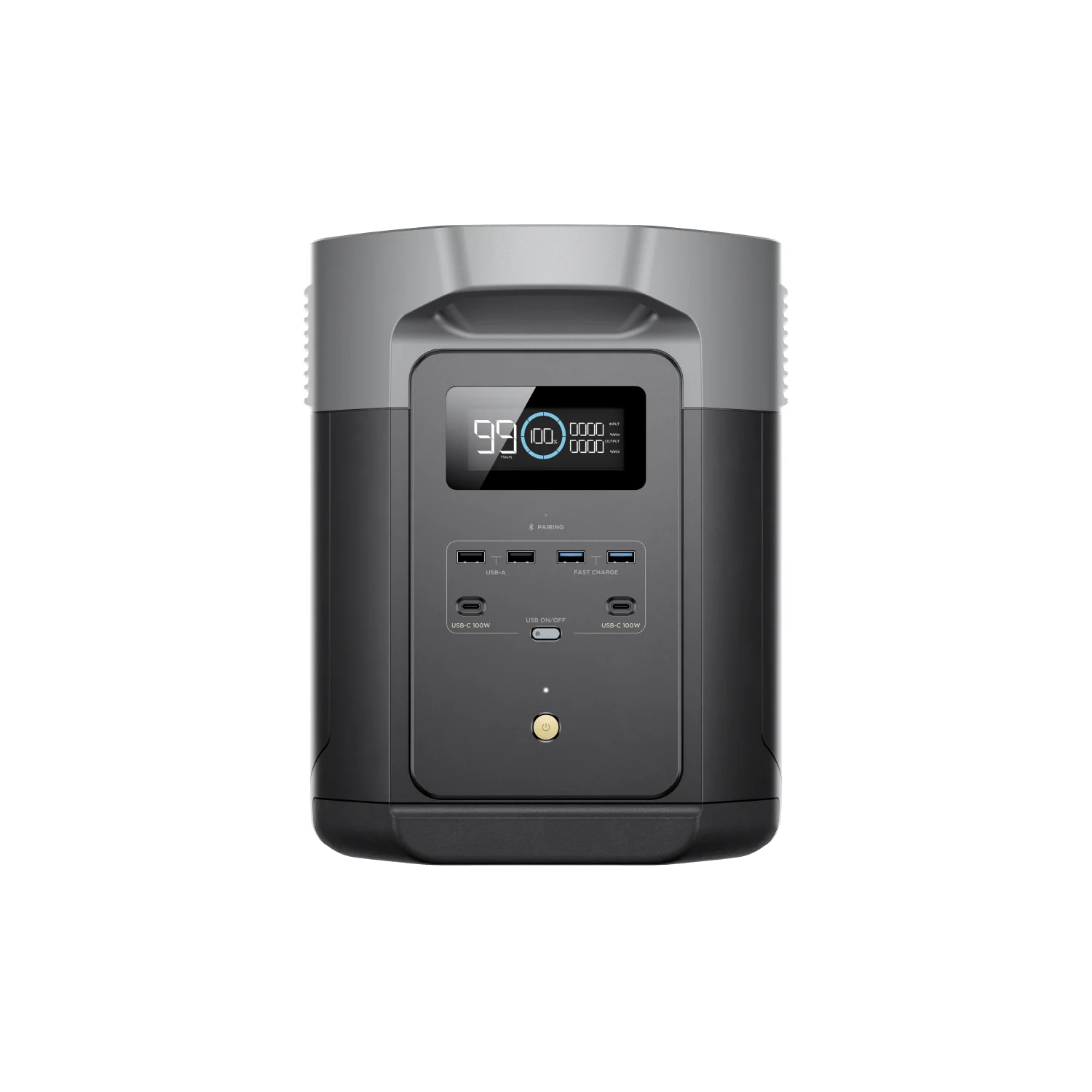
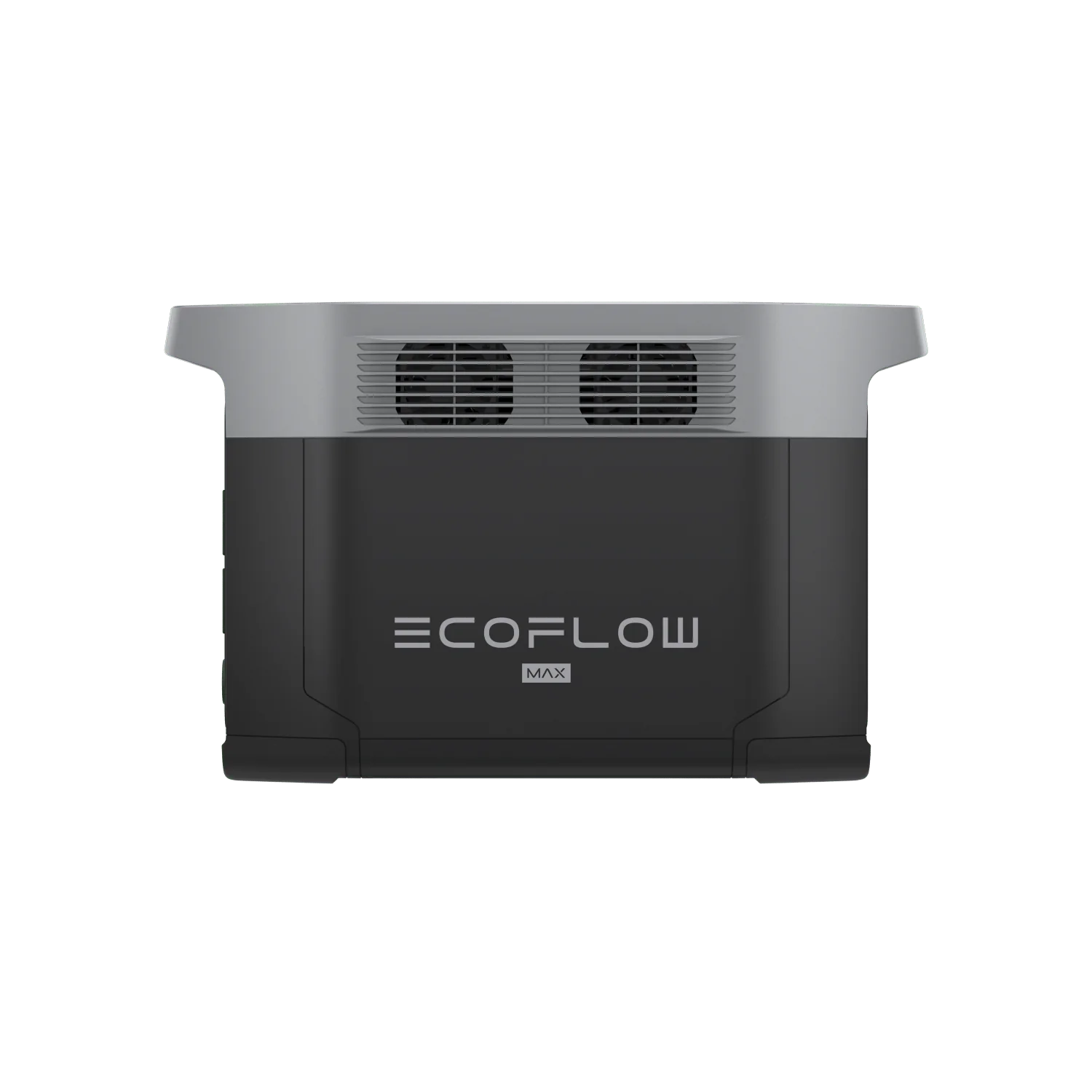

EcoFlow DELTA 2 Max Portable Power Station
By EcoFlow · Portable Power Stations · Audio & Electronics
- 2,048Wh LiFePO4 capacity, expandable to 6,144Wh with two Smart Extra Batteries
- 2,400W AC output (4,800W surge), X-Boost up to 3,400W
- 1,800W AC input: 80% in about 1.1 h
- 3,000+ cycles to 80% capacity (~10 years daily use)
Lowest price seen
$810.56
from $810.56 at AliExpress · Checked Oct 12, 2026
- AliExpress dfgde Store $810.56View at AliExpress
- The Cabin Depot $1,265.33View at The Cabin Depot
- SanTan Solar $1,699.00View at SanTan Solar
- Generator Factory Outlet $1,899.00View at Generator Factory Outlet
- Electric Generator Depot $1,899.00View at Electric Generator Depot
- EcoFlowView at EcoFlow
- NorwallView at Norwall
- The Home DepotView at The Home Depot
- Lowe'sView at Lowe's
- AdoramaView at Adorama
- eBayView at eBay
- eBay (used) eBay: used, open-box, refurbishedView at eBay (used)
- AmazonView at Amazon
Prices are snapshots. Check the current price with the store.
Summary
A 2,048 Wh LFP portable power station with a 2,400 W inverter, six grounded AC outlets and up to 1,000 W of solar input, aimed at homes that need real backup capacity rather than a small weekend unit. Check availability before you plan around it: EcoFlow’s US page showed most variants sold out on 2026-10-03, and one comparison site says the model was discontinued in July 2026.
Strengths
- Sustains its rated 2,400 W continuously with an accurate display, no cut-outs and no excessive fan noise in The Solar Lab’s test.
- 86% measured inverter efficiency and about 13.6 W of idle draw with the inverter live, low for a 2 kWh-class unit.
- Six grounded AC outlets, where the smaller DELTA 2 has two.
- Up to 1,000 W of solar across two ports, which is generous for the battery size.
- Expands to 6,144 Wh with two Smart Extra Batteries, and EcoFlow sells matching panels, an 800 W alternator charger and the WAVE and GACIER generators.
- AC Always-on mode, clean load switching in a simulated grid outage, and an app The Solar Lab calls one of the best in the category.
Weaknesses
- Surge is the weak point: The Solar Lab found the unit struggled with any load above 2,400 W, even slightly, and advises a bigger station for air conditioners, compressors, well pumps and washing machines.
- X-Boost’s 3,400 W is a voltage-drop trick, not extra inverter capacity.
- No built-in light, on a unit heavy enough to need two hands.
- No parts catalog, teardown or service channel was found, so a hardware fault means a warranty claim rather than a repair.
- One owner measured roughly 12% per hour self-discharge under a constant load, needed a manual BMS reset every other day, and saw the output readout run 20–30 W high.
- Owner reports also include extra batteries that will not balance, a second solar port that stops waking, and a unit stuck at 0%.
Verified specifications
| Model | EFD350, US 120 V version. |
|---|---|
| Capacity | 2,048 Wh, expandable to 4,096 Wh or 6,144 Wh with two Smart Extra Batteries. |
| Battery chemistry | LFP (LiFePO4). EcoFlow’s product page rates 3,000 cycles to more than 80% of capacity; the US manual says 4,000. |
| Inverter | pure sine wave, 2,400 W continuous across six AC outlets, 120 V at 50/60 Hz. The US manual prints 4,800 W surge; EcoFlow’s FAQ says 3.4 kW. |
| X-Boost | claimed 3,400 W on US and Canadian units. |
| AC input | up to 1,800 W at 15 A, 100–120 V AC. The manual’s full-charge estimate is about 80 minutes. |
| Solar input | two PV ports, 11–60 V, 15 A; 500 W on a single port or 1,000 W across both. EcoFlow claims 99% MPPT efficiency. |
| USB-C | two ports at up to 100 W each, 200 W combined. |
| USB-A | two ports at 12 W each (24 W combined) plus two fast-charge ports at 18 W each (36 W combined). |
| Car socket | 126 W at 12.6 V, 10 A. Two DC5521 outputs at 38 W each. |
| Port count | 15 on the US version. |
| Expansion | two Smart Extra Batteries. EcoFlow says connecting two DELTA 2 Max units to each other can damage both and voids the warranty. |
| Power switching | about 20 ms to battery, which the manual warns is not a 0 ms transfer for servers and workstations. |
| Standby | defaults to a 2-hour timeout with the output buttons off, adjustable in the app. |
| Storage | EcoFlow says to charge fully, discharge to 60% and repeat every three months, and not to leave the unit uncharged for more than six months. |
| Dimensions | 19.6 × 9.5 × 12 in (497 × 242 × 305 mm). Weight: about 23 kg (50 lbs); independent readings were 50.7 lb and 51.8 lb. |
| In the box | unit, user manual and warranty card, AC charging cable. Solar bundles add a car charging cable and a barrel cable. |
| Warranty | 5 years, per EcoFlow’s US pages. |
Full research notes and sources
Output, surge and X-Boost
The Solar Lab retested a DELTA 2 Max roughly two years after release with hands-on lab work and a two-night car trip. It measured 86% inverter efficiency, about 13.6 W of idle draw with the inverter on and nothing plugged in, and a full AC charge in 1.2–1.5 hours at the 1,800 W input limit. It held 2,400 W under steady resistive loads without fan noise or cut-outs, switched loads cleanly in a simulated grid outage, and finished the camping trip with charge in reserve.
Two numbers on the box are not what they look like. X-Boost works by dropping output voltage while the readout still calculates at the nominal 120 V, so the extra watts on the display are not extra inverter capacity; one commenter in r/Ecoflow_community does the arithmetic as 105 V × 22.85 A still being 2,400 W while the unit shows 2,742 W. Surge matters more: the same tester found the unit barely exceeded 2,400 W even with X-Boost enabled, and specifically recommends a larger unit for air conditioners, compressors, well pumps and washing machines. EcoFlow’s own documents disagree, with the manual printing 4,800 W surge and the FAQ saying 3.4 kW, and neither matches the testing. Plan motor loads against the continuous rating. There is also no 240 V output, which rules out 240 V appliances.
The layout gets a specific mention: USB on the front, AC on the rear, so the unit can sit against a wall or in a vehicle without losing access. There is no built-in light, which is a strange omission on something this heavy.
Recharging and solar input
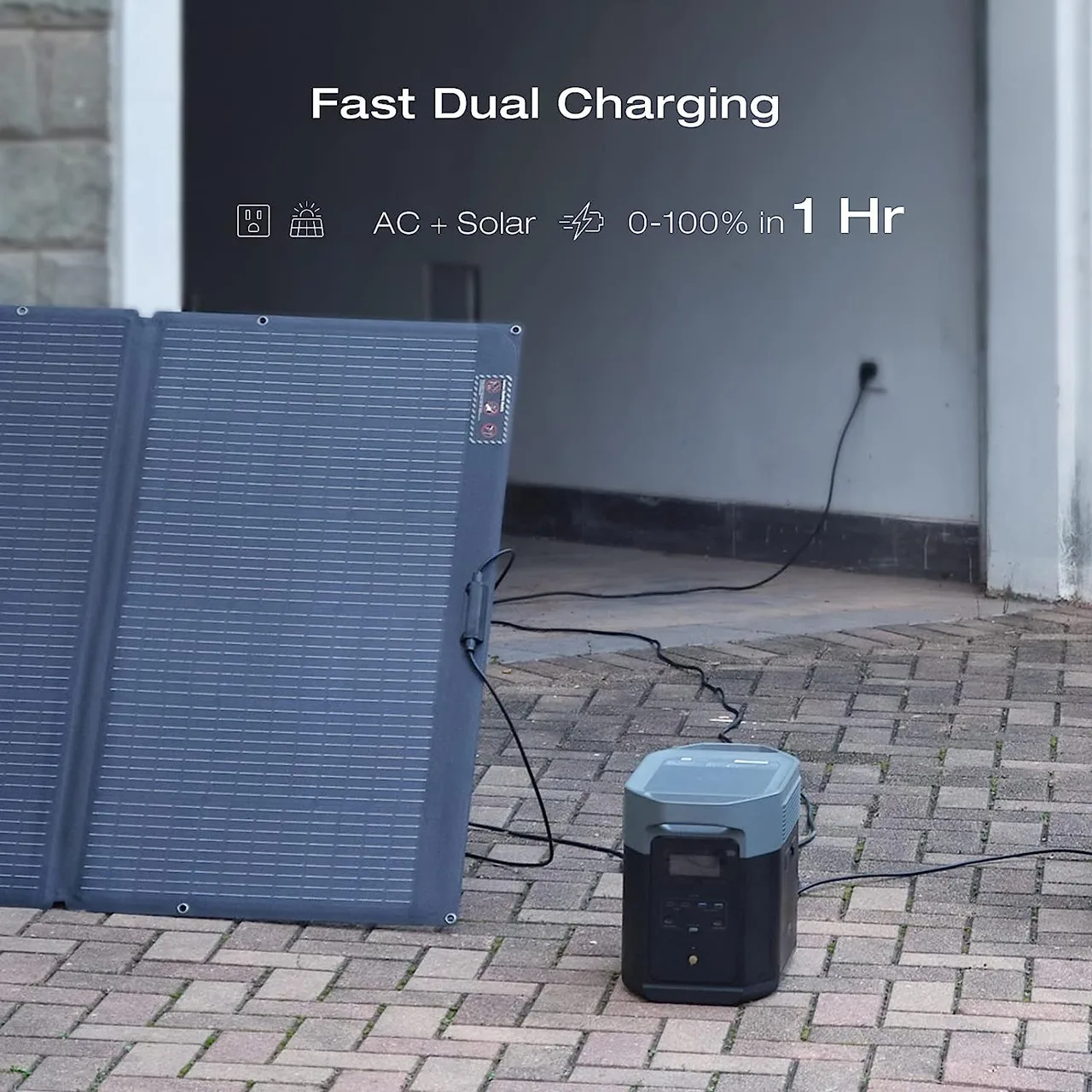
Recharge figures need care, because EcoFlow publishes several. The 43-minute number that circulates is AC and solar together. EcoFlow’s own blog says 63 minutes with solar added, its FAQ says 66 minutes on AC alone, and the US manual says fully charged in about 80 minutes on AC. The Solar Lab measured 1.2–1.5 hours to 100% at the 1,800 W input limit. Budget about 80 minutes on the wall.
The solar side is the better story. Two PV ports take 11–60 V at up to 1,000 W combined and 500 W on one port, with 99% MPPT efficiency claimed. The Solar Lab took a 1,000 W panel setup from empty to full in about two hours in explicitly very good sun, and cautions that poor orientation or thin sun will be slower. The same tester confirmed the 800 W alternator charger works, filling the unit in a little over a two-hour drive.
Left alone with the output buttons off, the unit sleeps after two hours by default and the app can change that. If AC input current climbs above 20 A, the physical overload switch pops and has to be pressed before charging resumes. Expansion capacity comes from Smart Extra Batteries, not from pairing units.
Owner reports, repairs and running costs
Exact-model owner reports are thin, and none of them establish a failure rate. The most detailed comes from an owner who verified a roughly 70 W computer load with two power meters and found both the unit display and the app reporting about 100 W, 20–30 W high, and who saw the displayed output fall when a 12 W fan was switched on. The same owner reports losing roughly 12% per hour under a constant load, needing a manual BMS reset every other day, and describes the second of two solar inputs intermittently identifying as a car input and refusing more than about 1 W until the unit was power-cycled. That owner suspected firmware and was considering returning the unit.
Other owners report extra batteries that will not balance out, a battery recognized by the station and app but neither charging nor discharging, mornings where solar showed 0 W until a reset, and one 2026 unit that stuck at 0% and would not accept a normal charge. A separate new owner asked about a coil whine and crackling; EcoFlow’s official account replied that the noise was not normal and asked for order details, and no follow-up was readable. Note that the 1 kWh DELTA 2 extra battery is not on EcoFlow’s compatibility list for this model, so mixed-battery reports may involve the wrong pack.
Repairs are the real weak side. No replacement parts catalog, teardown or service channel was found for this model, on EcoFlow’s support pages or anywhere else checked. With a BMS, an inverter and app and firmware dependence, diagnosing the reports above realistically means a firmware update or a warranty claim. EcoFlow states a 5-year US warranty, but it excludes normal wear and battery wear, so the term is not a five-year capacity-retention promise; the detailed claim terms could not be read.
There is no fuel and no consumable cycle part. Electricity is the main routine cost, and idle draw matters more than many buyers expect: about 13.6 W with the inverter live, left on continuously, is roughly 119 kWh a year, or about $21.81 at the EIA’s July 2026 US residential average of 18.31 cents/kWh, before any useful load is powered. An optional 2,048 Wh Smart Extra Battery was $899 from EcoFlow and the 800 W alternator charger was $269; expansion batteries have been estimated at roughly $800–$1,000 each.
Is it worth it?
Two anchors bracket the price. Launch MSRP was $1,899 standalone. In October 2026 EcoFlow’s US store listed the base unit at $1,029 against a $1,299 regular price and marked it as a pre-order, Home Depot listed it at $1,085.43, and Wirecutter gave $979 at The Home Depot. February 2026 deal coverage reported $849, down from $1,700.
The measured performance supports a buy up to about $1,050: sustained 2,400 W, 86% efficiency, low idle draw, six grounded outlets and 1,000 W of solar. Above that, weigh the buy against a smaller, far more portable station; Wirecutter’s own pick is a 768 Wh unit weighing 17.2 lb. At roughly the same money the newer DELTA 3 Max has been around $879–$899 when available with the same capacity class and 10 ms switching, Jackery’s Explorer 2000 v2 lists at $899 with 2,042 Wh and 2,200 W, and BLUETTI’s AC200L lists at $1,199 with 1,200 W of solar input. There is no fuel and no consumable cycle part, which is the standing argument against a gas generator.
Check availability before anything else. Most variants on EcoFlow’s US page rendered as sold out when checked, and one comparison site says EcoFlow discontinued the DELTA 2 Max in July 2026 and now routes buyers to the DELTA 3 Max. Until a checkout is finished, treat the price and the availability as unverified.
Which model this is
This is the US 120 V DELTA 2 Max, manufacturer model EFD350, 2,048 Wh and 2,400 W, launched in May 2023 as the second-generation successor to the NCM-based DELTA Max. The ASIN for this page is B0C4DW17PD.
The US and Japanese versions have six AC outlets; the UK, EU and Australian versions have four, with X-Boost ratings of 3,100 W and 3,300 W there. Everything on this page is the US version.
Do not merge it with the DELTA 2 at 1,024 Wh and 1,800 W, the NCM-based DELTA Max, or the DELTA 3 Max, which is a different 2,048 Wh unit with a 3,000 W inverter and 6,000 W surge. Coverage of the last two gets mixed up regularly, and one outlet and weight reading you may see in a sibling-model test does not describe this machine.
Sources
Manufacturer:
- EcoFlow DELTA 2 Max user manual, US edition (PDF)
- EcoFlow DELTA 2 Max US product page
- EcoFlow DELTA 2 Max FAQ: everything you need to know
- EcoFlow DELTA series portable power station comparison
- EcoFlow DELTA 2 Max solar generator bundle page
- EcoFlow DELTA 2 Max Europe product page
- EcoFlow DELTA 2 Max Australia product page
- EcoFlow US limited warranty policy
- EcoFlow warranty registration and support
- EcoFlow launches its new solar generator (PR Newswire)
- EcoFlow DELTA 2 Max Smart Extra Battery
- EcoFlow 800 W alternator charger
Independent reviews:
- The Solar Lab: DELTA 2 Max measurements two years on
- Wirecutter portable power station buying guide
- StorageReview: EcoFlow DELTA 2 Max review
- GMToday hands-on look at the battery change
- TechRadar coverage and specification recap
- Backup Power Hub: DELTA 2 vs DELTA 2 Max and the discontinuation claim
Owner reports:
- What the unit can and cannot start (r/Ecoflow_community)
- Self-discharge, readout and second solar port issues (r/Ecoflow_community)
- Crackling or buzzing noise on a new unit (r/Ecoflow_community)
- Warranty claim on two extra batteries that will not balance (r/Ecoflow_community)
- Main unit not drawing from an extra battery (r/Ecoflow_community)
- Extra battery recognized but not charging or discharging (r/Ecoflow_community)
- Solar charging issues (r/Ecoflow_community)
- Unit stuck at 0% (r/Ecoflow_community)
Retailer listings:
Alternatives: