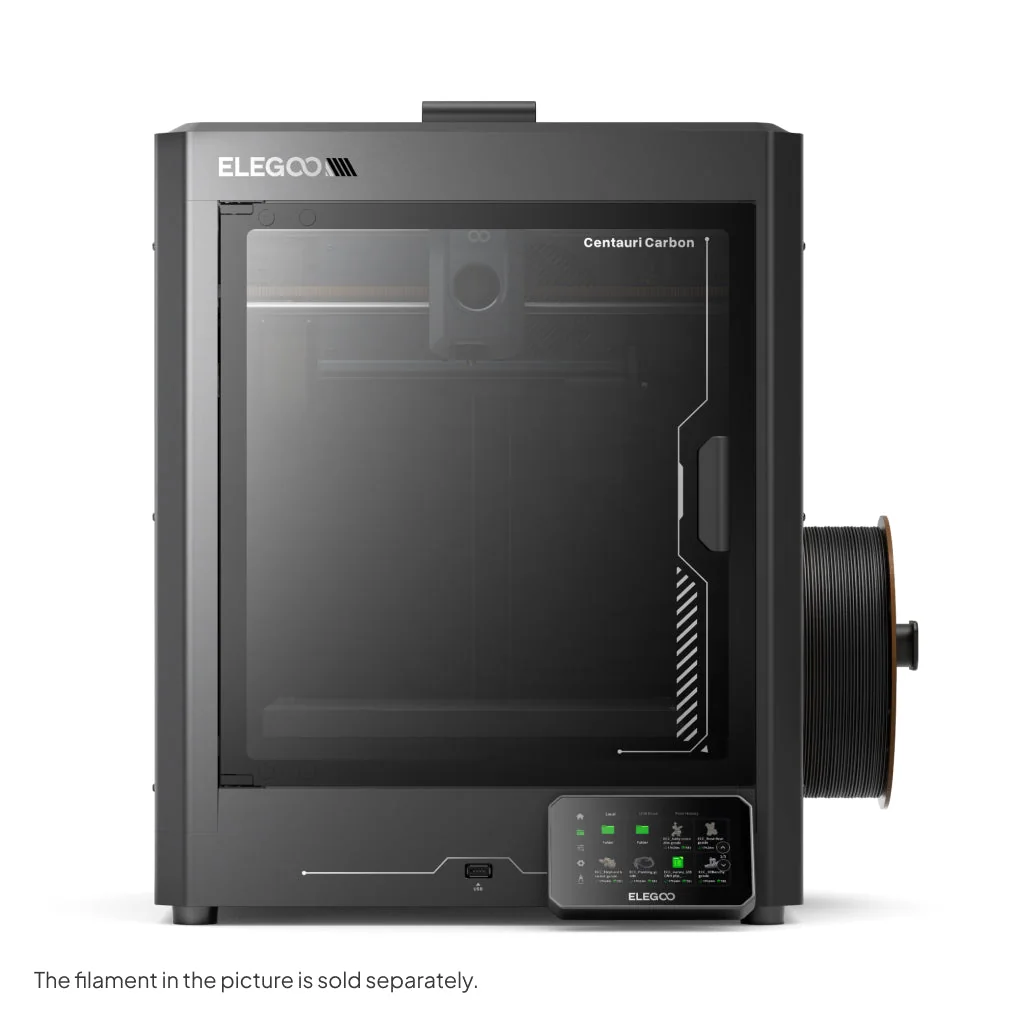
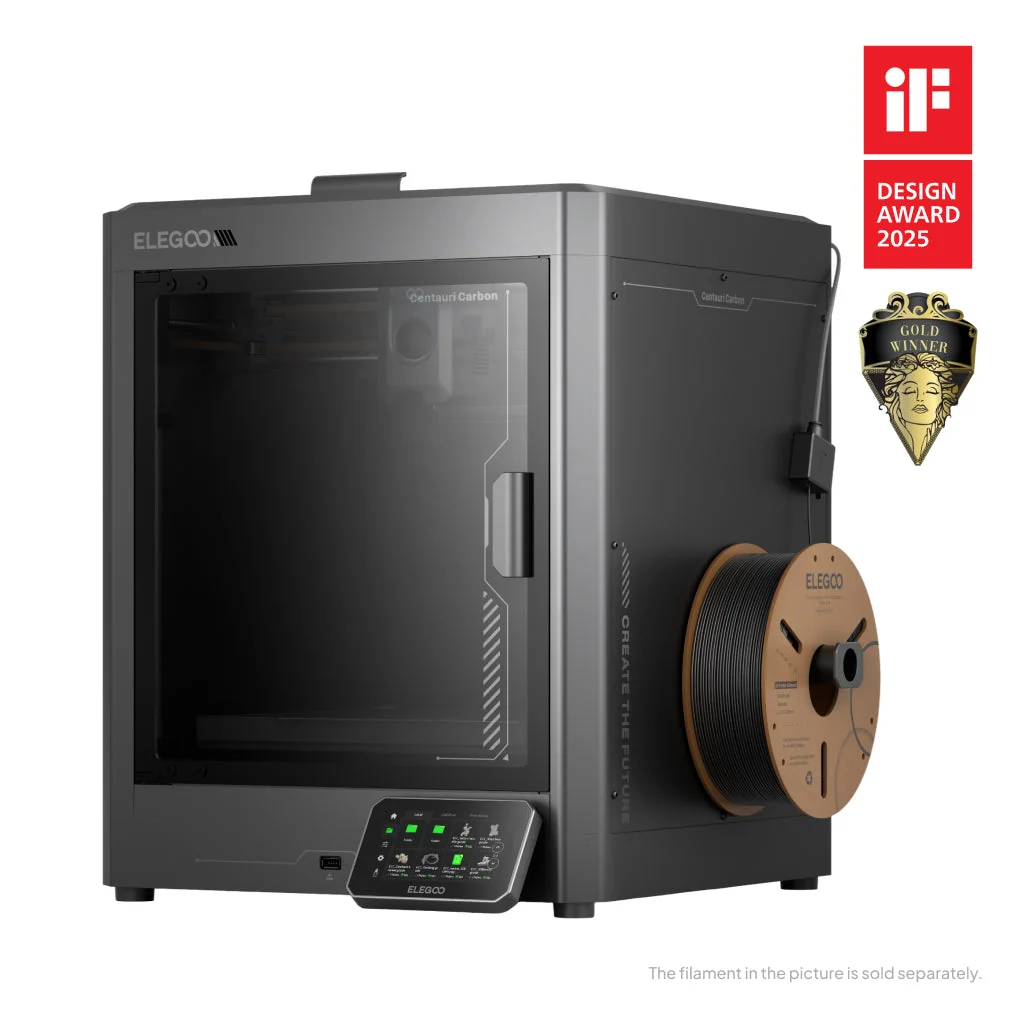
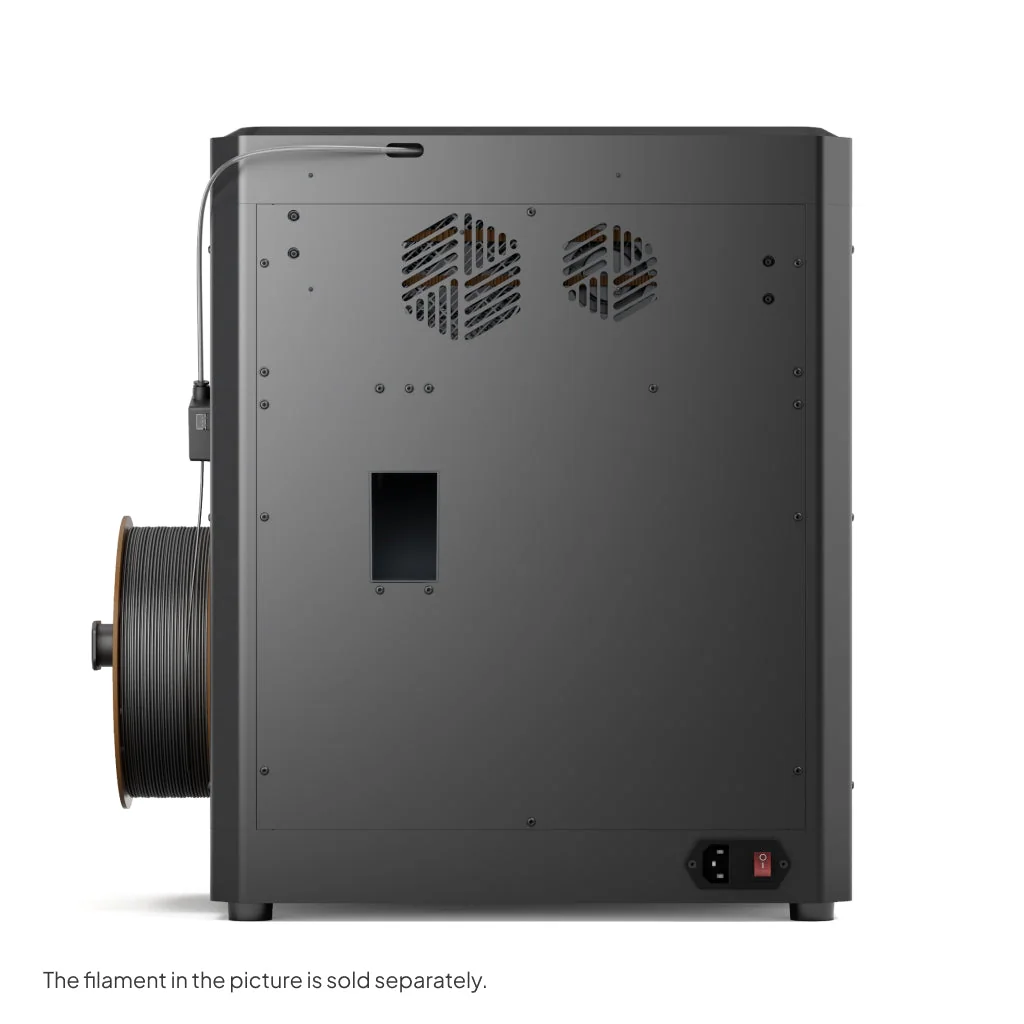
ELEGOO Centauri Carbon 3D Printer
By ELEGOO · 3D Printers · 3D Printing
- CoreXY structure with 500 mm/s velocity and 20,000 mm/s² acceleration
- 256×256×256 mm build volume
- 320°C brass-hardened steel nozzle in fully enclosed chamber
- Full-auto calibration with built-in chamber camera
Lowest price seen
~$279.00 (approx.)
from $279.00 at Amazon
- Amazon ~$279.00 (approx.)View at Amazon
- ELEGOOView at ELEGOO
- Micro CenterView at Micro Center
- eBayView at eBay
- eBay (used) eBay: used, open-box, refurbishedView at eBay (used)
Prices are snapshots. Check the current price with the store.
Summary
A fully enclosed 256 mm CoreXY FDM printer rated at 500 mm/s, with a 320 °C hotend and 121-point auto leveling, that independent reviewers recommend as a first CoreXY. Check your material plan before buying: there is no heated chamber, and the top cover has to come off for PLA and TPU.
Strengths
- Tom’s Hardware gave it an Editor’s Choice and praised its out-of-the-box experience.
- 121-point auto leveling with Z-offset and input shaping removes paper leveling.
- Fast for the price: a measured speed Benchy in 18 minutes 19 seconds.
- Enclosed CoreXY with Wi-Fi, LAN and front USB, and no cloud requirement.
- Prints PLA, PETG, TPU, ABS, ASA and carbon-fiber blends.
- Tom’s Guide’s reviewer set it up in under 10 minutes.
Weaknesses
- No heated chamber; measured 41 °C after 20 minutes of printing.
- The top cover must come off for PLA and TPU or the chamber overheats.
- Interior lighting and the camera image are very dim.
- The smooth cool-plate side grips poorly at the suggested 30 °C and works better at 60 °C.
- The first layer may need a manual Z-offset nudge of a few tenths of a millimetre.
- TPU loading needs the Bowden tube disconnected to hand-feed the last few centimetres.
Verified specifications
| Printer type | FDM, enclosed CoreXY. |
|---|---|
| Build volume | 256 x 256 x 256 mm (10.07 x 10.07 x 10.07 in). |
| Print speed | up to 500 mm/s; acceleration 20,000 mm/s². |
| Nozzle | 0.4 mm standard, maximum 320 °C, described by the manufacturer as brass-hardened steel. |
| Heated bed | maximum 110 °C, 1000 W AC. |
| Leveling | automatic, four strain gauges, 121 points, with Z-offset and input shaping. |
| Chamber | fully enclosed with no active heater; measured 41 °C after 20 minutes of printing. |
| Extruder | direct drive, hardened-steel dual gear, 5.2:1 reduction, integrated filament cutter. |
| Layer thickness | 0.1-0.4 mm, 0.2 mm recommended. |
| Filament | 1.75 mm. |
| Claimed maximum flow | 32 mm³/s. |
| Display | 4.3-inch capacitive touchscreen. |
| Connectivity | Wi-Fi, LAN and USB flash drive, with 8 GB of internal flash; no cloud required. |
| Power | 100-240 V; 350 W at 110 V and 1100 W at 220 V. |
| Dimensions | 398 x 404 x 490 mm (15.60 x 15.90 x 19.29 in); 17.5 kg (38.58 lb). |
| Software | ELEGOO Slicer, based on Bambu Studio and OrcaSlicer; the machine runs a Klipper fork with Fluidd. |
Full research notes and sources
Why the enclosure matters
There is no heated chamber. With the lid off and the door closed at 20 °C ambient, Tom’s Hardware measured the chamber at 31 °C on average, dropping to 27 °C with the door open and reaching 41 °C after 20 minutes of enclosed printing. That is enough to keep drafts off ABS and PC without an active heater, and a Prusament PC Blend frame still lifted at the corners even on a 100 °C bed. Because low-temperature filament overheats in the enclosure, the removable top lid has to come off for PLA and TPU, which trades dust protection for printability.
Measured performance
Tom’s Hardware measured the bed heating from 32 °C to 110 °C in just over seven minutes at 110 V. A speed Benchy at 0.25 mm layers with raised acceleration took 18 minutes 19 seconds; a PLA dragon took 1 h 10 min with no stringing; a PETG planter took 4 h 27 min; and a vase-mode TPU bag printed in 1 h 7 min at 12 mm³/s flow. Tom’s Guide’s reviewer ran complex prints of roughly four and seven hours without issues. Input shaping runs as part of the auto-leveling program.
Setup, maintenance and support
Tom’s Guide set the machine up in under 10 minutes, and CNX Software describes it as nearly pre-assembled with a first-boot self-check that takes about 30 minutes and is very loud. TPU needs the Bowden tube popped off the extruder to hand-feed the last few centimetres, and normal filament loading takes extra force through a sharp bend near the toolhead. The hotend is similar to the Neptune 4 Plus/4 Max, and ELEGOO sells a hardened steel nozzle as a swap. A spare heatbed nozzle wiper, an unclogging pin, lubricant and a glue stick ship in the box. The warranty term for this exact model was not read.
Is it worth it?
ELEGOO’s direct price was documented at $299.99 at launch and in early review, with $299-$309 in later snapshots against a $375-$400 database band and a $400 MSRP. At $310 or below the capability per dollar is hard to argue with. Above roughly $310 the case depends on deal pricing, and above the $319 direct price of the Centauri Carbon 2 successor the first-generation model is being asked to beat its own replacement. The named alternatives for a buyer who wants guaranteed upgrades or an actively heated chamber are much more expensive: a Bambu Lab P1S with a four-color AMS unit at $829 and a Prusa CORE One DIY kit at $949 or an MK4S upgrade at $450. ELEGOO’s first CoreXY machine also has no published long-run data, so buy it as a first or second printer and use the return window to verify first layers.
Which model this is
This page covers the ELEGOO Centauri Carbon enclosed FDM printer, ASIN B0FDQP54X8. Do not merge it with the Centauri Carbon 2, the Centauri Carbon 2 Combo, or the non-enclosed Centauri variant. Firmware is an ELEGOO fork of Klipper with Fluidd as the web interface, and the machine is documented in the Centauri Carbon user manual, EN version 1.2.
Sources
Manufacturer:
- Elegoo Centauri Carbon official page
- Centauri Carbon user manual EN v1.2 (PDF)
- Centauri Carbon product brochure (PDF)
Independent reviews: