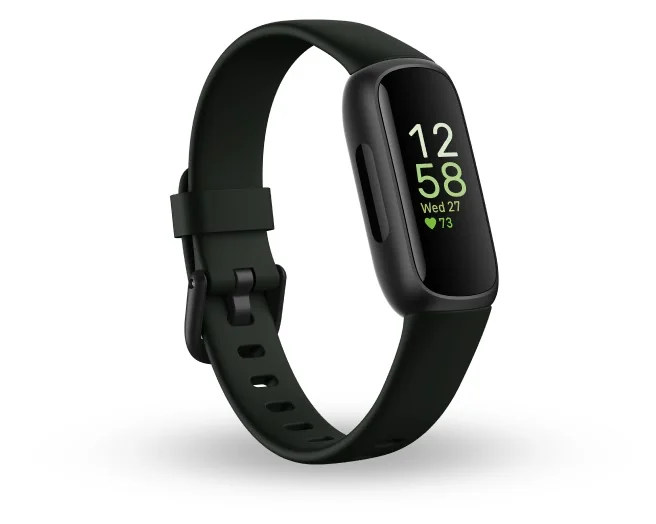
Fitbit Inspire 3 (Midnight Zen/Black)
By Fitbit · Fitness Trackers · Phones & Computers
- AMOLED color touch screen
- Up to 10-day battery life
- SpO2 sensor for overnight readings
- 164ft (50m) water resistance
- 1.55 x 0.73 x 0.46 inches
Lowest price seen
$99.95
from $99.95 at Abt · Checked Oct 10, 2026
- Abt $99.95View at Abt
- Heart Rate Monitors USA $99.95View at Heart Rate Monitors USA
- FitbitView at Fitbit
- Best BuyView at Best Buy
- WalmartView at Walmart
- eBay (used) eBay: used, open-box, refurbishedView at eBay (used)
- eBayView at eBay
- TargetView at Target
- Kohl'sView at Kohl's
- StaplesView at Staples
- NeweggView at Newegg
- AdoramaView at Adorama
- CDWView at CDW
- AmazonView at Amazon
Prices are snapshots. Check the current price with the store.
Summary
The Fitbit Inspire 3 is a small, light fitness band built for sleep, steps and passive heart-rate tracking, with up to 10 days of battery and no subscription needed for the basics. Check the gaps before you buy: there is no built-in GPS and no altimeter, and the optical heart rate is unreliable during hard workouts.
Strengths
- Small and light enough that owners say they forget they are wearing it.
- Battery life is the headline: the claim is up to 10 days and Consumer Reports measured 302 hours of typical use.
- Sleep stages, overnight SpO2, HRV, breathing rate and skin-temperature variation, with the basic stats free.
- The color AMOLED screen with an always-on option is a real upgrade over the monochrome Inspire 2.
- Water-resistant to 50 m; owners report swimming laps and even a scuba dive without failure.
- Widely placed as the best tracker under $100 of its generation.
Weaknesses
- No built-in GPS; route and pace tracking depend on carrying your phone.
- No altimeter, so floors climbed are not tracked.
- SpO2 is overnight only and cannot be measured on demand.
- Optical heart rate is weak in hard intervals and outdoor cycling.
- The battery is not replaceable and there are no user-serviceable parts.
- The companion app is buggy and syncing is unreliable for many owners.
Verified specifications
| Model | Fitbit Inspire 3, manufacturer model FB424 (FCC ID XRAFB424); the Midnight Zen retail SKU is FB424BKBK-US. |
|---|---|
| Display | color AMOLED touchscreen with an always-on option; Corning Gorilla Glass 3. |
| Interaction | two haptic buttons plus swipe and tap; no dedicated physical buttons. |
| Sensors | 3-axis accelerometer, optical heart-rate monitor, red and infrared SpO2 sensors, ambient light sensor and a device temperature sensor. |
| SpO2 | overnight only, with no on-demand measurement. |
| Water resistance | 50 m / 5 ATM; the regulatory text also describes it as IPX8 and IP6X. |
| Battery | rechargeable lithium-polymer, claimed up to 10 days; charge time about 2 hours. |
| Memory on the tracker | 7 days of detailed motion data and 30 days of daily totals. |
| Connectivity | Bluetooth 5.0; no Wi-Fi, no NFC and no cellular. GPS is connected, meaning it runs on your phone. |
| Compatibility | iOS 16.4+ and Android 11+ as currently listed; at launch PCMag cited Android 9 and iOS 14. |
| Weight | 17.69 g (0.039 lb); some listings round this to 0.62 to 0.7 oz. |
| Dimensions | 1.55 × 0.73 × 0.46 in (39.32 × 18.6 × 11.75 mm). |
| Operating temperature | 32° to 104°F; max operating altitude 28,000 ft. |
| Bands | interchangeable but proprietary; small 5.1 to 7.5 in and large 6.3 to 8.7 in wrist circumference, though PCMag lists 5.4 to 7.6 in and 7.6 to 8.7 in. |
| In the box | Inspire 3, small and large classic bands and a proprietary magnetic charging cable; no USB power adapter is included. |
| Warranty | one-year limited covering manufacturing defects; an optional extended warranty adds a second year. |
Full research notes and sources
Heart rate and workouts
The Inspire 3 tracks resting heart rate well, but the optical sensor struggles when you push hard. DC Rainmaker saw cadence lock at the start of an interval run and called an outdoor cycling trace “literally never right”; PCMag measured heart rate well below an Apple Watch Series 8 on two of three one-mile runs. Consumer Reports rates the tracker “less accurate than most other tested smart wearables” for fitness measurement while still calling heart-rate measurement “very good”. If precise training zones matter, look for a device with a chest strap or built-in GPS: the Inspire 3 accepts no external heart-rate sensor and cannot broadcast heart rate to gym equipment or third-party apps.
There is no built-in GPS to fall back on either. Walk, run and ride tracking leans on the accelerometer when your phone is not with you, which some owners find poor, and water on the screen makes swiping unreliable mid-swim.
Battery and charging
The claim is up to 10 days, and Consumer Reports measured 302 hours of typical use with an 81-minute full charge. Real-world results depend on settings: PCMag judged about 8 days realistic, and the always-on display cuts that to roughly 2 to 3 days. Charging uses a proprietary magnetic cable and takes about 2 hours; there is no USB power adapter in the box.
A June 2026 thread in the Google Health Community has several owners reporting battery life falling from one to two weeks down to 18 to 36 hours after a firmware update, or the band refusing to charge past about half, with support attributing part of it to normal aging. The battery is not replaceable, and r/fitbit threads discuss battery swelling as a wear-out failure. Nobody has published a failure rate, so treat both as caution signals rather than a defect you can count on.
Running costs, support and the app
Most day-to-day stats are free, but the useful trend views — 90-day graphs, the Daily Readiness breakdown and skin-temperature trends — sit behind Fitbit Premium at $9.99 a month or $79.99 a year. Six months are included with the tracker. The device needs a Google account rather than a standalone Fitbit account, and Fitbit commits to at least two years of security updates after the device is last sold.
One year of warranty is standard; an optional extended warranty adds a second year and accidental-damage cover for $19.99. Accessories are extra: a stainless-steel mesh band at $69.95, a translucent band at $34.95 and a clip at $19.95. Owners’ top recurring gripe is a buggy companion app and unreliable syncing, and PCMag also hit crashes during setup. Keep the band clean and dry, especially after swimming or sweating, to avoid skin irritation.
Is it worth it?
Value is almost entirely about price. At the $99.95 list price it is only fair, because there is no GPS and workout accuracy is average; discounted toward $75 to $80 it is an easy recommendation for a beginner, a small-wristed user, a swimmer or anyone who mainly wants passive sleep and step tracking. Consumer Reports listed street prices from $74.00 during 2026, and Best Buy showed the Midnight Zen SKU at $89.99. Above the list price there is no reason to choose it over a discounted tracker with built-in GPS.
Which model this is
This page covers the third-generation Inspire, manufacturer model FB424 (FCC ID XRAFB424), sold as Midnight Zen (FB424BKBK-US), Lilac Bliss (FB424BKLV-US) and Morning Glow (FB424BKYW-US). Don’t confuse it with the Inspire 2 (model FB418, monochrome screen) or the original Inspire and Inspire HR (FB412 and FB413). The Midnight Zen listing is ASIN B0B5F9SZW7.
Sources
Manufacturer:
- Fitbit Inspire 3 technical specifications (Google Store US)
- Fitbit Inspire 3 technical specs, security updates (Google Store GB)
- Fitbit Inspire 3 user manual
- Fitbit Inspire 3 product page
Independent reviews:
- Fitbit Inspire 3 review (PCMag)
- Fitbit Inspire 3 review (CNET)
- Fitbit Inspire 3 review (Tom’s Guide)
- Fitbit Inspire 3 in-depth review (DC Rainmaker)
- Fitbit Inspire 3 review (Consumer Reports)
- Fitbit Inspire 3 review (Live Science)
- Fitbit Inspire 3 review (TechRadar)
- Fitbit Inspire 3 review (Business Insider)
- Fitbit Inspire 3 hands-on (The Verge)
Owner reports: