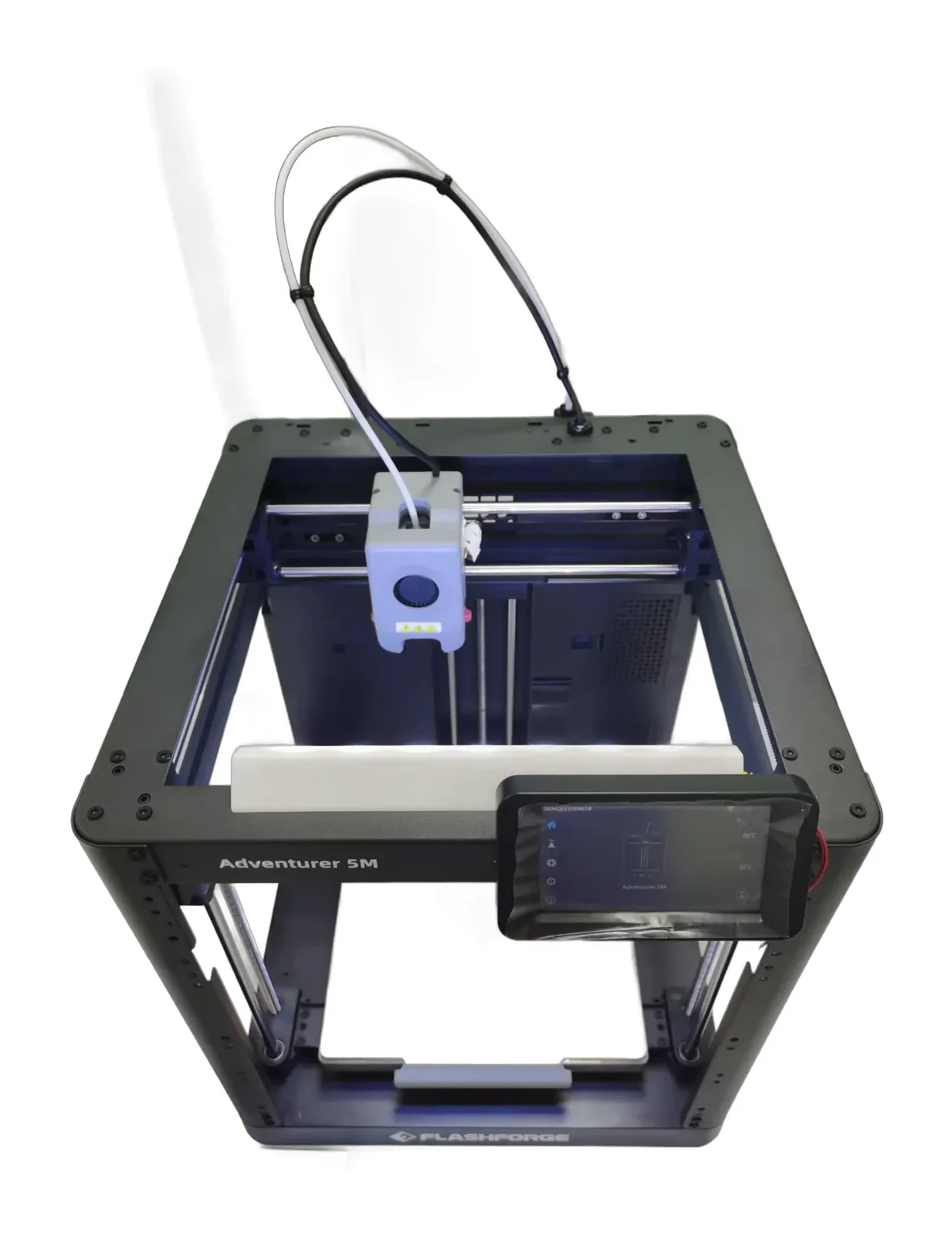
FlashForge AD5M
By FlashForge · Budget 3D Printers · 3D Printing
- Open-frame CoreXY-style FDM, one-click fully automatic calibration
- 220 x 220 x 220 mm build volume, up to 600 mm/s
- 7,700+ ratings -- one of the most-reviewed budget machines on Amazon
Lowest price seen
$230.00
from $230.00 at eBay · Checked Oct 12, 2026
- eBay $230.00View at eBay
- FlashForge (official D2C) $249.00View at FlashForge (official D2C)
- NeweggView at Newegg
- TargetView at Target
- 3D Printers DepotView at 3D Printers Depot
- B&H PhotoView at B&H Photo
- eBay (used) eBay: used, open-box, refurbishedView at eBay (used)
- AmazonView at Amazon
Prices are snapshots. Check the current price with the store.
Summary
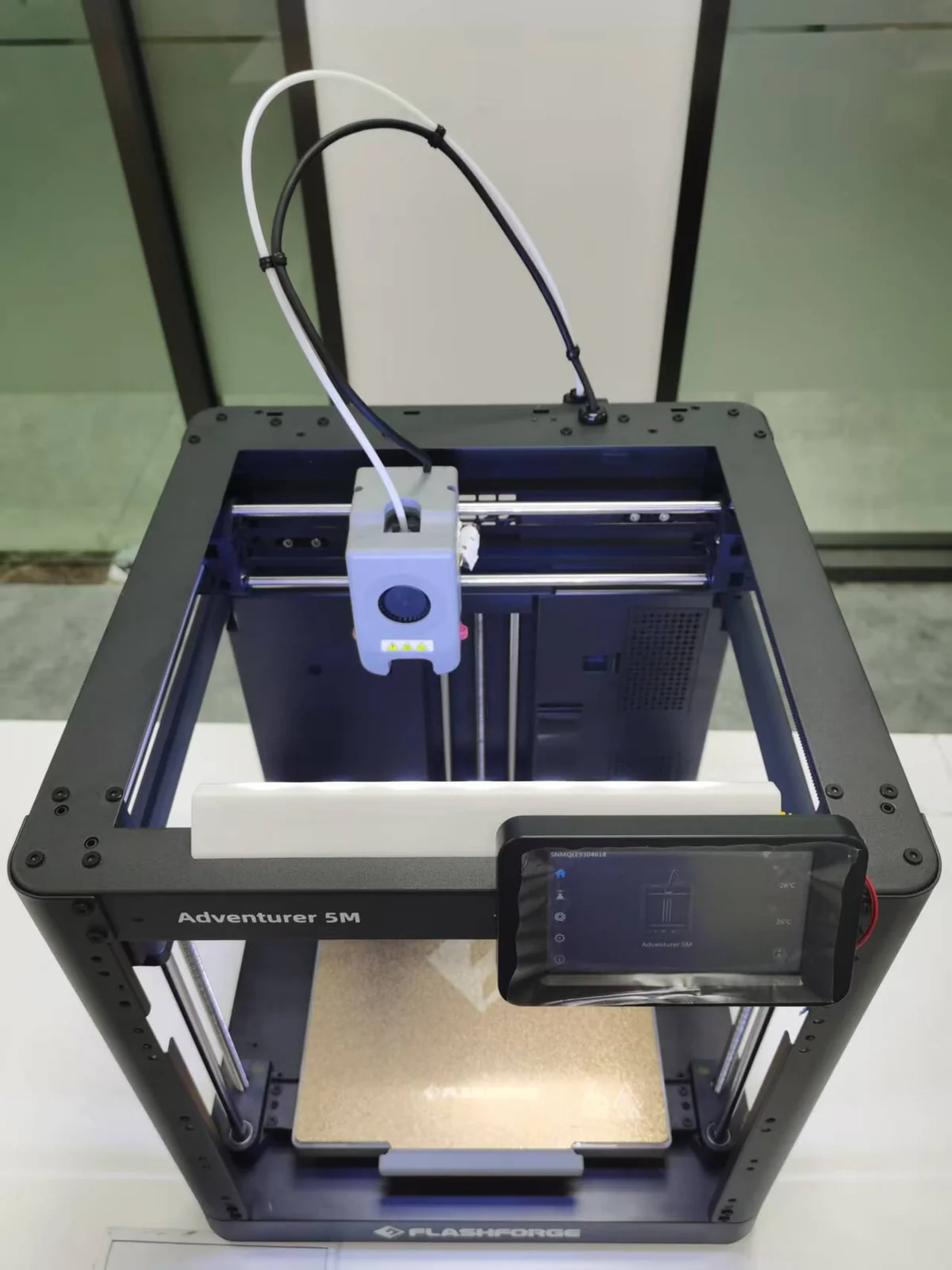
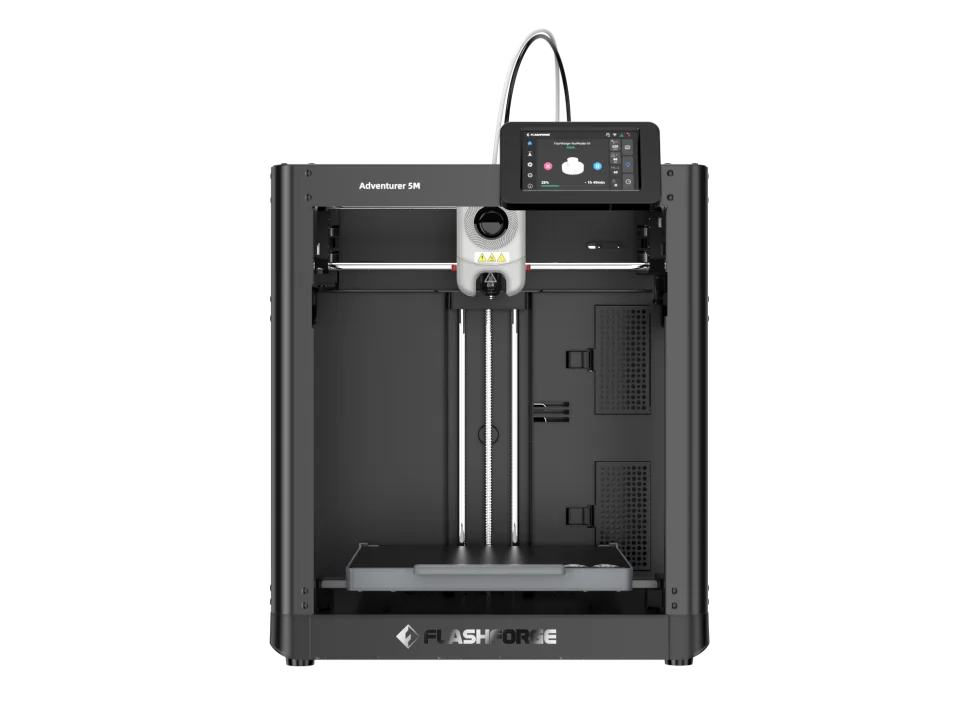
A fast, budget open-frame CoreXY printer best suited to single-color PLA and PETG printing, with automatic leveling, quick-swap nozzles and Ethernet alongside Wi-Fi. Check what you actually need before buying: the base machine has no enclosure, camera, lighting or multicolor, and FlashForge officially rules out ABS-series filament.
Strengths
- Genuine CoreXY hardware with direct drive, auto leveling, Ethernet and power-loss recovery at a budget price.
- The speed holds up in testing: a lab Benchy finished in 26.8 minutes and the nozzle reaches 200°C in about 46 seconds.
- Setup and first prints go smoothly; owners repeatedly call it an easy upgrade from Ender-class machines.
- Quick-swap nozzles and a removable PEI plate turn routine maintenance into minutes of work.
- Ethernet gives a dependable fallback where Wi-Fi is flaky, which owners specifically value.
- Repairable architecture: FlashForge sells enclosure, nozzle, PEI plate, extruder and touchscreen assemblies, and owners do replace boards and modules.
Weaknesses
- It is loud by measurement, not just opinion: 62.3 dB(A) while printing, with the hotend fan alone at 54.8 dB(A).
- The base machine ships without enclosure, camera, interior light or filtration, and prints one color at a time.
- No ABS officially: third-party claims that an enclosure unlocks ASA don’t override FlashForge’s own incompatibility guidance.
- Proprietary quick-swap nozzles add up over time, a recurring long-term cost complaint among owners.
- The extruder is warrantied for only 3 months, and the certified-refurbished unit carries just a 3-month warranty.
- Bridging and overhangs tested weaker than several rivals in TechGearLab’s comparison.
Verified specifications
| Motion system | open-frame all-metal CoreXY with a single direct-drive extruder. |
|---|---|
| Build volume | 220 × 220 × 220 mm nominal; TechGearLab measured 217 × 217 mm of usable bed. |
| Speed and acceleration | 600 mm/s maximum travel, 20,000 mm/s² maximum acceleration — a motion ceiling, not a sustained print speed. |
| Temperatures | 280°C maximum nozzle; 100°C maximum bed per FlashForge’s current spec, though some retailer sheets say 110°C. |
| Nozzles | quick-detach modules in 0.25, 0.4, 0.6 and 0.8 mm; flexible removable PEI steel build plate. |
| Display and connectivity | 4.3-inch display; Wi-Fi, Ethernet and USB. |
| Safeguards | filament runout reminder and power-loss recovery. |
| Materials | PLA and PETG with the 0.4 mm nozzle; TPU, PLA-CF and PETG-CF with the 0.6 mm nozzle; ABS-series filament is explicitly not compatible. |
| Slicers | FlashPrint 5, Orca-Flashforge and Orca Slicer. |
| Dimensions | 363 × 376 × 413 mm without display and spool holder; 363 × 402 × 448 mm with the display installed; around 10.8 kg (24 lb). |
| Power | 350 W PSU (AC 100–120 / 200–240 V); Igor’sLAB measured about 320 W peak while heating, 130 W printing PLA, 25.9 W standby with motors active and 11.3 W idle. |
| Heating | 46 seconds to a 200°C nozzle, about two and a half minutes to a 60°C bed. |
| Warranty | 12 months limited on the printer, 3 months on the extruder; consumables excluded, and after-sales service goes through the selling channel. |
| In the box | printer, power cord, quick-start docs, filament holder, small PLA sample, USB drive, tools and hex keys, grease, pliers, glue and a leveling tool; bundles vary by seller. |
Full research notes and sources
How fast it really is
Treat 600 mm/s as a motion ceiling, not the speed of an actual print — some retailer copy calls it a maximum print speed, which overstates it. What’s verified is still quick: TechGearLab’s Benchy finished in 26.8 minutes, and heating takes 46 seconds to a 200°C nozzle and about two and a half minutes to a 60°C bed. TechGearLab’s lab score landed at 68/100, with subscores of 6.7 for print quality, 7.2 for ease of use, 6.0 for print capabilities and 8.0 for support removal; bridging and overhangs were the weak spot, while the measured bed gradient was a tight 2.6°C.
Igor’sLAB’s February 2025 bench test found good dimensional and calibration prints, including a 0.15 mm clearance spinner and a clean Z-wobble result, and characterized the machine as reliable with strong bed adhesion. On the same machine it printed the supplied fast boat in about 14 minutes.
Noise
This printer is loud by measured numbers, not just owner grumbling: 62.3 dB(A) while printing and 41.1 dB(A) idle, per Igor’sLAB. The hotend fan alone produced 54.8 dB(A), and a manufacturer-supplied replacement fan stayed just as loud. Plan for it to live somewhere that isn’t your desk.
Reliability, repairs and upkeep
Owner experience is polarized. On the good side, multiple owners report 600–1,000 hours of reliable single-color printing, with some units logged past 1,000 and even 1,400 hours, and painless setup is the most repeated praise in owner threads. On the other side, recurring threads document auto-level and probe faults — sometimes with the toolhead crashing into the bed — firmware and boot problems, network freezes, and extrusion clogs that show up as a clicking or slipping feeder. One documented clog persisted after a feeder replacement, with community diagnosis pointing to a blocked nozzle, so a clicking feeder isn’t automatically a bad feeder. Electronics failures exist too: a month-old unit with about 200 hours on it ultimately needed a motherboard after screen and cable swaps didn’t help. Nobody has published a failure rate, so treat these as known failure modes rather than odds.
Support runs through whoever sold the printer, and reports range from fast replacement parts to weeks of back-and-forth. One owner reported FlashForge sending a complete heating-bed, sensor and nozzle set free after the warranty had expired; another waited about two weeks for tracking on a promised mainboard. Routine care is ordinary FDM work: keep the PEI plate clean, lubricate the rods and mechanisms per the manual, and when feeding starts clicking, inspect the nozzle and filament path before blaming the extruder. Keep firmware changes conservative on a machine that’s printing well — some owners blame updates for behavior regressions, though forum reports can’t prove causation.
Parts and running costs
FlashForge sells the exact-model spares directly. A quick-swap nozzle module runs about $35, a PEI build plate about $19, an extruder assembly from about $95, an enclosure kit and a camera kit $39.99 each, and an LED strip $15.30; none has a published replacement interval, so you buy them when a part clogs, wears or fails. Filament is the real recurring cost: one 1 kg roll a month of FlashForge’s $25.99 PLA comes to about $312 a year before shipping, and abrasive carbon-filled filament wears the $35 nozzles faster than plain PLA or PETG.
Electricity is minor. Igor’sLAB measured about 130 W while printing PLA and 11.3 W idle; at 10 print-hours a week and off otherwise, that is roughly $12 a year at the July 2026 US residential average, and leaving the machine idling around the clock costs more than optimizing individual prints. There is no filter or subscription to buy, because the base machine has no filtration.
Is it worth it?
Buy it on sale. FlashForge listed the new printer at $249, MatterHackers and Newegg’s FlashForge storefront matched it, and Fabreeko listed $239 when checked in September 2026; the certified-refurbished unit is $199 with only a 3-month warranty. At those prices this is a lot of CoreXY hardware for the money, as long as single-color PLA and PETG describe your actual printing. Above $300 it stops making sense, because Creality’s enclosed K1 is $299, Bambu Lab’s larger A1 is $349 and FlashForge’s own multicolor AD5X is about $349. Check the store panel above for current prices.
Which model this is
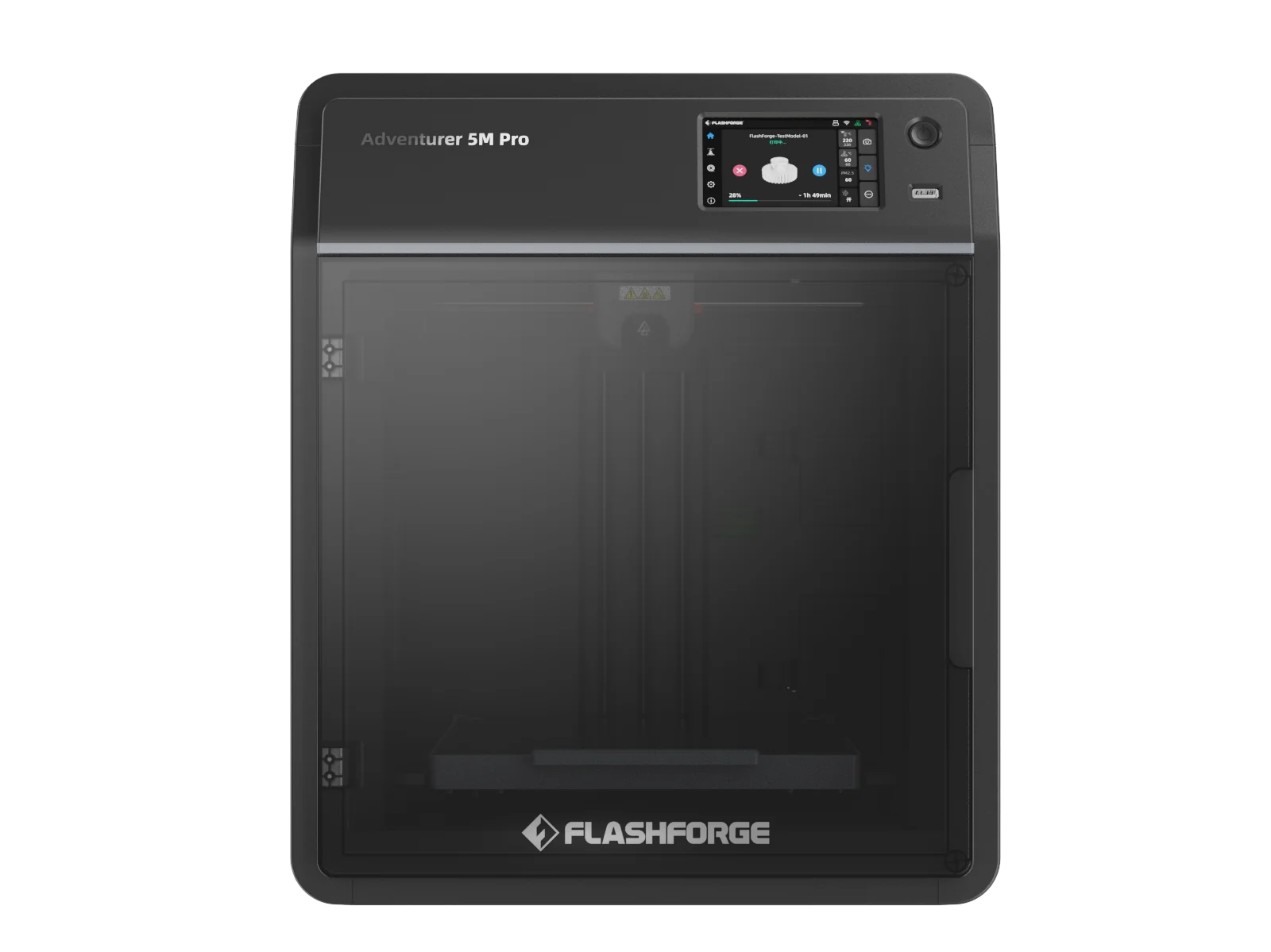
FlashForge sells this open-frame base model as the Adventurer 5M, internally the AD5M; the Amazon listing for the base machine is ASIN B0DLZHVWBG. It is not the enclosed Adventurer 5M Pro, which adds filtration and a camera, nor the multicolor AD5X. On marketplaces, an official FlashForge storefront coexists with third-party duplicate listings, so match on the base AD5M and buy from the storefront.
Sources
Manufacturer:
- FlashForge Adventurer 5M product and spec page
- FlashForge Adventurer 5M product record
- FlashForge warranty and return policy
- FlashForge certified-refurbished AD5M
- FlashForge Adventurer Series accessories
- FlashForge AD5M Series nozzle assembly
- FlashForge AD5M/AD5X PEI build plate
- FlashForge filament catalog and PLA pricing
Independent reviews:
- TechGearLab hands-on test
- TechGearLab 3D-printer lab comparison
- Igor’sLAB review and test
- Igor’sLAB test prints
- Igor’sLAB measurements and conclusion
Retailer listings:
Owner reports:
- Long-term ownership, mixed experience (r/FlashForge)
- Leveling failure and support trouble (r/FlashForge)
- Homing, leveling and motion failure (r/FlashForge)
- One-month-old unit needed a motherboard (r/FlashForge)
- Feed clicking and clog troubleshooting (r/FlashForge)
- New-unit toolhead crash into the bed (r/FlashForge)
- Two-year ownership: nozzle and firmware complaints (r/FlashForge)
- Positive support experience (r/FlashForge)
- Long-run hours and maintenance (r/FlashForge)
- Bed-leveling drift discussion (r/FlashForge)
- Homing and probe failures (r/FlashForge)
- Official-firmware bootloop and recovery (r/FlashForge)
- Mainboard replacement support delay (r/FlashForge)
- Clogging discussion (r/FlashForge)
- Support sent parts after warranty (r/FlashForge)