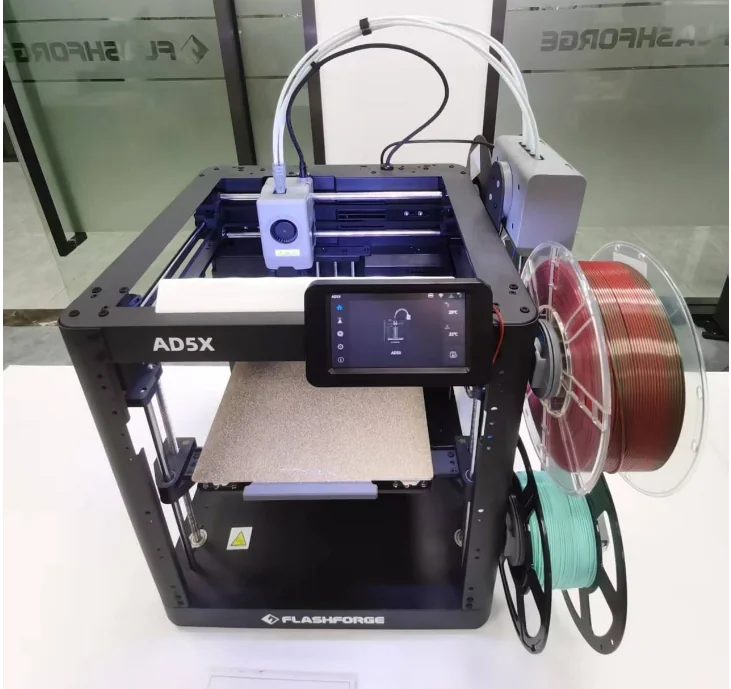
FlashForge AD5X with IFS (4-Color)
By FlashForge · Budget 3D Printers · 3D Printing
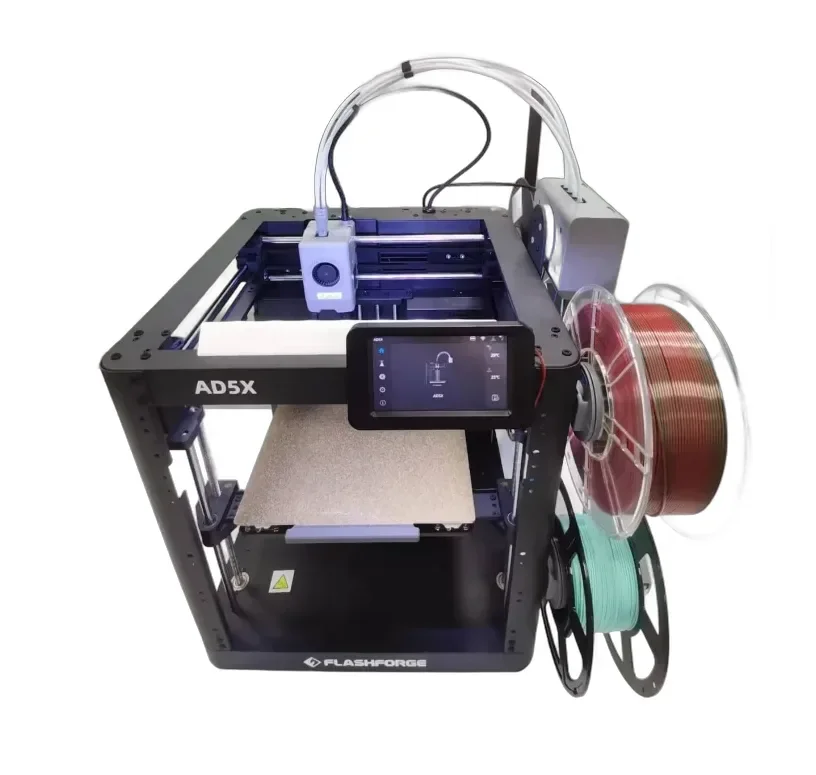
- Open-frame FDM with integrated IFS four-color system included
- Up to 600 mm/s, automatic leveling
- Ships with four 10 g filament samples to try multi-color immediately
Lowest price seen
$349.00
from $349.00 at FlashForge (D2C) · Checked Sep 28, 2026
- FlashForge (D2C) $349.00View at FlashForge (D2C)
- NeweggView at Newegg
- eBayView at eBay
- B&H PhotoView at B&H Photo
- eBay (used) eBay: used, open-box, refurbishedView at eBay (used)
- AmazonView at Amazon
Prices are snapshots. Check the current price with the store.
Summary
The FlashForge AD5X is an open-frame CoreXY FDM printer whose four-color IFS is built in as standard rather than sold as a separate multi-material add-on. Check the software before you buy: reviewers found the bundled slicer buggy, and color changes waste a lot of filament.
Strengths
- Four-color printing is standard, so there is no separate multi-material box to buy.
- Reviewers describe print quality as excellent with minimal visible layer lines.
- Setup is close to plug-and-play: the machine ships essentially assembled and leveling is automatic.
- The quick-release nozzle swaps without replacing the whole head and has a steel insert rated to 300 °C.
- The IFS mechanism works well in practice, with color swaps executing cleanly.
Weaknesses
- The bundled OrcaSlicer-based software crashed frequently at review time and would not sync filament data or report purge waste.
- Color changes waste a lot of filament, and no manufacturer figure quantifies it.
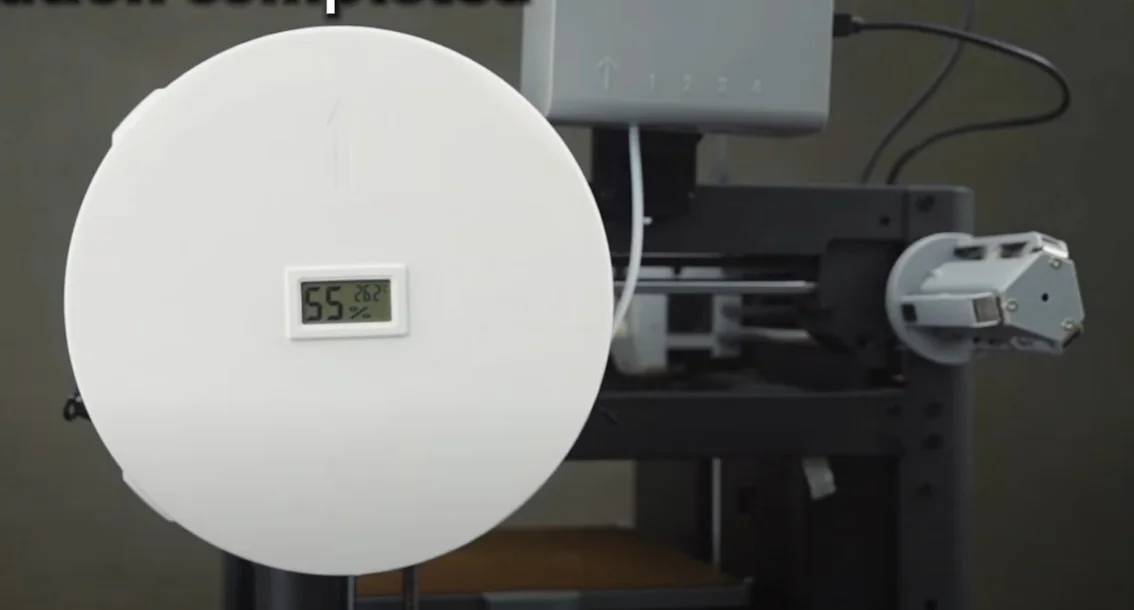
- The base machine has no enclosure, camera, chamber lighting or filament storage.
- The enclosure is a DIY kit that needs user-printed parts and is required for ABS and ASA.
- There is no sleep mode, and the rear power switch is awkward to reach between jobs.
- The touchscreen needs pressure rather than a light touch, and the interface is icon-driven.
Verified specifications
| Type | desktop open-frame FDM printer with CoreXY motion and an all-metal structure. |
|---|---|
| Build volume | 220 × 220 × 220 mm (8.66 × 8.66 × 8.66 in). |
| Multi-color | four colors, integrated as standard with four external spool holders. |
| Extruder | single direct drive with a quick-release nozzle and steel insert rated to 300 °C. |
| Nozzle diameter | 0.4 mm standard; 0.25 / 0.6 / 0.8 mm optional. |
| Bed | heated PEI flexible steel sheet, magnetic and removable, to 110 °C. |
| Layer thickness | 0.1–0.4 mm on retail pages, 0.05–0.4 mm on the product sheet. |
| Max travel speed | 600 mm/s. |
| Max print speed | 300 mm/s. |
| Max acceleration | 20,000 mm/s². |
| Leveling | full-auto one-click with auto Z-offset. |
| Filament runout detection and power-loss recovery: yes. | |
| Screen | 4.3-inch color touchscreen. |
| Connectivity | USB, Ethernet, Wi-Fi and an app that monitors only. |
| Dimensions | 363 × 402 × 448 mm (14.29 × 15.82 × 17.63 in); 11.4 kg. |
| In the box | four-color IFS module, mounting plate, connection cable, four spool holders, Bowden tubes, power cord, toolkit, quick-start guide and a four-pack of sample filament. |
Full research notes and sources
Speed: travel versus print
The number sellers quote is 600 mm/s, but that is travel speed. FlashForge’s own product sheet lists travel speed max at 600 mm/s and print speed max at 300 mm/s as separate lines, and the manufacturer’s Hong Kong page describes printing speed up to 300 mm/s. Retail copy repeats only the larger figure.
No instrumented third-party benchmark of print speed, dimensional accuracy or temperature stability was found for this machine. AppleInsider states outright that it had no real-world testing to prove the speed claim. FlashForge’s own print-time comparisons name no competitor model, settings or methodology, so they are manufacturer claims rather than test results.
Software and the slicer
Tom’s Hardware reviewed a bundled OrcaSlicer-based build that crashed frequently, did not carry filament type and color from the device tab to the prepare tab, and never reported how much filament color swaps consumed. The reviewer treated this as a fixable software problem, compared it to a similar Anycubic Kobra 3 issue that was later fixed, and left the machine off its recommended list because of it. That review is dated October 2025, and no page read in this check documents the current software state, so verify slicer behavior before buying rather than assuming either way.
The same review notes the touchscreen requires pressure rather than touch, and AppleInsider separately found the interface awkward to navigate through small, unlabeled function icons. The app monitors the printer but cannot slice.
Filament waste and what the base machine lacks
With one nozzle, unused material is purged on every color change and exits through a hole in the rear of the printer. AppleInsider had to print a catch bin for it and noted that the wider community routinely 3D-prints parts the machine does not ship with. One r/FlashForge owner reports the purge output as excessive and says a single 10 × 10 mm tower consumed almost a whole 0.25 kg roll. FlashForge publishes no grams-per-swap figure, and the slicer does not report it either. Anyone printing large multi-color objects should treat filament as the dominant running cost.
The base machine has no enclosure, no camera, no chamber lighting and no filament storage. Spools mount externally and must be removed and sealed when idle because there is no dry box. FlashForge sells the enclosure as a DIY kit with clear panels and hardware while the buyer supplies printed parts; it is what enables ABS and ASA, which reviewers list as enclosure-dependent and FlashForge’s own retail filament table omits. One measured figure exists for this model: about 75 dB at the loudest moments, with the fan steady at 60 dB.
Warranty, support and repairs
FlashForge publishes a 12-month limited warranty on its 3D printers and 3 months on extruder parts, with the period starting from the outbound date or the invoice date. A separate after-sales policy says the period starts from the manufacture date, excludes coverage once total running time exceeds 400 hours for consumer FFF equipment, and lists excluded items including the build platform, filament and the toolkit. A separate US storefront states a 12-month standard and a 16-month professional warranty but adds a 20% restocking fee, pre-paid return shipping and a condition that the printer be unoperated with no marks or signs of use. Which entity fulfills a given US order determines which terms apply.
The machine is documented as serviceable at the module level. FlashForge’s wiki publishes procedures covering the touchscreen cable, touchscreen, mainboard, extruder connection cable, extruder board, cooling fan and nozzle, and owner threads describe pulling the 4-in-1 feeder off the hotend and opening the extruder body to clear jams. After any nozzle change, a temperature calibration and bed leveling are required. Owner discussion concentrates on the IFS and extruder rather than on print quality.
Which model this is
This page covers the standard FlashForge AD5X, which includes the four-color IFS as part of the machine rather than as a separate add-on. Do not confuse it with the Adventurer 5M or AD5M, which share the steel frame but have no IFS. The listing this page covers is ASIN B0F8PZ1WCT; the AD5X has also been listed under other ASINs, so bundles and prices can differ between listings. FlashForge produces 110 V and 220 V versions for different regional power standards.
Sources
Manufacturer:
- FlashForge AD5X product page (US store)
- FlashForge AD5X product page (AU store)
- FlashForge AD5X product page (EU store)
- FlashForge AD5X specifications (HK site)
- FlashForge AD5X product information sheet (PDF)
- AD5X FlashForge Wiki
- AD5X hardware troubleshooting (FlashForge Wiki)
- AD5X print quality troubleshooting (FlashForge Wiki)
- AD5X Q&A — troubleshooting and tips (FlashForge)
- Warranty policy (FlashForge)
- After-sales policy (FlashForge)
- Shipping and returns (FlashForge USA)
Independent reviews:
Owner reports: