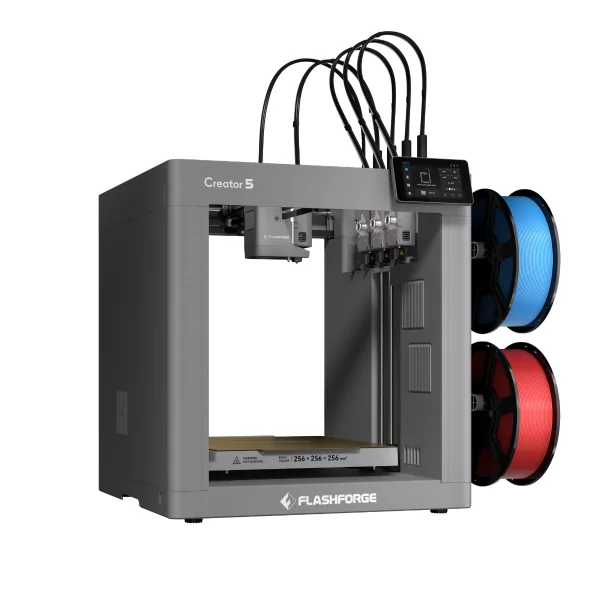
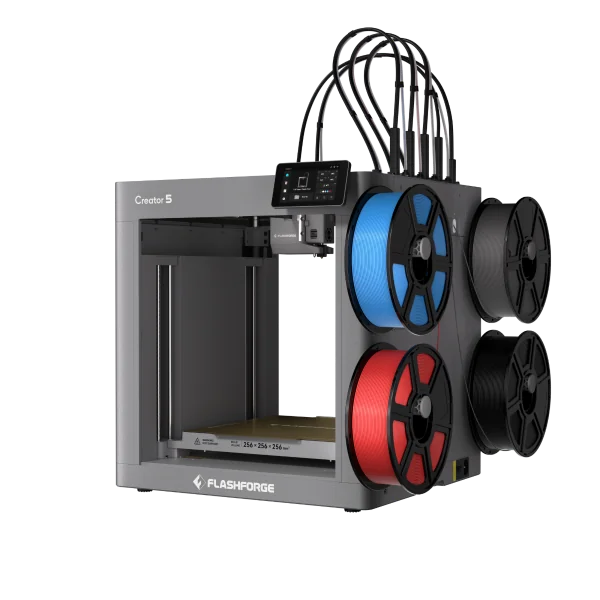
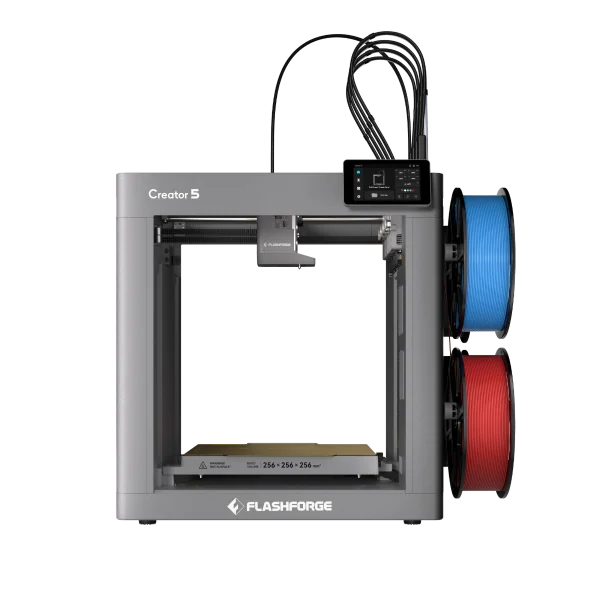
FlashForge Creator 5 (4-toolhead)
By FlashForge · 3D Printers · 3D Printing
- 4 independent toolheads via FlashSwap system
- 256 x 256 x 256 mm build volume
- Open-frame CoreXY, up to 600 mm/s travel speed
- No active chamber heating or HEPA/carbon filtration -- see the Pro variant below for those
Lowest price seen
$699.00
from $699.00 at FlashForge (official store) · Checked Sep 28, 2026
- FlashForge (official store) $699.00View at FlashForge (official store)
- eBay $699.00View at eBay
- MatterHackers $699.00View at MatterHackers
- NeweggView at Newegg
- 3D Printers DepotView at 3D Printers Depot
- eBay (used) eBay: used, open-box, refurbishedView at eBay (used)
- AmazonView at Amazon
Prices are snapshots. Check the current price with the store.
Summary
A 2026 CoreXY 3D printer with four independent full-bed toolheads — the point of it is multicolor, multi-material and soluble-support printing without flushing one shared nozzle. Know two things before you buy: the software platform is young, with owner reports of freezes and docking calibration errors, and the open frame rules out ABS and nylon work.
Strengths
- Four true toolheads, each covering the whole 256 mm bed; Tom’s Hardware found the magnetic pickup mechanism reliable in testing.
- Tool changes skip the color-flush that makes one-nozzle multicolor printing slow and wasteful.
- Heads can be dedicated to colors, soluble supports or different nozzle sizes; PVA and BVOH are officially supported.
- Automatic leveling, tool-offset and pressure-advance calibration handle the setup burden of a complex mechanism.
- Hardened 320 C hotends and official CF-blend support widen the material list despite the open frame.
- An official spare-parts catalog already exists, so a worn hotend is a part swap, not a write-off.
Weaknesses
- Open frame: ABS, ASA and nylon belong on the enclosed Pro, not this machine.
- Four heads mean four hotends, four filament paths and four docks — every one a calibration and service point.
- Tom’s Hardware found the slicer profiles needed work and saw heavy filament purge during loading.
- Side-mounted spools and overhead tubes stretch the operating footprint far past the 436 × 432 mm body.
- Hotend replacement takes tools and patience; the heater and thermistor come as one replace-as-a-unit part.
- It launched in 2026, so long-term reliability history simply does not exist yet.
Verified specifications
| Toolheads | four independent FlashSwap heads, each reaching the full build area. |
|---|---|
| Build volume | 256 × 256 × 256 mm, CoreXY motion system. |
| Nozzles | hardened-steel 0.4 mm standard, with 0.25/0.6/0.8 mm options. |
| Temperature | 320 C hotends, 120 C bed. |
| Speed | 300 mm/s max print speed, 600 mm/s max travel, 30,000 mm/s² max acceleration, 32 mm³/s stated max flow. |
| Calibration | automatic bed leveling, toolhead-offset calibration and pressure-advance calibration; filament runout and tangle detection; power-loss recovery. |
| Display and camera | 4-inch 800 × 480 touchscreen; 1280 × 720 camera at 30 fps. |
| Connectivity | USB plus dual-band Wi-Fi (2.4 and 5 GHz); works with Orca-Flashforge, Flash Studio and OrcaSlicer. |
| Power | 700 W rated input. |
| Materials without an enclosure | PLA, PETG, TPU-90A/95A/64D, PLA-CF, PETG-CF, Silk, PVA and BVOH; FlashForge steers ABS, ASA and nylon toward the enclosed Creator 5 Pro. |
| Body | 436 × 432 × 480 mm; 14 kg net, 18 kg gross; operating envelope with tubes and holders 520 × 443 × 710 mm. |
| Clearance | at least 10 mm left and rear, 200 mm right, 500 mm front. |
| Build plate | textured PEI flexible steel. |
| Noise | FlashForge says the series stays below 55 dB in Silent mode; no standardized independent measurement exists. |
| Toolhead-offset calibration takes roughly 15–20 minutes and is required at setup, after hotend replacement or after a nozzle collision. | |
Full research notes and sources
Living with four toolheads
The value here is architectural. A one-nozzle multicolor printer unloads, flushes and reloads a single melt zone at every color change; the Creator 5 parks one head and picks up the next. Tom’s Hardware called it a good entry-level toolchanger — the least expensive it had tested — and the pickup system held up through the review period. 3DWithUs spent about two months with the machine, printed multicolor and flexible material cleanly, and noted the lighter hotend-only heads as an advantage over toolchangers that carry an extruder motor on every dock. Owners echo the speed: one exact Creator 5 owner says a multicolor job printed far faster than on an AD5X and names the tool-changing workflow as the reason to buy, though the same thread reports a top-heavy chassis that visibly moves during printing and a plan to brace or enclose the base machine. The cost is upkeep: four hotends to keep clear, four docks to keep aligned, and an offset calibration to rerun after any hotend swap or crash.
Firmware, freezes and docking errors
This is the part to weigh. Owner threads from July and August describe the touchscreen and UI freezing; one report tied the freezes to Flash Studio 1.7.12, and users said rolling back to 1.7.11 fixed it. Separate threads describe E0142/E0143 errors after toolhead pickup or release, plus misaligned docking — one owner traced repeated pickup errors to per-toolhead position calibration and fixed them for good, while another with a stuck dock sensor was sent a replacement extruder-dock assembly that solved it. There are also isolated early hardware failures: one owner had three of four toolheads throw clog errors on first use, another saw an MCU communication fault that ended with the active nozzle driving into the PEI plate and smoke from the toolhead, and a Pro unit lost MCU communication. FlashForge’s own error-code pages show these pickup faults can come from nozzle boards, wiring harnesses, dock boards, magnets or sensors, and the official fix often ends in part replacement. These are caution signals, not a measured failure rate, and several have known calibration or software fixes. Treat the firmware as fast-moving — the download page already lists 1.9.9 releases — and plan to update early and often.
Parts and running costs
FlashForge sells exact-model spares directly: a nozzle assembly is $39.90, an extruder assembly $79, a PEI build plate $29.90, an extruder cooling fan $49.90, an extruder bus cable $16.90 and a silicone sock $9.90. None has a published replacement interval, so budget by wear rather than a yearly schedule.
There is no subscription or cloud fee. Electricity is modest next to filament: the machine is rated at 700 W, and 10 print-hours a week at that nameplate would be about 364 kWh a year, roughly $66.65 at the July 2026 US residential average, though real draw is lower because the heaters cycle. Filament is the only routine consumable, and it varies too much with print volume, material and purge settings for one honest annual figure. The toolchanger cuts color-change waste, but Tom’s Hardware showed that default settings can still waste more than expected: it measured a default prime block that weighed 44 g for a 33 g model. Those slicer values can be tuned down.
Warranty and repairs
FlashForge’s policy covers printers for 12 months, but the FFF extruder only gets 3 months, and build plates, filament and tools fall under consumable exclusions. The seller of record handles after-sales service, which matters when you buy through a marketplace reseller rather than direct. No independent lab has measured normal or high-speed noise or real energy draw, so the 55 dB Silent-mode figure stays a manufacturer claim.
Is it worth it?
If you print multicolor often, need soluble supports or juggle materials, this is unusually capable hardware for the money — four real hotends instead of purge tricks. FlashForge listed the standard Creator 5 at $799 with an automatic $100 cart discount, an effective $699, when checked in September 2026, and 3D Universe, 3D Printers Depot, Best Buy and B&H converged on the same $699 street price. As a mostly single-color printer it is the wrong purchase: cheaper, mature CoreXY machines do that job with far less to calibrate and fewer things that can freeze; FlashForge’s own four-color AD5X is $349. Price the enclosed Pro before you decide — it lists at $949 with the same $100 cart discount, an effective $849, only about $150 more — and FlashForge says the standard model cannot be converted into a Pro later. The Snapmaker U1 is another four-tool option at $849. Check the store panel above for current prices.
Which model this is
This page covers the standard open-frame FlashForge Creator 5 with four FlashSwap toolheads. The Amazon listing is ASIN B0GST9NRL4. Don’t confuse it with the Creator 5 Pro, a materially different enclosed machine with active chamber heating and filtration. Some launch coverage also lists a LAN port that the current official spec omits; count on USB and Wi-Fi.
Sources
Manufacturer:
- FlashForge Creator 5 product page and FAQ
- Creator 5 firmware and manual hub
- FlashForge warranty and return policy
- Creator 5 series accessories collection
- Creator 5 nozzle assembly
- Creator 5 extruder assembly
- Creator 5 PEI build plate
- FlashForge Creator 5 Pro product page
Independent reviews:
- Tom’s Hardware hands-on review
- 3DWithUs hands-on review
- All3DP launch coverage
- 3DPrinting.com launch and pricing coverage
Retailer listings:
Owner reports:
- Multicolor speed and chassis movement (r/FlashForge)
- Screen freezing and the 1.7.12 rollback (r/FlashForge)
- Early freezing and LAN complaints (r/FlashForge)
- Six-day hardware failure report (r/FlashForge)
- E0143 pickup error solved by per-head calibration (r/FlashForge)
- Filament stuck in the extruder dock (r/FlashForge)
- MCU error and build-plate crash (r/FlashForge)
- Multiple issues on first use (r/FlashForge)
- Dock-board fault fixed by replacement (r/FlashForge)