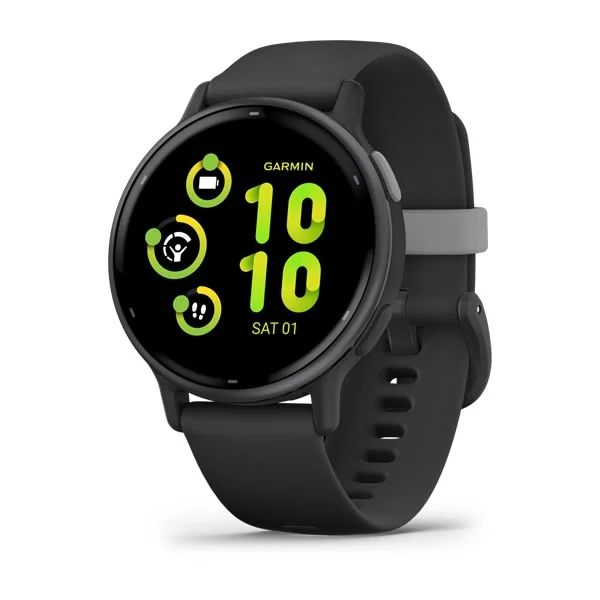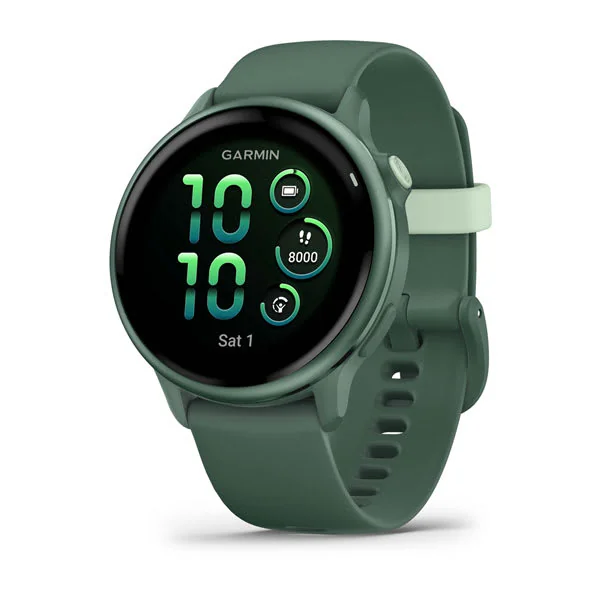
Garmin vivoactive 6 (Jasper Green, 42mm)
By Garmin · Fitness Trackers · Phones & Computers
- AMOLED touch display
- Built-in GPS
- round-the-clock heart rate monitoring
- Body Battery energy monitoring and Sleep Coach
- Up to 11 days battery life
Lowest price seen
~$299.99 (approx.)
from $299.99 at Amazon
- Amazon ~$299.99 (approx.)View at Amazon
- GarminView at Garmin
- WalmartView at Walmart
- eBay (used) eBay: used, open-box, refurbishedView at eBay (used)
- eBayView at eBay
Prices are snapshots. Check the current price with the store.
Summary
Garmin’s 42 mm fitness smartwatch with an AMOLED display, single-band GPS and up to 11 days of battery life, built for runners and gym-goers who want the full Garmin training ecosystem on a small wrist. Check the omissions before you buy: no barometric altimeter, no dual-band GPS, no maps, no ECG and no speaker.
Strengths
- Battery life for the size: up to 11 days in smartwatch mode, with one owner reporting 8–10 days of regular use.
- At 36.9 g and 13 mm thick, it is among the lightest GPS watches GearLab has tested and sits flat on the wrist.
- Body Battery, sleep score and HRV status are presented in a digestible, actionable way that even a former Fenix owner praises.
- Garmin’s ecosystem — Connect, Coach, ConnectIQ faces and apps — is unmatched at this size and price.
- Outdoor Gear Lab scored it 78/100 and gave it two budget-category awards.
Weaknesses
- No barometric altimeter, so elevation, ascent and descent are not properly measured.
- Single-band GPS only, with minor drift under heavy tree cover — GearLab calls it less ideal for dedicated trail runners.
- No onboard maps: breadcrumb navigation with GPX import only, so your phone stays the navigator.
- No speaker or microphone, so on-wrist calls and dictation are out; call notifications only.
- Battery life trails rivals at this price: 20 hours GPS-only in GearLab’s test, which scored Battery Life 4.6/10.
- Some advanced features sit behind a subscription paywall, which reviewers call an unwelcome addition.
Verified specifications
| Display | 1.2 in (30.4 mm) AMOLED touchscreen, 390 × 390 pixels, Corning Gorilla Glass 3, optional always-on mode. |
|---|---|
| Water rating | 5 ATM for swimming; GearLab lists a 50 m max depth. |
| Battery life (Garmin's figures) | up to 11 days smartwatch, 5 days with always-on, 21 days Battery Saver, 21 hours GPS-only, 17 hours all-systems GNSS, 8 hours all-systems with music. |
| Memory | 8 GB for music storage. |
| Sensors | Elevate 4 wrist heart rate, accelerometer, gyroscope, compass, thermometer, Pulse Ox and ambient light; no barometric altimeter. |
| Connectivity | Bluetooth, Wi-Fi, NFC and Garmin Pay. |
| Body | fiber-reinforced polymer case, anodized aluminum bezel, 20 mm band, two buttons plus touchscreen. |
| Dimensions | 42.0 mm diameter × 13.0 mm thickness; 36.9 g (1.3 oz) on GearLab’s scale. |
| Sport profiles | more than 80 preloaded. |
| Charging | Garmin proprietary plug charger; the lithium-ion battery is not user-replaceable. |
| Warranty | 1 year, per GearLab’s comparison table. |
Full research notes and sources
Battery life and charging
Garmin’s own numbers are honest about the trade: up to 11 days in smartwatch mode, 5 days with the always-on display, 21 days in Battery Saver, 21 hours GPS-only, 17 hours on all-systems GNSS and 8 hours with music. Outdoor Gear Lab measured 20 hours in GPS-only mode, about five days with always-on and roughly 11 days on raise-to-wake, and Consumer Reports’ lab saw 300 hours of typical daily use. Charging from empty took 118 minutes at GearLab and 134 at Consumer Reports. One owner in r/Garmin, a former Fenix user, reports 8–10 days without always-on display with regular workouts and blood-oxygen sleep tracking.
Garmin’s manual documents the levers: battery saver, shorter screen timeout, no always-on, lower brightness, UltraTrac mode, Bluetooth off when idle, Resume Later for long pauses, fewer phone notifications and manual pulse-ox readings.
What it leaves out
The price is reached by removing hardware: no barometric altimeter, so elevation, ascent and descent are not properly measured; single-band GNSS only; no onboard maps, just breadcrumb navigation with GPX import and off-course alerts; no ECG sensor; and no speaker or microphone, so calls are notifications only, never answered. Business Insider notes there is no third-party app ecosystem like Apple’s App Store or Wear OS. Pulse Ox is not available in all countries, per Garmin. Some advanced features also sit behind a subscription paywall, which GearLab calls a relatively new and unwelcome addition to the Garmin ecosystem — core function stays free.
Accuracy and everyday use
Outdoor Gear Lab, which bought its unit, put the single-band GPS within ±0.04 miles on a 2-mile course, with clean track shape on open roads and minor drift under heavy tree cover. Its heart-rate test against a Polar Verity Sense armband showed the usual warm-up lag, then a median difference of 1.0 BPM after about 15 minutes; GearLab calls the Elevate 4 sensor a generation behind the Elevate 5 but negligible for most training. Consumer Reports’ lab rated fitness measurements very good and accurate for BPM, Pulse Oximeter and heart rate, and the watch passed both its scratch and dunk tests.
The redesigned interface departs from the vivoactive 5, and two buttons plus touchscreen is fewer controls than Garmin’s five-button layout — less convenient with gloves, and the lower button stays stiff. The Independent’s reviewer, wearing it for two months, found iPhone interactions less smooth than Apple Watch. Another owner in the same r/Garmin thread says the software “often felt unfinished” and the battery life was not as impressive as expected.
Is it worth it?
Garmin’s launch MSRP in April 2025 was $299.99. Outdoor Gear Lab lists $300, Consumer Reports’ shop module showed $230.00 in 2026, and The Telegraph listed £279 at its October 2025 review. At $230 the value case is strong: a 42 mm Garmin body, GPS accurate to ±0.04 miles on open roads, 8 GB of music storage, Garmin Pay, Pulse Ox and more than 80 sport profiles. Between roughly $231 and $280 it stays defensible if you want Garmin’s software on a small wrist and can live without an altimeter. Above $300 the calculus changes — GearLab points to the Forerunner 165 as a cheaper option and the Forerunner 970 as a step up that fixes the gaps, while the Coros Pace 4 trades daily smartwatch features for dramatically better battery life. Nobody has published a failure rate or battery-degradation data for this model, so treat long-term reliability as untested rather than proven.
Which model this is
This page covers the Garmin vivoactive 6, the 42 mm case in the Jasper Green colorway — 42 mm is the only size Garmin sells for this model. Announced in April 2025 as the replacement for the vivoactive 5, it is not a vivoactive 5, Forerunner, Venu or Fenix unit.
The Amazon listing for this variant is ASIN B0F38G9DLV.
Sources
Manufacturer:
- Garmin vívoactive 6 user manual — battery information and specifications
- Garmin vívoactive 6 product page
- Garmin press release: meet vívoactive 6
- Garmin manual: tips for maximizing battery life
Independent reviews:
- Outdoor Gear Lab review
- Consumer Reports review
- Business Insider review
- The Independent review
- The Telegraph review
Owner reports: