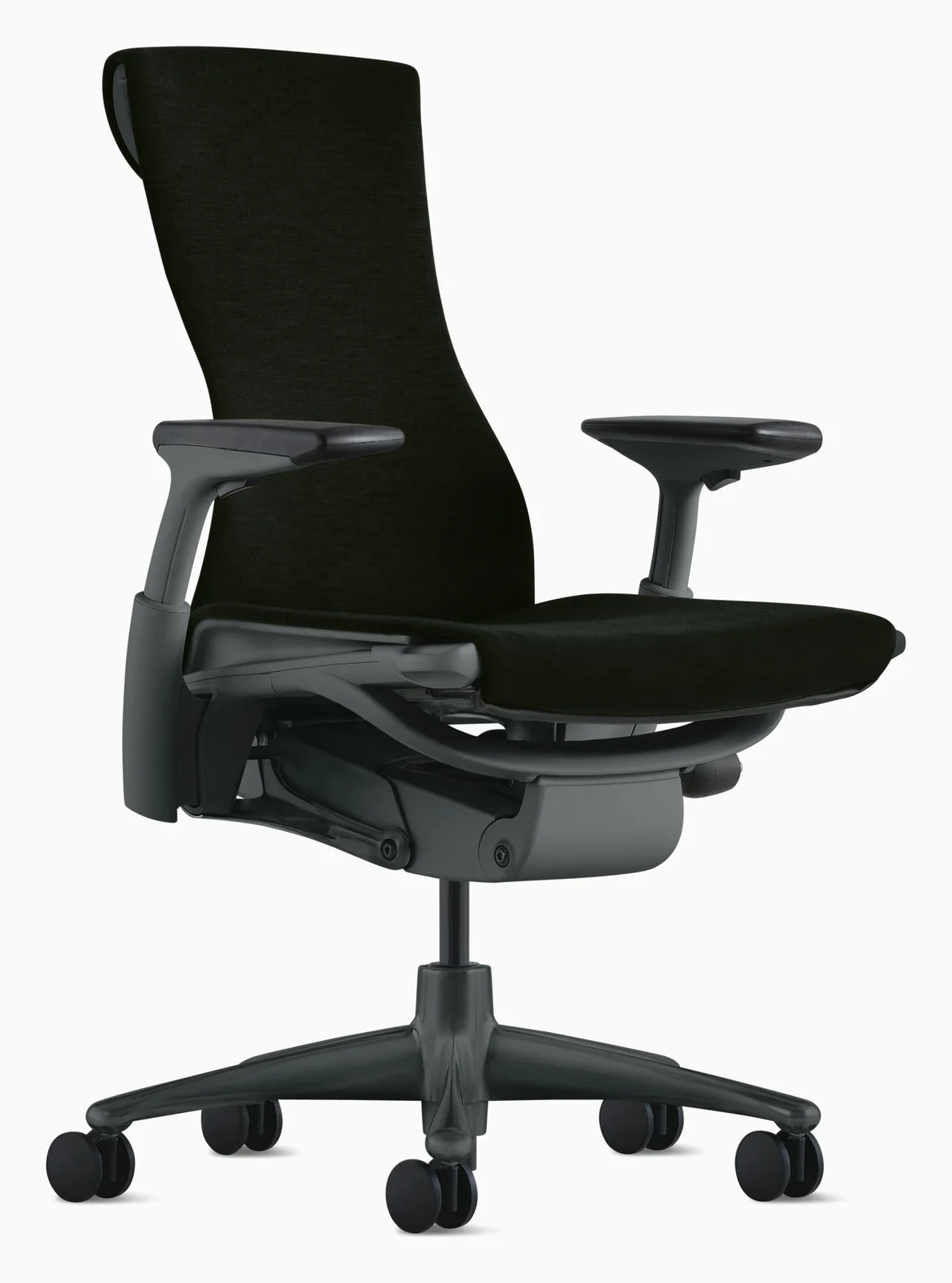
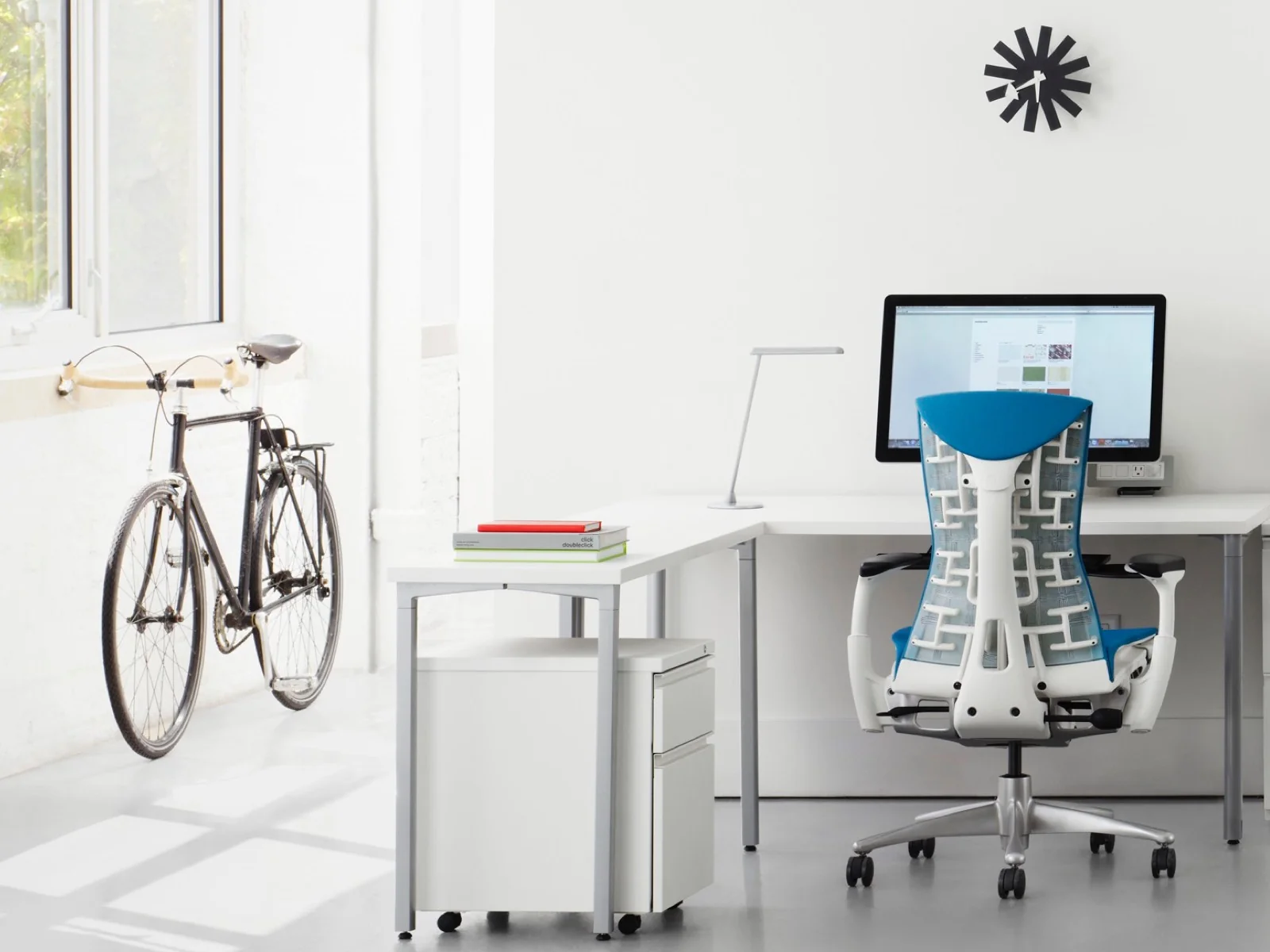
Herman Miller Embody Ergonomic Office Chair
By Herman Miller · Office Chairs · Home & Workspace
- Backfit adjustment tunes backrest support to the spine
- Pixelated seat and back layers distribute pressure point by point
- Harmonic tilt links recline to natural back movement
- Designed by Bill Stumpf and Jeff Weber
- 12-year warranty coverage
Price not listed
- Herman MillerView at Herman Miller
- Office Logix ShopView at Office Logix Shop
- eBay (used) eBay: used, open-box, refurbishedView at eBay (used)
- eBayView at eBay
Prices are snapshots. Check the current price with the store.
Summary
The Herman Miller Embody is a premium ergonomic office chair built around a pixelated support matrix instead of foam, and it is a different chair from the Logitech G Embody Gaming version. Confirm your fit on a 30-day trial before buying: the firm seat and pronounced lumbar curve suit some bodies and not others.
Strengths
- Recline is smooth, deep and effortless, and reviewers call it the best in any office chair.
- The narrow back and pixelated matrix allow unusual freedom of arm and torso movement.
- Build quality holds up: after three years of daily use only the fabric shows wear.
- The 12-year, 3-shift warranty covers the original purchaser and includes parts.
- Owners report back pain easing after they switch to it.
- It ships fully assembled, and the wide seat makes cross-legged sitting easy.
Weaknesses
- The firm pixelated seat concentrates pressure and can bring on tailbone soreness over long sessions.
- The pronounced lumbar curve pushes some users’ shoulders forward and feels aggressive.
- Seat depth adjustment is clunky for a chair at this price.
- Armrests adjust for height and width only, with no depth or pivot.
- Fit is divisive: a 5'11" tester could not get comfortable, and some owners found it no better than a regular office chair.
- It is heavy and awkward to move, and the price is the main barrier.
Verified specifications
| Model | Embody work chair, not the Embody Gaming Chair. |
|---|---|
| Designers | Bill Stumpf and Jeff Weber. |
| Maximum user weight | 300 lbs (136 kg). |
| Population range | 2nd–98th percentile. |
| Back support | PostureFit sacral support, adjustable lumbar and pixelated support standard. |
| Seat height | Low 15–19 in, Standard 16–20.5 in, Extended 17–22 in. |
| Seat depth | adjustable, 15–18 in. |
| Tilt | limiter with 4 stopping points. |
| Arms | fully adjustable for height and width, with no depth or pivot adjustment. |
| Adjustments measured | |
| Dimensions | 43.5 × 29.5 × 29 in (H × W × D). |
| Frame | die-cast aluminum. |
| Upholstery | Medley or Sync, both 100% polyester. |
| Seat | four-layer with elastic suspension and independent support coils. |
| Sustainability | 42% recycled materials, 95% recyclable at end of useful life. |
| Warranty | 12-year, 3-shift. |
| Assembly | ships fully assembled. |
| Included | the chair only, with no accessories by default. |
Full research notes and sources
Pixelated support and comfort
Herman Miller’s Embody replaces seat and back foam with a matrix of plastic pixels that flex independently to spread pressure and follow the body. That makes the chair feel firm but adaptive, and BTOD describes the result as a softer feel than expected from a chair with no pad.
The trade-off is pressure. The firm seat can build tailbone soreness across a long day, and the pronounced back curve pushes some users’ shoulders forward. The lumbar is adjustable in amount through the Backfit dial but cannot be moved up or down, so the aggressive curve cannot be repositioned, only softened.
Fit is the big unknown. TechGearLab’s testers mostly rated comfort highly, but one 5'11" tester could not dial it in, producing a love-it-or-hate-it result. On Reddit, some owners report the chair feeling like a regular office chair for the money; others report back pain easing after they switch to it.
Recline, movement and adjustment
Recline is the feature reviewers return to: smooth, deep and effortless, with the best range of arm and torso movement of the chairs tested. A tilt limiter holds the seat at 4 stopping points. The wide, flexible seat layout makes cross-legged sitting comfortable.
Adjustability is broad but not complete. TechGearLab counts 6 points of adjustment and scores it high, while docking the missing ones: armrests move only for height and width, with no depth or pivot, and the lumbar height is fixed. Seat depth does adjust, but testers call the mechanism clunky for a chair near $2,000. Herman Miller ships it fully assembled.
Build, warranty and repairs
BTOD’s three-year long-term review found the frame, arm pads, recline mechanism and pixelated system all in pristine condition, with only the fabric showing wear. The 12-year, 3-shift warranty covers the original purchaser buying new from Herman Miller or an authorized reseller, and one owner reported a claim where the gas cylinder was replaced and the chair cleaned with about a week’s turnaround at no cost. There are no consumables or subscriptions, and Herman Miller publishes care and maintenance guides for the frame and polyester upholstery.
Buying channel matters. One owner who bought from a third-party seller with no real return address ended up with what they called a $1,500 paperweight, so buy through Herman Miller or an authorized dealer to keep the warranty intact.
Price and value
Herman Miller lists the work chair at $1,945–$2,395 depending on variant (Herman Miller, Oct 2026), and the chair has climbed a long way from its early pricing. TechGearLab put the 2018 list price at $2,075, Tom’s Guide reported a 2021 starting price of $1,495 and a $1,895 maximum, and TechRadar Pro logged a February 2026 sale at $1,624, down from $2,030.
At a sale price of $1,600–$1,800 the Embody is strong value for a full-time sitter who values recline and back movement, backed by the 12-year warranty. At $1,945 and up it is a fit-dependent buy. Wirecutter’s 2026 office chair guide tested dozens of chairs but did not recommend the Embody, naming the Steelcase Gesture ($1,599) and the Herman Miller Aeron ($2,150) instead; BTOD rates the Steelcase Leap and Haworth Fern as better all-day options for some users. Because the fit is divisive, the 30-day trial is the deciding step: try it for a full work week and return it if it does not suit your body.
Which model this is
This page covers the Embody work chair, launched in 2009 and designed by Bill Stumpf and Jeff Weber. It comes in Medley, Sync and other upholstery grades, with Graphite, White or Titanium frames, and it is one fixed size. Do not confuse it with the Embody Gaming Chair, a distinct Logitech G co-branded version with different padding and pricing, or with other Herman Miller models such as the Aeron and Cosm.
Sources
Manufacturer:
- Embody Chairs product sheet (Herman Miller)
- Embody Chair (Herman Miller Store)
- Embody Chair variant (Herman Miller Store)
- Embody Chairs product details (Herman Miller)
Independent reviews:
- Herman Miller Embody review (TechGearLab)
- Why I changed my mind on the Herman Miller Embody (BTOD)
- Herman Miller Embody vs Aeron (Tom’s Guide)
- The best office chair (Wirecutter)
- Herman Miller Embody price cut (TechRadar Pro)
- Herman Miller Embody review (ISO50 Blog)
- Herman Miller Embody office chair review (Business Insider)
Owner reports: