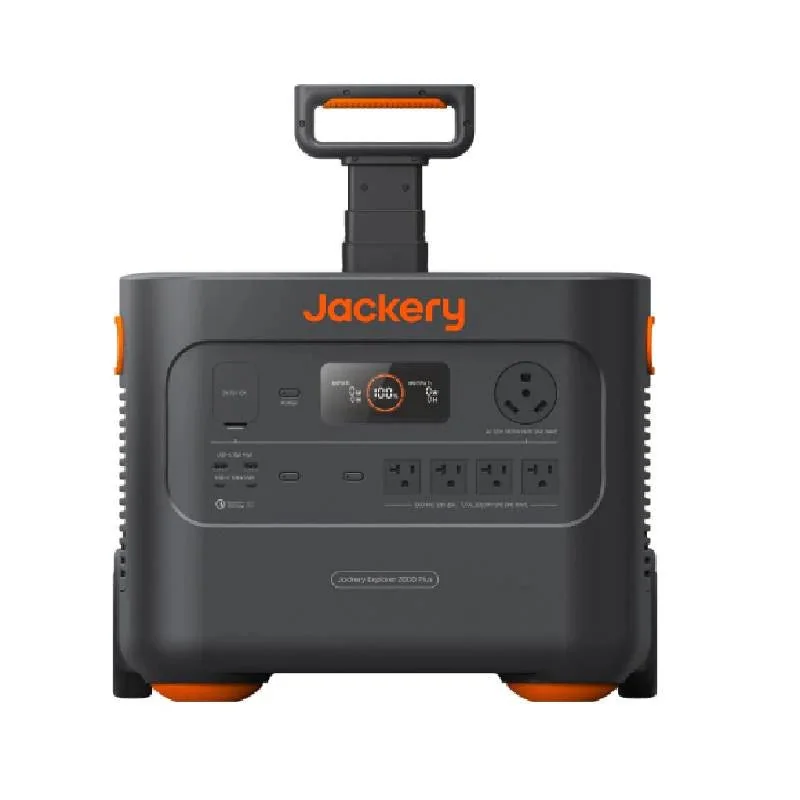
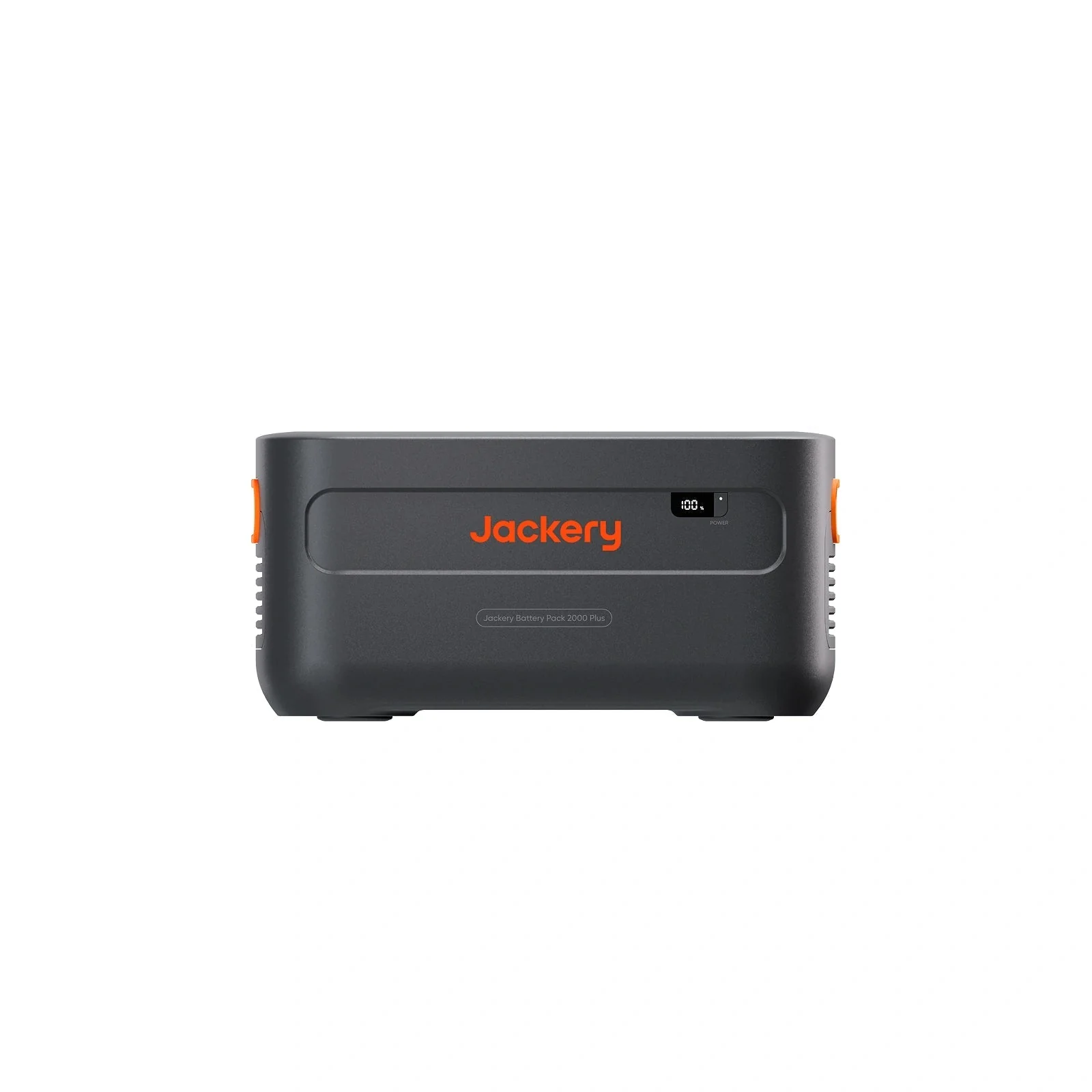
Jackery Explorer 2000 Plus Portable Power Station
By Jackery · Portable Power Stations · Audio & Electronics
- 2,042Wh LiFePO4 capacity, expandable from 2 kWh up to 24 kWh with add-on battery packs
- 3,000W AC output, up to 6,000W in parallel connection, 120V/240V expandable voltage
- Fast solar charge in 2 hours with 6x 200W panels (IBC technology)
Lowest price seen
~$1,429.00 (approx.)
from $1,429.00 at Amazon
- Amazon ~$1,429.00 (approx.)View at Amazon
- JackeryView at Jackery
- The Home DepotView at The Home Depot
- WalmartView at Walmart
- Best BuyView at Best Buy
- B&H PhotoView at B&H Photo
- Renewable OutdoorsView at Renewable Outdoors
- Lowe'sView at Lowe's
- eBayView at eBay
- eBay (used) eBay: used, open-box, refurbishedView at eBay (used)
Prices are snapshots. Check the current price with the store.
Summary
A 2,042.8 Wh LiFePO4 power station built around an expansion platform: up to five add-on packs per unit, or two units in parallel for 240 V and 24 kWh. The trade is weight — 61.5 lb and wheeled — and a single unit cannot produce 240 V, so check your loads before buying.
Strengths
- Three labs measured usable AC capacity at 83–88%, at or above the industry’s 85% guideline.
- Fast AC recharge: OutdoorGearLab measured a full charge in 95 minutes, ahead of the two-hour claim.
- The expansion socket is the differentiator: five packs per unit, or two units for 240 V and 24 kWh.
- 4,000 cycles to 70% capacity is long for the class.
- 3,000 W continuous output gives more headroom than many 2 kWh stations.
- A 3+2 year warranty and an app with remote control and Quiet Charging Mode.
Weaknesses
- 61.5–62.3 lb and wheeled; testers call the plastic handle and wheels suitable only for smooth ground.
- A single unit is 120 V only; 240 V and 6,000 W continuous need two units in parallel.
- Jackery uses proprietary solar connectors, advises against third-party panels, and requires matching panel types and counts across the two DC inputs.
- A sealed internal battery with no cell-level or BMS service path.
- Service friction: owners report hard returns on a heavy unit and warranty refusals outside authorised channels.
- The battery-cell warranty is conditional on charging within 7 days of purchase and at least once every 6 months.
Verified specifications
| Model | Explorer 2000 Plus, JE-2000C. |
|---|---|
| Battery | 2,042.8 Wh LiFePO4 (45.6 Ah at 44.8 V DC), 4,000 cycles to at least 70% remaining capacity. |
| AC output (US) | five pure-sine receptacles, four at 120 V 20 A max and one at 120 V 25 A max, 3,000 W continuous, 6,000 W surge peak. |
| AC input | 120 V, 60 Hz, 15 A max; about two hours to full. |
| DC/solar input | two DC8020 inputs, 11–17.5 V at 8 A max and 17.5–60 V at 12 A max, up to 1,400 W combined. |
| Solar recharge | six SolarSaga 200W panels about two hours; four panels 3.8 hours; two panels seven hours; one 200W panel 14 hours; 12 V car about 25 hours. |
| USB | two USB-A Quick Charge 3.0 at 18 W, two USB-C at 100 W. |
| Car port | 12 V, 10 A. |
| Expansion | one rear port for the Battery Pack 2000 Plus, 2,042.8 Wh and 41.9 lb (18.5 × 13.2 × 9.1 in). One base unit takes up to five packs; two units in parallel give 240 V and up to 24 kWh. |
| App | Wi-Fi/Bluetooth with remote monitoring, Battery Saving Mode and Quiet Charging Mode at 30 dB or less. |
| EPS | automatic transfer to battery within 20 ms; Jackery states it is not a 0 ms UPS. |
| Dimensions | 18.6 × 14.1 × 14.7 in; 61.5 lb (62.3 lb measured). |
| Operating temperature | charge 32–113 °F, discharge 14–113 °F. |
| Warranty | 3 years plus 2 years on registration; the battery-cell clause requires a full charge within 7 days of purchase and at least once every 6 months. |
| In the box | AC charging cable, car charging cable, two DC7909-to-DC8020 adapters and an accessory bag. |
Full research notes and sources
Capacity, charging and runtime
Three independent outlets measured usable AC capacity in a tight band. StorageReview pulled 1,750 Wh from the 2,042.8 Wh pack, 87.5% of rated, while a full 0–100% charge drew 2,310 Wh from the wall. CNET measured 88.13%. OutdoorGearLab measured 1,678 Wh, which it reports as 83% of a 2,048 Wh claim. CNET notes as a brand pattern that Jackery’s usable capacity runs about 5% below competitors’ even when it clears the 85% industry guideline, so read 87–88% as consistently good rather than defective.
Charging is the clearer win. Jackery claims two hours on AC, and OutdoorGearLab measured 1,290 Wh/h and a full charge in 95 minutes. Solar is real but conditional: two SolarSaga 200W panels sustained over 350 W in StorageReview’s field test, and WIRED measured a SolarSaga 200W panel at a consistent 170 W and took the unit from 32% to full in one hot day. The two-hour solar headline needs six SolarSaga 200W panels, and the two DC inputs must carry the same panel type and count.
Runtime is where the expansion math pays. Alone, the unit ran an average 600 W fridge for 8.5 hours in OutdoorGearLab’s test, and WIRED ran an EcoFlow Wave 2 portable AC for almost 7 hours, rising to just under 13 hours with one Battery Pack 2000 Plus attached. A single 100 W panel takes about 21 hours in ideal sun. One unit holds up to five packs for 12,256 Wh, and two units in parallel plus packs reach 24 kWh, 240 V and 6,000 W continuous.
Weight, build and owner reports
At 61.5 to 62.3 lb this is a wheeled object, not a carryable one. OutdoorGearLab found the telescoping handle and wheels almost entirely plastic and unsuited to sloped or dirt ground, and WIRED found the finish marks easily and needed a screwdriver for the rear port covers. StorageReview disagreed on the wheels, calling them sturdy over grass and gravel, so treat smooth surfaces as the common ground. There is no wireless charging, no single-unit 240 V and no built-in smart features.
Exact-model fault reports exist but are too few to estimate a rate. One owner reported an F6 fault after long-term use that stopped the unit charging and discharging at the same time; another using an expansion pack reported recurring F2, F6 and F7 codes during solar and EV charging. A third owner’s new Battery Pack 2000 Plus was not recognised until the system was soft-reset several times, and one owner said an espresso machine drew less power once the battery fell below roughly 40–50%, well under the 3,000 W rating. The manual documents F8 and F9 recovery steps but routes other fault codes to after-sales service, so F2/F6/F7 cases have no complete user procedure. On top of that, owners on r/Jackery describe difficulty getting a 60-plus-pound unit picked up for return and warranty refusals because the seller was not an authorised dealer; another reported a replacement that arrived visibly used. Those are service complaints, not evidence that the unit fails electrically, and no exact-model failure rate is defensible.
Repairs, parts and running costs
The unit is a sealed plastic box with an internal battery, and no cell-level or BMS service path was found; the manual says not to disassemble it and directs repair to qualified personnel. The warranty is 3 years plus 2 on registration, but the battery cell is covered only if you fully charge it within 7 days of purchase and at least once every 6 months after that, and coverage does not apply to units bought through unauthorised sellers or auction houses; Jackery also warns that leaving the unit depleted for 3–6 months degrades it.
There are no scheduled consumables. StorageReview measured 2.310 kWh drawn from the wall for a full 0–100% recharge, which at the July 2026 US residential average of 18.31 cents/kWh works out to about $0.42 per recharge, or roughly $22 a year if you run a full cycle once a week. Expansion is capital, not upkeep: a Battery Pack 2000 Plus was $799 from Jackery and B&H, the Jackery Connector that joins two base units was $199, a SolarSaga 200W panel was $379 direct, and a replacement DC7909-to-DC8020 adapter or car cable was $29.90 each. Two adapters and a car cable are already in the box.
Is it worth it?
The model has been discounted hard from a list of roughly $1,999–2,199. Best Buy listed the JE-2000C at $999, marked down from $1,199 and flagged non-returnable, and its Labor Day stock sold at $899. A 2026 secondary source had it at $899 from $1,399, and WIRED’s 2023 review recorded $899. An Explorer 2000 v2 is $899 direct, and Jackery’s HomePower 2000 Plus v2 was recently listed around $1,069–1,199.
Under about $900–1,000 this is a strong buy only if you need the 3,000 W inverter, the 1,400 W solar input or the legacy expansion platform: measured 87–88% usable capacity, the fastest AC charge in the class, the 3+2 warranty and an expansion path almost nothing else at the price offers. Around $1,600 it is hard to justify, and at list price it is poor value. Buy it when you need 240 V, need more than 12 kWh, or want the packs; skip it when you need a single 2 kWh unit. Check the store panel above for live prices.
Which model this is
This page covers the Explorer 2000 Plus base unit. Don’t merge it with the kits: the Explorer Kit 4000 adds a Battery Pack 2000 Plus, and the Solar Generator 2000 Plus is the base plus a SolarSaga 200W panel. It is also not the non-expandable Explorer 2000 v2 or the Li-ion Explorer 2000 Pro, and its expansion pack is not compatible with the newer Battery Pack 2000 Plus v2. The bare-unit US stock number is MFR 21-0001-000036Y and UPC 810105523829. The US listing is ASIN B0DY7NS98L.
Sources
Manufacturer:
- Jackery Explorer 2000 Plus product page
- Jackery Explorer 2000 Plus user manual (US, PDF)
- Jackery support: Explorer 2000 Plus basic information
- Jackery Battery Pack 2000 Plus
- Jackery Solar Generator 2000 Plus
- Jackery Explorer 2000 v2 product page
- Jackery HomePower 2000 Plus v2
- Jackery accessories catalog
- Jackery cables and connectors
- Jackery DC7909-to-DC8020 adapter
- Jackery SolarSaga 200W solar panel
- Jackery 2000 Pro vs 2000 Plus comparison
Independent reviews:
- StorageReview Explorer 2000 Plus review
- CNET Explorer 2000 Plus review
- CNET portable power station roundup
- WIRED Explorer 2000 Plus review
- OutdoorGearLab Explorer 2000 Plus review
- The Inertia portable power station roundup
Owner reports:
- F6 failure and warranty replacement (r/Jackery)
- First impressions and recurring F2/F6/F7 codes (r/Jackery)
- New battery pack not recognized (r/Jackery)
- Not operating to specs at lower state of charge (r/Jackery)
- Return experience for disabled customers (r/Jackery)
- Warranty returns (r/Jackery)
- Found out my Jackery didn’t work (r/Jackery)
- Jackery customer service reviews (Trustpilot)
Parts and stores: