Jackery Explorer 300 Portable Power Station
By Jackery · Portable Power Stations · Audio & Electronics
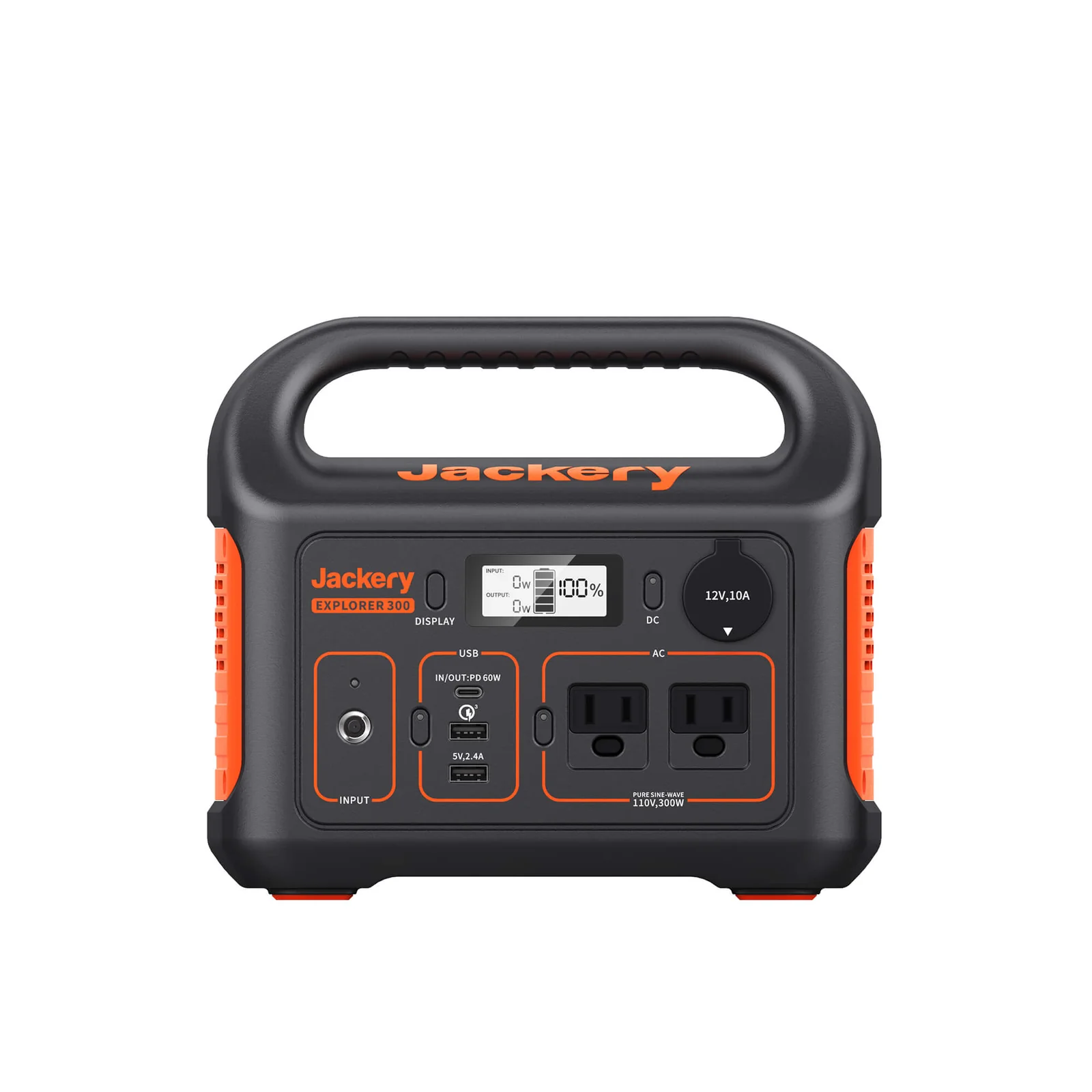
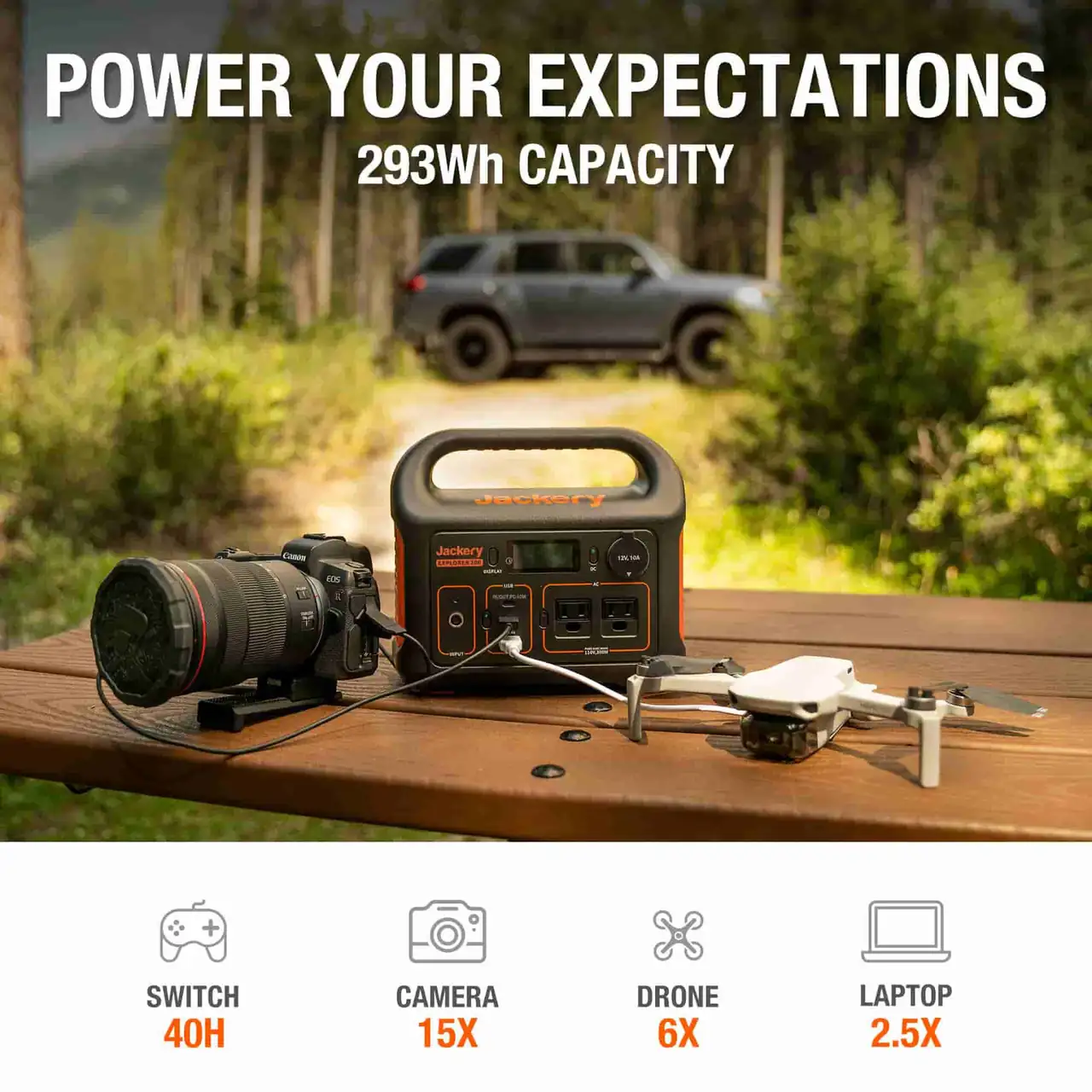
- 293Wh lithium-ion capacity
- 300W pure sine inverter, 500W surge
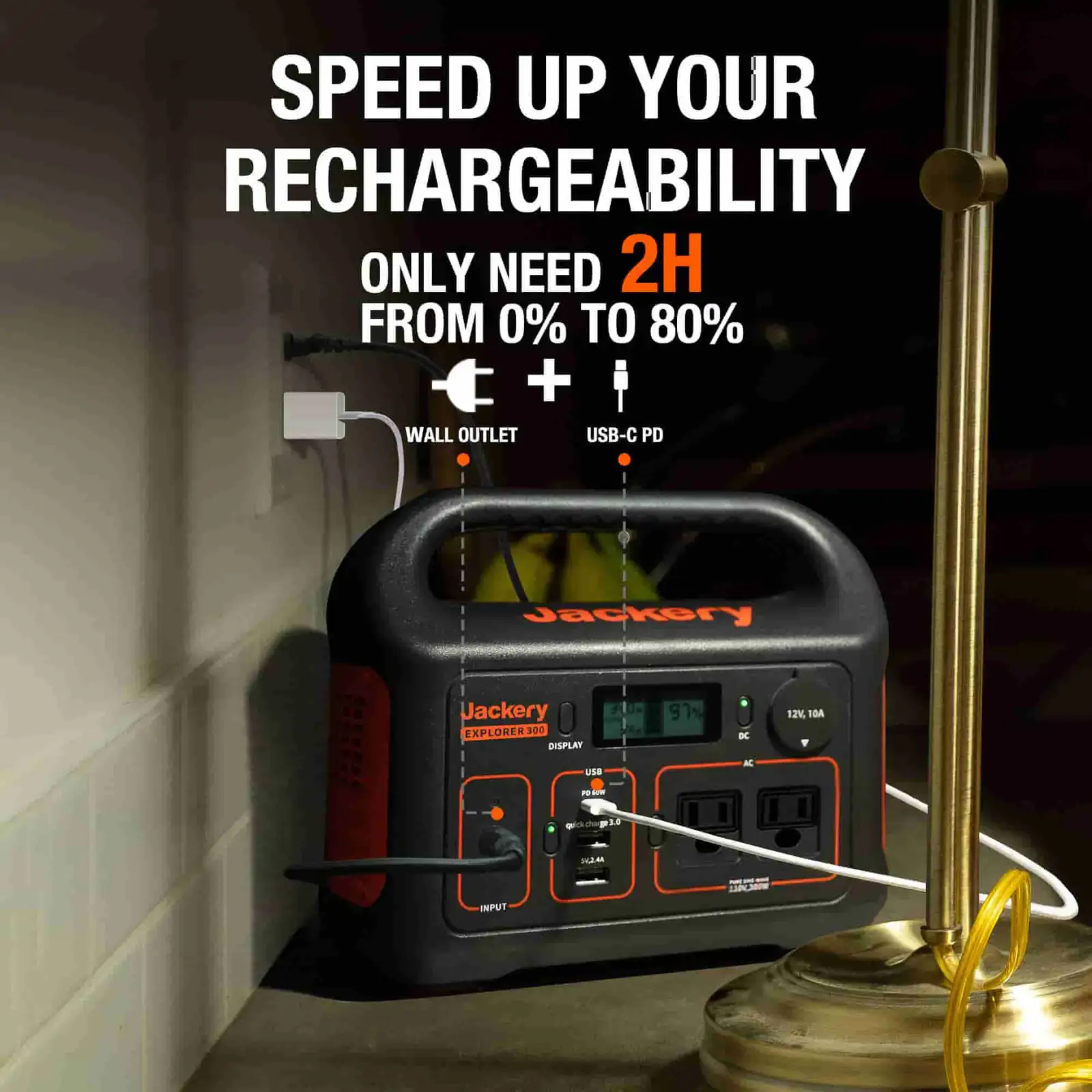
- 2.5 h recharge via 90W wall + 60W USB-C PD
- 36.4 dB
Lowest price seen
$80.15
from $80.15 at TheJackery Shop · Checked Oct 4, 2026
- TheJackery Shop $80.15View at TheJackery Shop
- JackeryView at Jackery
- WalmartView at Walmart
- eBayView at eBay
- eBay (used) eBay: used, open-box, refurbishedView at eBay (used)
- AmazonView at Amazon
Prices are snapshots. Check the current price with the store.
Summary
A 293.8Wh lithium-ion portable power station with a 300W pure sine-wave inverter and a 7.1 lb body that fits in a daypack. Check the job before buying: measured usable capacity is around 250-260Wh, and it will not run a fridge, heater or other high-wattage appliance.
Strengths
- It is small and light enough for a daypack, at about 7.1 lb, and it carries easily.
- The pure sine-wave inverter runs two AC outlets with 500W of surge.
- The 60W USB-C port charges laptops and phones without an extra adapter.
- Measured AC inverter efficiency is about 85%, and pass-through charging works.
- A 60W USB-C input adds a second charging path, and the 12V car cable is included.
Weaknesses
- Usable capacity is about 250-260Wh, roughly 11-15% below the 293Wh nameplate.
- Wall recharge is slow: about 4.5 hours single-input, and charging is capped at 90W.
- The 300W ceiling means no fridge, coffee maker, hot plate, heater or projector.
- Solar input is limited to one panel, and real charge rates fall under the panel nameplate.
- No app control, no weather rating, no built-in light, no UPS/EPS mode and no bypass output.
- The screen shows no time remaining and the AC wattage readout lags.
Verified specifications
| Battery capacity | 293.8Wh; the manual states 20.4Ah at 14.4V (293Wh). |
|---|---|
| Chemistry | lithium-ion (NCM). |
| Cycle life | 800 cycles to at least 80% capacity. |
| AC output | 110V, 60Hz, 300W maximum through two outlets. |
| Surge | 500W peak. |
| Waveform | pure sine wave. |
| USB-C output | 60W maximum, with 5V/9V/15V and 20V at 3A, QC 3.0. |
| USB-C input | 20V at 3A (60W ceiling). |
| Car port | one 12V, 10A outlet. |
| AC input | 24V at 3.75A, 90W. |
| Recharge time | about 4.5 hours from the wall and about 5 hours from a car. |
| Dual-input recharge | 2.5 hours using the 90W wall charger plus a 60W USB-C PD charger. |
| Solar | one 100W panel maximum; two panels in parallel are not supported. |
| Temperatures | charge 0-40°C, discharge -10-35°C, storage 0-40°C. |
| Housing | PC + ABS high-strength plastic. |
| Noise | cooling fan at 55 dB or less; the product page claims 36.4 dB. |
| Standby consumption | 5W; self-discharge about 1-3% per month. |
| Pass-through charging | supported, capped at 200W AC and 120W DC. |
| Dimensions | 23 × 13.3 × 19.9 cm (about 9.1 × 5.2 × 7.8 in). |
| Weight | about 3.2 kg (7.1 lb). |
| In the box | AC charger, 7909 car charger cable and user manual. |
Full research notes and sources
Capacity and what it can run
The 293.8Wh nameplate is not the same as usable energy. OutdoorGearLab measured 260Wh of output, 89% usable, and TechRadar measured 85% inverter efficiency, putting real AC capacity near 250Wh. Both labs found it could not run a refrigerator, and OutdoorGearLab says it suits phones and laptops rather than coffee makers, hot plates, heaters or projectors. In their tests it ran Starlink for about five hours, delivered roughly three laptop charges and about 80 phone charges. It is a charging-first device, and no price changes that.
Recharging and solar
The headline 2.5-hour recharge is a dual-input figure. Jackery’s own support page lists about 4.5 hours from the wall and about 5 hours by car, and the product page’s 2.5 hours needs the 90W wall charger and a 60W USB-C PD charger together. The USB-C port caps at 60W each way, so a 100W laptop charger is still drawn at 60W. Solar is limited to one panel; Jackery explicitly does not support two in parallel. A SolarSaga 100W panel reached a full charge in under six hours in one test and in about five hours in another, and a forum poster measured only about 87W from a 100W panel.
Metering and standby drain
The LCD shows battery percentage plus input and output wattage but no time-remaining estimate. TechRadar found the AC output reading lags by several seconds and continues to show draw after a load is removed, and lists that flaky metering as a reason to avoid the unit. Output sections do not switch themselves off, and standby consumption is 5W, so unused sections should be powered down or the battery bleeds. Self-discharge is rated at 1-3% per month. The fan is audible on medium-to-high loads; Jackery’s fan spec is 55 dB or less, while the product page claims 36.4 dB without stating a load. Pass-through charging works but is capped at 200W AC and 120W DC.
Reliability and warranty
Reliability evidence is thin. Jackery rates the cell at 800 cycles to at least 80% capacity, though the manual still says more than 500, so the documentation has drifted. Jackery warrants the 300 Series for 2+1 years, but the extra year is available only at jackery.com, and there is a 30-day return window. The battery-cell warranty requires a full charge within 7 days of purchase and at least once every 6 months after that. Owner reports are encouraging but singular: one owner says his unit still works after about three years and several outages, and one forum poster ran a Dometic cooler for about 12 hours. Error-code threads on the Explorer 300 Plus and Explorer 5000 are different models, not failure modes for this unit.
Is it worth it?
Independent list prices sit at $289 (OutdoorGearLab, 2026), $299.99 (TechRadar, 2021) and $279 from a 2026 comparison guide. Around $200 to $250 this is a reasonable buy for the job it does. Above roughly $300, a LiFePO4 unit at the same money brings 3,000-4,000 cycles, 100W or more of USB-C, an app and a five-year warranty, and Jackery’s own material routes buyers to those successors. Several domains using Jackery branding but not jackery.com advertise the Explorer 300 at 65-70% off with implausible prices; they are not official.
Which model this is
This page covers the original Jackery Explorer 300, the 293.8Wh lithium-ion (NCM) unit with the 300W inverter. It is not the Explorer 300 Plus (288Wh LiFePO4), the Explorer 300 v2, the Explorer 300D or the newer 292Wh LiFePO4 variant. If a listing says LiFePO4 or 100W USB-C, it is a different machine. The ASIN is B082TMBYR6.
Sources
Manufacturer:
- Explorer 300 Basic Information — Jackery Help Center
- Jackery Explorer 300 user manual (J300-UM-001)
- Warranty Policy (2+1 years, 300 Series) — Jackery Help Center
- After-Sales Policy (30-day return) — jackery.com
Independent reviews:
- Jackery Explorer 300 Review — OutdoorGearLab
- Jackery Explorer 300 review — TechRadar
- Jackery Solar Generator 300 Review — Halfway Anywhere
Owner reports: