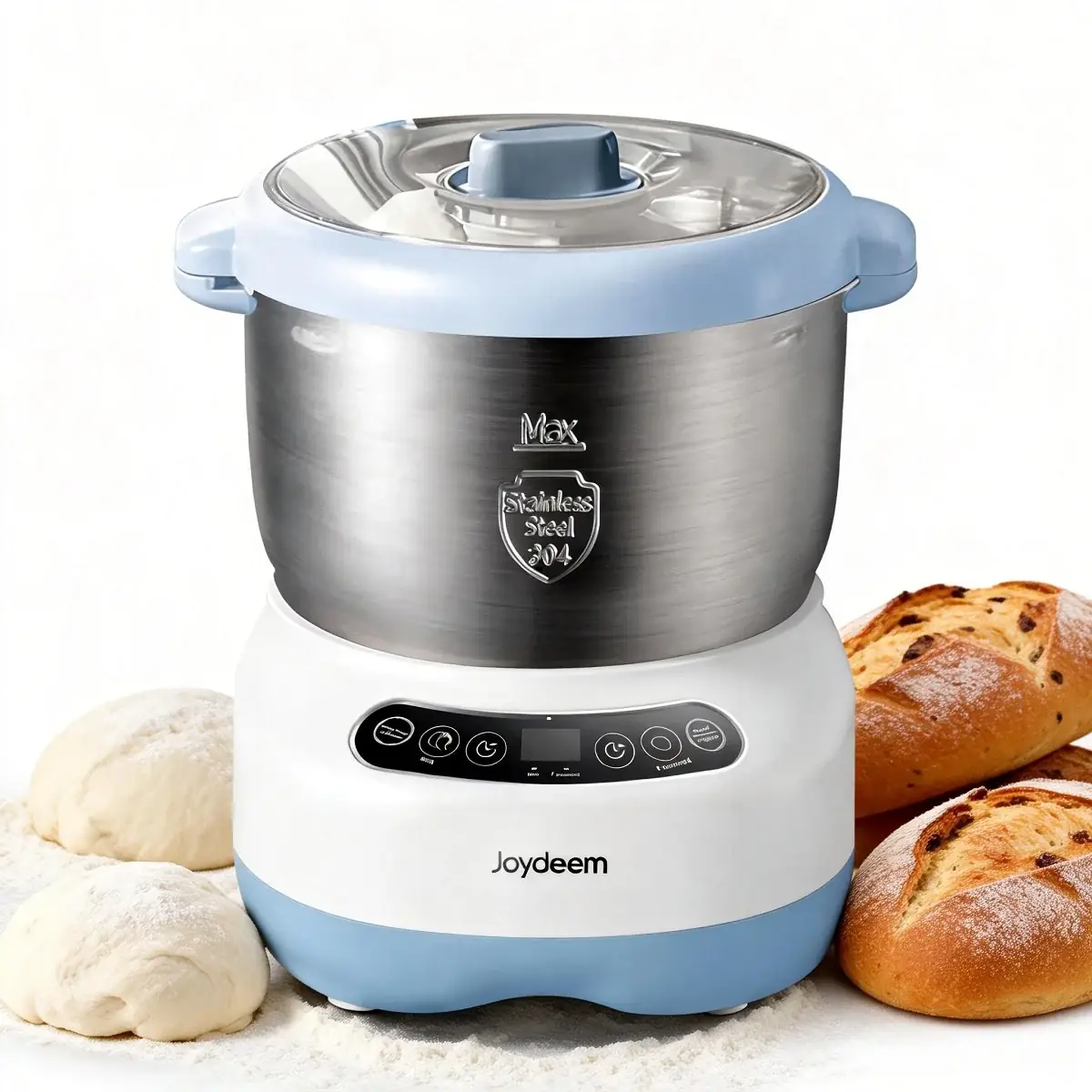
JOYDEEM JD-HMJ7L (Blue)
By JOYDEEM · Blenders & Stand Mixers · Kitchen & Cooking
- 7.4Qt stainless steel dough maker
- Ferment function with microcomputer timing
- Face-up touch panel
- 250W pulsing knead motor
Lowest price seen
~$119.00 (approx.)
from $119.00 at Amazon
- Amazon ~$119.00 (approx.)View at Amazon
- JOYDEEMView at JOYDEEM
- eBay (used) eBay: used, open-box, refurbishedView at eBay (used)
- eBayView at eBay
- doughstretch.comView at doughstretch.com
- weee.comView at weee.com
Prices are snapshots. Check the current price with the store.
Summary
The JOYDEEM JD-HMJ7L is a countertop dough kneader and proofer with a 7-liter stainless-steel bowl that mixes in bursts and can warm dough for rising in the same vessel. It does not bake bread and cannot replace a stand mixer, and its stop-start kneading is slower than a planetary mixer, so check your counter space and your patience before buying.
Strengths
- Handles big batches: the brand markets about 3.2 kg of dough, and owners report 1.4 kg batches and two 2-lb loaves at a time.
- Warms dough in the same bowl, which keeps a cold kitchen from stalling a rise.
- Suction feet hold it steady; a hands-on tester reported strong countertop adhesion and tolerable noise.
- Real recipe data: a tester measured dough at about 28°C after 45 minutes of mixing.
- Owners on r/Breadit reported the machine still working after roughly a year of frequent use.
- At least some parts are listed for sale: CyberHome maps Bear HMJ-A70C1 spares to this model.
Weaknesses
- Kneading is slow: a tester needed roughly 50 minutes of pulsed mixing for a 375 g high-hydration toast dough.
- Small batches fare worse: 200 g flour steamed-bun dough took 40 minutes plus 5 minutes of hand work.
- The warming stage can over-proof: one JOYDEEM user measured dough at 81–82°F against a 78°F target.
- The paddle can bind after stiff bagel dough; one owner lightly oiled it to get it out.
- Sticky or stiff dough made the motor work harder for one owner who ran about 20 large batches, though no failure was documented.
- One r/Breadit comment reported a “U04” code and a paddle that would not turn, but the exact model was never confirmed.
Verified specifications
| Model | JD-HMJ7L, a 7 L / 7.4 US qt countertop dough maker shown with light-blue accents on a white body. |
|---|---|
| Claimed dough maximum | up to 7 lb (about 3.2 kg) of finished dough per batch, per the manufacturer. |
| Motor and supply | 250 W rated motor, 120 V / 60 Hz; an older listing gives 140–170 rpm. |
| Programs | a 15-minute kneading program and a 45-minute proofing program, all timer-controlled. |
| Proofing warmth | manufacturer advertises 77–100°F (25–38°C) warming. |
| Construction | 304 stainless-steel bowl and a detachable blade; the bowl and blade are dishwasher-safe, the powered base is not. |
| Dimensions | 11.6 × 11.4 × 13 in and 5.74 lb from a third-party manual listing (not manufacturer-confirmed). |
| In the box | a measuring cup and spoon, plus bilingual Chinese/English paper instructions. |
| Warranty | one-year limited warranty against manufacturing defects in household use. |
Full research notes and sources
Kneading and batch size
This is not a set-and-forget mixer. The paddle turns and pauses by design, which mimics intermittent hand kneading and can look like a fault to a new owner. The manufacturer advertises a 15-minute kneading program, but real dough often needs longer. A hands-on tester found that 375 g of flour for a high-hydration toast dough needed roughly 50 minutes of pulsed mixing to reach the gluten development they wanted, while 200 g of flour for steamed buns took 40 minutes plus 5 minutes of hand work. Their conclusion was that the machine mixes larger batches more effectively and that a stand mixer develops gluten more strongly. If you bake single small loaves, the 7 L bowl is more space than you need.
Against that, owners with bigger jobs report success: one verified-SKU buyer made about 1.4 kg of pretzel or pizza dough at a time, and another handled two 2-lb loaves per batch. The advertised ceiling is 7 lb (about 3.2 kg) of finished dough, which is a manufacturer claim, not an independently established limit for dense low-hydration doughs like bagels. A reseller’s claimed 2–7 kg per batch contradicts the maker’s own figure and should not be treated as safe.
Proofing warmth
The heater is there to help dough rise, not to bake it, and a separate oven is still required for crust. The maker advertises a 77–100°F (25–38°C) band, which is not proof that you can dial an exact setpoint. In a hands-on test, dough came out around 28°C after 45 minutes of mixing; in a separate JOYDEEM-family post, an owner measured 81–82°F when the sourdough formula targeted 78°F. That second report does not confirm this exact model, so treat over-proofing as a family-level caution rather than a measured defect. When a recipe is temperature-critical, knead without heat, proof in ambient conditions and check with a probe thermometer.
Reliability, parts and running costs
There is no defensible model-specific failure rate, median failure time or recall for the JD-HMJ7L, and many online complaints are about other Joydeem, Bear, bread-machine or KitchenAid products. The documented model-specific concerns are slow gluten development, a paddle that can bind after stiff dough, and extra motor load with sticky dough.
Routine ownership is cleaning the bowl and blade and re-seating the detachable parts. JOYDEEM says it can supply replacement bowls, blades and lids if you contact support with the exact model, but no JD-HMJ7L-specific part number or price was verified. CyberHome lists Bear HMJ-A70C1 family spares cross-labelled for the JD-HMJ7L with a starting price of $15, but every US variant was sold out when checked, and the individual part codes were not verifiable.
Running cost is low. There are no model-specific filters, pods, proprietary mixing chemicals or subscriptions, so scheduled consumables come to $0/year on the documented design. Power use is usage-dependent and no measured energy test was found; as an illustration only, a 250 W motor run 30 minutes for 100 sessions a year is 12.5 kWh, or about $3.13 at an assumed $0.25/kWh for mixing alone. The fermentation heater consumes extra power, and pulsed mixing varies the real draw, so do not read that as an expected annual bill. Flour, yeast, baking electricity and cleaning supplies are extra.
If the blade stops turning, switch off and unplug first, let the unit cool, take out the dough once it is safe, check for mis-seated parts or overloading, then contact JOYDEEM with a video and proof of purchase. Do not open the electrical base; unauthorized disassembly is excluded from the warranty.
Support and warranty
Coverage is a one-year limited warranty for manufacturing defects in normal household use, with proof of purchase. Unauthorized repair, abuse, accidents, commercial use and unsuitable conditions are excluded, and a report of bakery use does not extend the written warranty to commercial work. Claims go to JOYDEEM with the order proof, model and serial if available, photos or video, and a description; the brand advertises a 1–2 business day response, but no independent sample of resolution times exists. The support phone is 1-888-381-8996, Monday–Friday 10am–6pm Eastern. The store advertises 30-day returns, though JOYDEEM’s written policy makes personal-preference returns customer-paid and leaves the freight arrangements for defects after 30 days ambiguous enough to confirm in writing.
Is it worth it?
JOYDEEM’s own page lists the JD-HMJ7L at $119 (October 2026), reduced from an advertised $139, with free shipping to the contiguous 48 US states. The smaller independent Zhlshop storefront listed the same model at $129 but showed it sold out, CyberHome listed the Bear-branded HMJ-A70C1 cross-referenced to this model at $149.99, and one eBay seller asked $157.57 for a 6.6 qt JD-HMJ7L. As an editorial guide rather than a sale history: at $99 or below with a proper US warranty this is a good buy for frequent dough makers, $100–125 is reasonable against the brand-direct offer, and over $139 it is worth weighing the 9 L HMJ-A901 at $139 if larger batches matter or the 5 L HMJ-A501 at $99 if household batches are modest. Past $150, paying above brand-direct for the same model is hard to justify unless the seller adds something JOYDEEM does not.
Which model this is
This page covers the JD-HMJ7L, the 7 L dough maker in white with light-blue accents. It is not the smaller HMJ-A501 or the newer, similarly sized HMJ-A701. Some resellers and a third-party manual list the bowl as 6.6 qt, which does not match 7 liters; the manufacturer’s 7 L / 7.4 qt figure is the consistent conversion. Confirm the bowl marking on any older 6.6 qt listing before buying.
Sources
Manufacturer:
- JOYDEEM JD-HMJ7L 7 L dough maker
- JOYDEEM one-year warranty and support
- JOYDEEM returns policy
- JOYDEEM FAQ: US delivery and replacement parts
- JOYDEEM dough-maker range and US prices
Independent reviews:
- Dealmoon hands-on JD-HMJ7L kneading and proofing test
- Huarenstore JD-HMJ7L recipe videos
- Newegg older JD-HMJ7L listing
Owner reports:
- r/Breadit: JD-HMJ7L buyer and durability follow-up
- r/Baking: JOYDEEM family timing and proof temperature
- r/Breadit: photographed dough maker and unverified U04 report
Parts and stores: