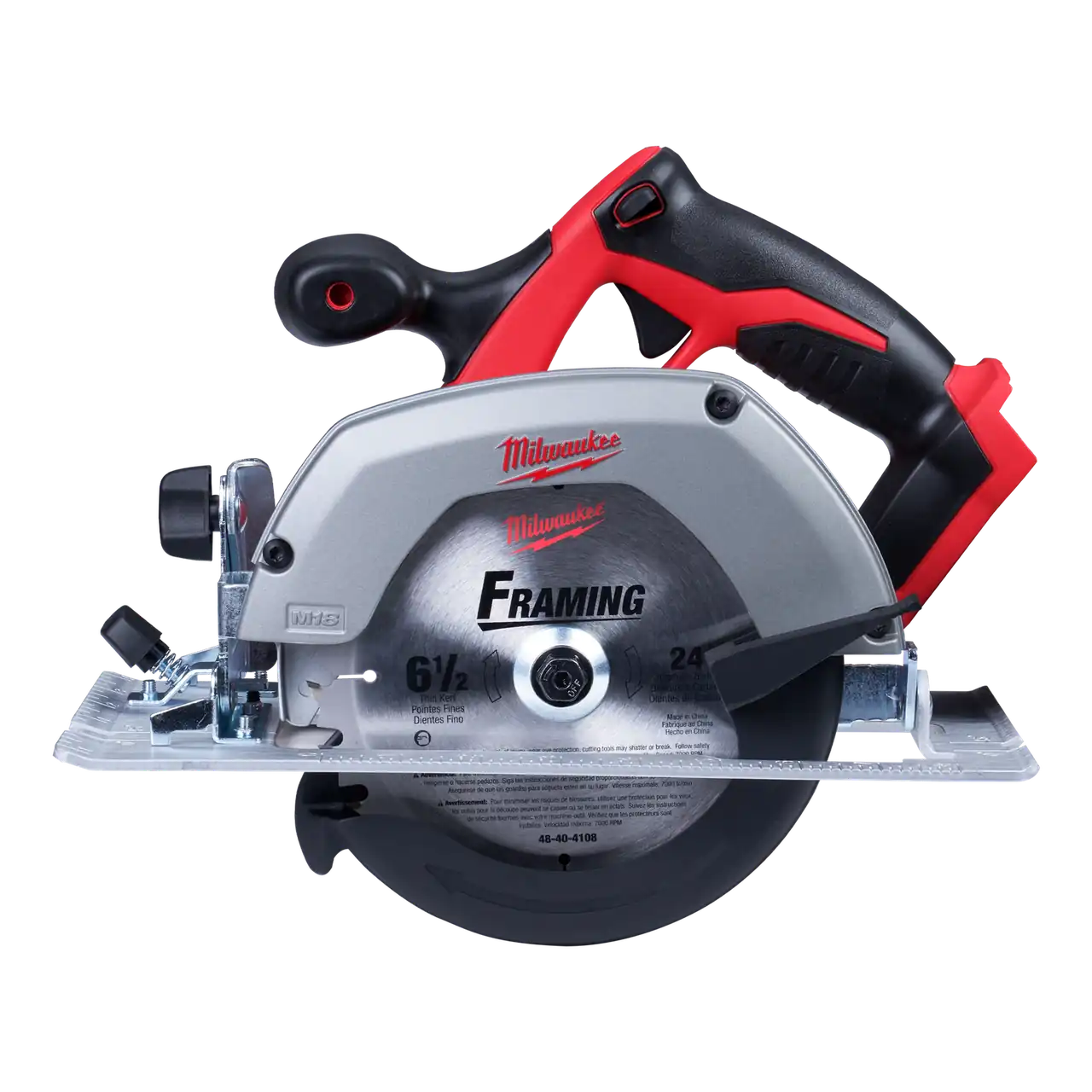
Milwaukee M18 6-1/2 in. Circular Saw (2630-20, bare tool)
By Milwaukee · Circular Saws · Power Tools
- M18 18V cordless 6-1/2 in. circular saw, bare tool
- 3,500 RPM motor with magnesium guards and shoe
- Tool-free adjustable shoe and bevel up to 50 degrees
- Runs on M18 REDLITHIUM batteries (sold separately)
Lowest price seen
~$118.51 (approx.)
from $118.51 at Amazon
- Amazon ~$118.51 (approx.)View at Amazon
- MilwaukeeView at Milwaukee
- WalmartView at Walmart
- eBay (used) eBay: used, open-box, refurbishedView at eBay (used)
- eBayView at eBay
Prices are snapshots. Check the current price with the store.
Summary
A brushed-motor, single-speed 18 V circular saw sold as a bare tool, and the cheapest way into Milwaukee’s M18 platform for someone who already owns batteries. It is light and left-bladed, but it has no LED light, rafter hook, dust port or detents, and it can stall in thick cuts unless you fit a sharp blade.
Strengths
- The cheapest way into Milwaukee’s M18 platform as a bare tool.
- Light and manageable, especially one-handed or on a ladder, owners say.
- The only instrumented test cut dense hardwood and plywood without binding and rated it above average.
- An aircraft-aluminum shoe, magnesium guard and electric brake in a simple, single-speed design.
- Blade changes are easy with the on-tool hex wrench and spindle-lock button.
- Covered by Milwaukee’s five-year limited warranty on the tool.
Weaknesses
- The brushed motor and 3,500 RPM blade speed sit well below Milwaukee’s 5,000–6,000 RPM FUEL saws.
- Owners repeatedly report the blade stalling or locking up mid-cut; no failure rate is published.
- No LED light, rafter hook, dust port or variable speed.
- No bevel or depth detents.
- The bare tool needs an M18 battery and charger you may not own, and it ships without a case.
- The 45° depth of cut is listed inconsistently at 1-5/8 in. and 1-9/16 in.
Verified specifications
| Model | 2630-20, M18 6-1/2 in. circular saw, tool only. |
|---|---|
| Voltage and battery | 18 V DC, M18 lithium-ion; battery and charger sold separately. |
| Motor | brushed, single speed; no FUEL and no ONE-KEY. |
| No-load speed | 3,500 RPM; measured at 3,220 RPM (about 92% of the rating) in the only instrumented test. |
| Blade | 6-1/2 in. with a 5/8 in. arbor; blade-left. |
| Depth of cut | 2-1/8 in. at 90°; 1-5/8 in. at 45° on most listings (1-9/16 in. on others). |
| Bevel | 50°. |
| Shoe and guard | aircraft-aluminum shoe; magnesium upper guard, with distributor listings and the independent test describing upper and lower guards. |
| Brake and controls | electric brake; trigger with a lock-off button. |
| Operating temperature | 0°F to 125°F. |
| Weight | not published by Milwaukee; listings vary from 7 lb to 9 lb, one labeling 9 lb as with the battery installed, so treat it as unresolved. |
| In the box | the saw and a 6-1/2 in. blade; no battery, charger or case. A hex wrench stores in the front handle beside a spindle-lock button. |
Full research notes and sources
Independent test results
The only instrumented review of this platform is Pro Tool Reviews’ test of the 2630-22 kit from December 2009, so treat it as platform-level evidence rather than a measurement of the bare tool. It measured 3,220 RPM, about 92% of the 3,500 RPM rating, and 81 dB at 3 ft no-load. The reviewer called it “amazingly quiet” but still recommended hearing protection, since cutting adds 15–20 dB. It made 35 cuts through a 2x4 of old-growth heart pine and left the battery at 3 of 4 bars, cut 3/4 in. plywood cleanly, and refused to bind even when twisted mid-cut. The reviewer also praised the deeply etched aluminum shoe markings, the secondary 45° line and the blade-change setup, while calling the bevel adjustment harder to use than the depth lever.
Stalling and blade speed
The most common owner complaint is the blade locking up partway through a cut. In an r/MilwaukeeTool thread on this exact model, a prospective buyer hesitated over “so many people complaining about the blade locked up halfway through cuts,” and another buyer summarized the split reviews: “some saying the speed jams up the cut, but others saying it’s excellent.” Owners trace it to the low 3,500 RPM blade speed next to Milwaukee’s 5,000–6,000 RPM FUEL saws, and to blade quality: a long-term owner who cuts hardwood with it says the saw “does benefit massively from a high quality blade.” Milwaukee’s manual points the same way, warning that dull blades overload the tool and raise kickback risk, that you should use only thin-kerf blades rated above the tool’s no-load RPM, and that a blade which will not follow a straight line usually just has dull teeth. Budget for a good blade. Nobody has published a failure rate, so treat the stalling as a known annoyance rather than a defect.
Maintenance, parts and warranty
Upkeep is basic: check that the lower guard closes freely before each use, never tie it open, and inspect it after a drop. The lower-guard spring can gum up, and a brake that misses repeatedly means a trip to an authorized service center. Repairability is good for the class — Milwaukee publishes a full service parts list (bulletin 54-40-2630) with individual part numbers, and runs an eService repair channel and a service-center locator from the product page. The tool carries a five-year limited warranty; registration is not required, and the manufacturing date is used if you have no receipt. Wear parts such as the shoe and blade clamps are excluded, and batteries are not covered under the five-year term. Two distributor listings also record a five-year warranty for this catalog number.
Running costs and what owners paid
The saw is bare, so an M18 battery and charger are the real hidden cost unless you already run the platform; Milwaukee’s 2630-22 kit bundles two XC batteries and a multi-voltage charger, which shows what that adds. Blades are the ongoing consumable. For the tool itself, new bare-tool listings cluster at $149.00–$149.99: Northern Tool and Farm and Fleet list $149.00, McCoy’s lists $149.99, and Midway Lumber lists $149.04. Global Industrial is $169.95, Ballard Industrial $205.00, and E.R. Industrial $222. Home Depot lists $193.00 on a limit-5 listing, which looks like constrained stock rather than a shelf price. A buyer on r/MilwaukeeTool reported getting one new, tool only, for $80 in 2023.
Is it worth it?
At $149 or less, this is a reasonable buy for someone already invested in M18 who wants a light second saw or an occasional-use saw. From $150 to $170 it is acceptable but no longer a bargain. From $171 to $193 it is weak, because the $229 bare-tool M18 FUEL 6-1/2 in. (2833-20) is close in price and adds a brushless motor, 6,000 RPM, an LED light, a rafter hook, a dust port, and bevel and depth detents. Above $193, look elsewhere. The instrumented data are old, so the real differentiator is platform economics: for a household already holding M18 batteries, the incremental cost is just the sticker price.
Which model this is
This page covers the bare-tool 2630-20; the 2630-22 kit is the same saw bundled with two XC batteries, a multi-voltage charger, a blade and a contractor bag. Don’t confuse it with the M18 brushless 7-1/4 in. (2631-20), the M18 FUEL 6-1/2 in. Gen I (2730-20) or Gen II (2833-20), or the M18 FUEL 7-1/4 in. (2834-20). It is a left-blade saw, not the more common right-blade layout. Its listing identifier is ASIN B005UQNS3U.
Sources
Manufacturer:
- Milwaukee M18 6-1/2 in. circular saw (2630-20)
- Operator’s manual for the 2630-20
- Registration and warranty
- Service parts list 54-40-2630
- M18 6-1/2 in. circular saw kit (2630-22)
- Warranty coverage
Independent reviews:
Owner reports:
Stores: