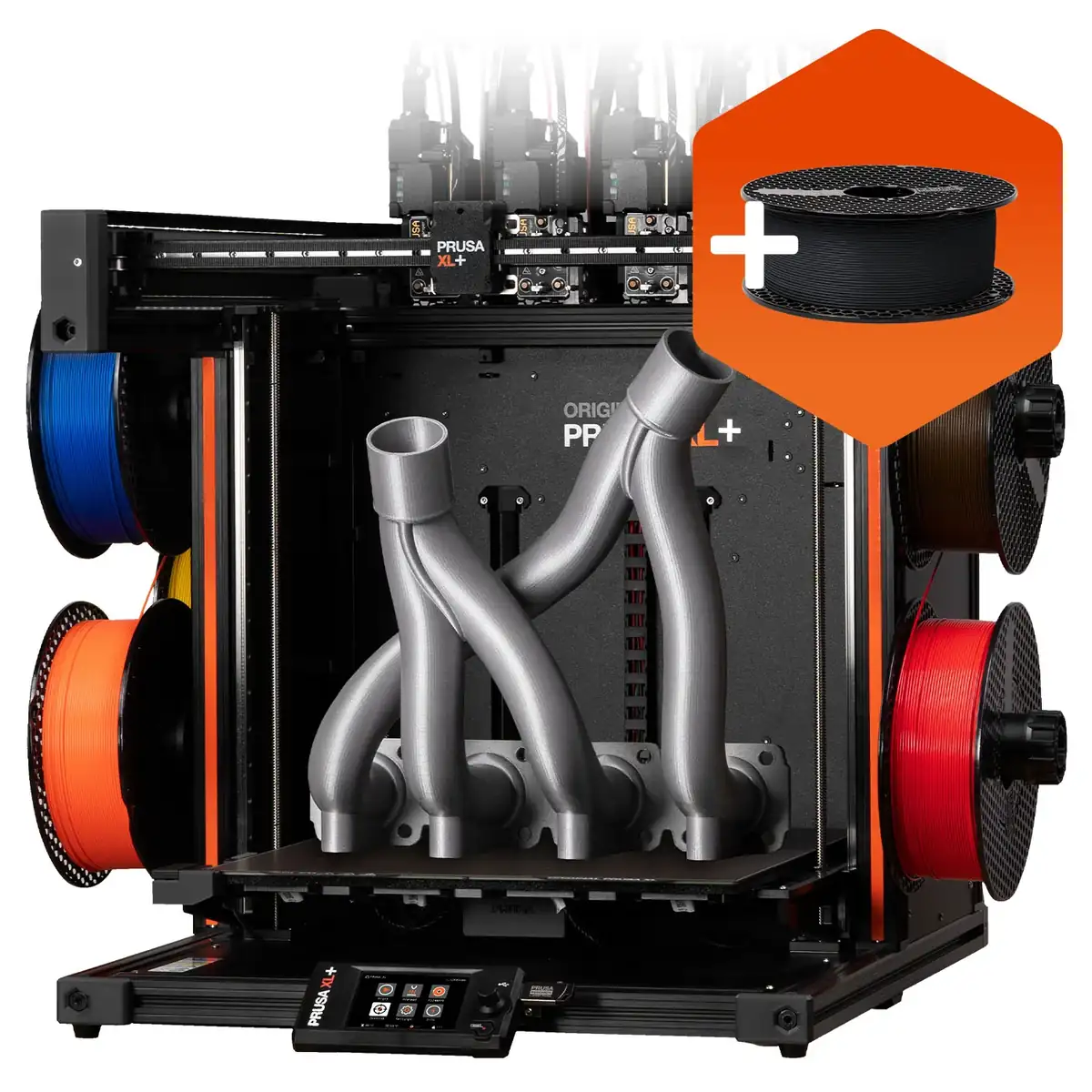
Prusa Research Original Prusa XL (5-toolhead)
By Prusa Research · 3D Printers · 3D Printing
- Up to 5 independent toolheads (tool-changer)
- 360 x 360 x 360 mm build volume
- Segmented heated bed (16 independently-heated zones)
- Open-source ecosystem, user-serviceable
Lowest price seen
$2,999.00
from $2,999.00 at West3D · Checked Oct 3, 2026
- West3D $2,999.00View at West3D
- Printed Solid $3,561.50View at Printed Solid
- Prusa Research $3,899.00View at Prusa Research
- eBayView at eBay
- eBay (used) eBay: used, open-box, refurbishedView at eBay (used)
- AmazonView at Amazon
Prices are snapshots. Check the current price with the store.
Summary
A large CoreXY toolchanger with five independent hotends, built for multi-material and multi-nozzle printing with very little purge waste — not for raw speed. Before buying, compare it against the newer XL+: the legacy five-head machine now sells at closeout prices not far below the revised model, so the generation matters more than the old launch comparisons.
Strengths
- Five complete hotends stay loaded and parked, so multi-material prints skip the purge-heavy unload-reload cycle entirely.
- Tom’s Hardware measured roughly six hours saved on a four-color print even though the XL was not the fastest mover.
- Different materials or nozzle diameters can stay mounted at once, including mixed-nozzle workflows.
- The 16-zone segmented bed heats only the zones a print actually occupies.
- The repair ecosystem is unusually good: public service documentation, separately sold boards and toolheads, and round-the-clock live chat.
- It prints happily offline; no cloud account is required.
Weaknesses
- It is very expensive: even discounted closeout five-head units remain around the mid-three-thousand-dollar mark.
- It is enormous, and the moving cable loops demand far more vertical clearance than the frame itself.
- The open frame needs a separately bought enclosure for warp-prone or fume-sensitive materials.
- Five toolheads mean five filament paths and more docking, calibration and nozzle-seal failure points than a single-tool printer.
- Owner threads still report docking hiccups, stuck filament, clogs and occasional electronics failures.
- The newer XL+ adds revised belts, a nozzle wiper and automatic tool-offset calibration, so the legacy machine must be judged against its own successor’s pricing.
Verified specifications
| Build volume | 360 × 360 × 360 mm (14.17 × 14.17 × 14.17 in), about 46.7 L. |
|---|---|
| Toolheads | five independent Nextruder direct-drive heads with 10:1 planetary gearboxes. |
| Filament | 1.75 mm, not vendor-locked. |
| Layer height | 0.05–0.30 mm published range. |
| Nozzle | 0.4 mm standard on current units; E3D V6 compatible with an adapter; maximum 290 °C. |
| Bed | up to 120 °C, 16 individually controlled heat zones, removable magnetic steel sheets. |
| Leveling | automatic mesh bed leveling through a load-cell system. |
| Electronics | custom 32-bit xBuddy board, Trinamic 2130 drivers, 3.5-inch color LCD. |
| Connectivity | USB, LAN and Wi-Fi via Prusa Connect; a fully offline workflow is supported. |
| Sensors | filament sensor, load cell, Power Panic, thermistors and fan-RPM monitoring. |
| Materials | PLA, PETG, Flex, PVA, PC, PP, CPE and PVB without an enclosure; an enclosure is recommended for ABS, ASA, HIPS, PA and similar. |
| Power | about 80 W standby, 550 W during heat-up, 235 W average while printing. |
| In the box (per a US reseller listing) | printer with configured toolheads, satin powder-coated steel sheet, 1 kg Prusament PLA, lubricant, cleaning needle, hand tools, USB drive and handbook; direct bundles can differ. |
| Dimensions | 700 × 900 × 720 mm (W × H × D; 27.5 × 35.5 × 28.5 in) including spool holders; 33.7 kg (about 74 lb); the cable and filament loops need clearance up to roughly 1.8 m above the frame. |
Full research notes and sources
Why five toolheads matter
The toolchanger is the whole point. Instead of retracting one filament, purging, and feeding another through the same hotend, the carriage parks a complete tool and picks up the next — so a five-color print wastes far less material and time. One long-term owner reported around 18,000 tool changes with only two manual interventions. Soluble and dissimilar-material support interfaces come out cleaner than on single-nozzle workarounds, and owners who run frequent multi-material jobs describe the workflow as transformed. Note the history: early launch units shipped with 0.6 mm nozzles and drew heavy tuning complaints, while later 0.4 mm machines with updated firmware tested far better — but current owners still report docking and filament issues, so neither era’s reputation should be copied blindly.
Footprint, power and reliability
Plan the space first: the frame is about 70 cm wide, 90 cm tall and 72 cm deep, the five-head machine weighs about 74 pounds, and Prusa’s own graphics show cable reach demanding up to roughly 1.8 meters of clearance. Power draw is modest for the class — a few hundred watts while printing. Maintenance is real but documented: belts, fasteners, firmware, and above all the toolchanger coupler surfaces, which Prusa says to clean and lubricate when print quality hints at it. Dry filament and well-tuned nozzle wiping come up repeatedly in owner advice. Nobody has published a fleet failure rate; stories of dead boards, heatbed tiles or stubborn docking are caution signals, not statistics.
Prices and generations
In September 2026 the original five-head XL was listed at $3,684.26 from Prusa and at $3,561.50 on sale (against a $4,190 regular price) at Printed Solid, while the incoming XL+ five-head was listed at $3,899 at Swing Design and $4,249 at Printed Solid. The gap is real but small, so a legacy five-head near $3,900 is hard to defend once the XL+ is on the same shelf. On the running side, the optional five-head starter pack with extra nozzles, a sheet and maintenance items is $389, and Prusa quotes filament at roughly $12–30 per kg; those are vendor figures, not measured ownership costs.
Which model this is
This page covers the Original Prusa XL with five toolheads — the 2025-generation original XL, not the XL+. In 2026 Prusa discontinued the semi-assembled XL, cut pricing, and began transitioning to the XL+ with its revised belts, nozzle wiper and automatic tool-offset calibration. The one- and two-toolhead XLs are the same platform with fewer heads and can be upgraded to five later. Keep the generations separate when comparing listings: resellers currently list the legacy assembled five-head a few hundred below the XL+, and some product pages blur the two.
Is it worth it?
For a workshop that actually runs multi-material jobs, the toolchanger pays for itself in saved time and wasted filament. For mostly single-material printing, it is too much machine: most of the price buys capability that would sit idle. Below roughly $3,400 the closeout five-head is a defensible specialist purchase; from $3,400 to $3,700 it is fair for a shop that needs five independent tools now; at $3,900 and up, buy the newer XL+ unless a specific legacy configuration offers something the replacement does not. Check the store panel above for current prices.
Sources
Manufacturer:
- Prusa Original XL product and configuration page
- Prusa business page for the XL
- Prusa blog: the XL in 2026 — new toolheads, lower price
- Official XL maintenance guide
- Prusa customer support and warranty channels
- Five-toolhead starter pack
- Single-tool to five-head upgrade kit
Independent reviews:
Retail listings:
- Printed Solid — assembled Original XL five-head
- Printed Solid — assembled XL+ five-head
- Swing Design — XL+ five-head listing
- MatterHackers — Original XL listing with specs and package contents
- Dynamism — assembled five-head listing
Owner reports:
- Multi-head ownership and tool-change reliability (r/prusa3d)
- Owner satisfaction and maintenance discussion (r/prusa3d)
- Docking, clogging and toolhead complaints (r/prusa3d)
- Stuck-filament and tool-change reports (r/prusa3d)
- Heatbed and electronics support case (r/prusa3d)
- Intermittent stops and electronics troubleshooting (r/prusa3d)