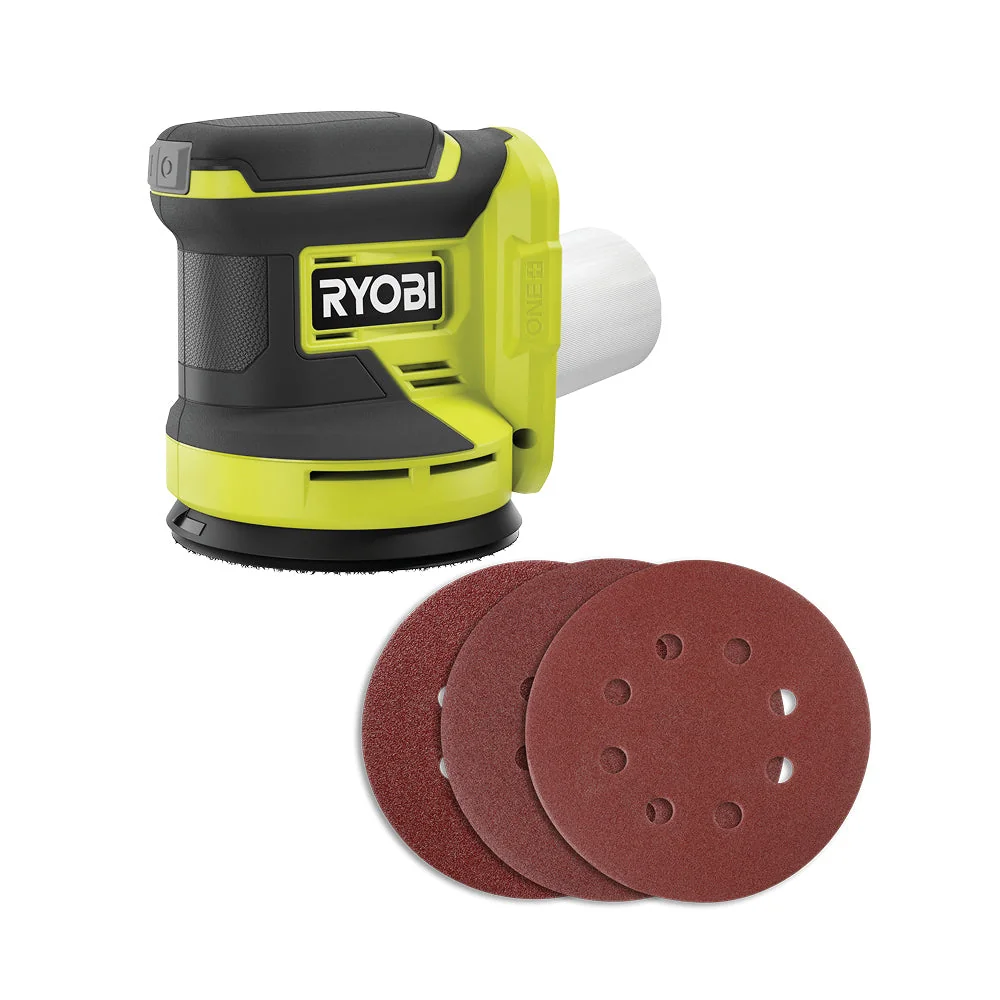
Ryobi ONE+ 18V 5 in. Random Orbit Sander (PCL406B, bare tool)
By Ryobi · Orbital Sanders · Power Tools
- ONE+ 18V cordless 5 in. random orbit sander, bare tool
- Up to 10,000 orbits per minute for a swirl-free finish
- 40% reduced vibration for maximum control
- Hook & loop sanding pad for easy sandpaper attachment
- Dust collection bag and 3-year limited warranty
Lowest price seen
~$49.99 (approx.)
from $49.99 at Amazon
- Amazon ~$49.99 (approx.)View at Amazon
- RyobiView at Ryobi
- eBay (used) eBay: used, open-box, refurbishedView at eBay (used)
- eBayView at eBay
- The Home DepotView at The Home Depot
Prices are snapshots. Check the current price with the store.
Summary
A bare-tool cordless 5-inch random-orbit sander on Ryobi’s 18V ONE+ platform, running at a fixed 10,000 orbits per minute and covered by a 3-year warranty. It suits occasional light DIY sanding if you already own ONE+ batteries; without a battery and charger in hand, budget for those separately.
Strengths
- Tool-only price is low, and the 3-year warranty beats many rivals.
- Any Ryobi 18V ONE+ battery works, so existing owners need nothing else.
- Hook-and-loop pad takes standard 5 in. discs.
- Dust port fits both 1-1/4 in. and 1-7/8 in. shop-vacuum hoses.
- A woodworking reviewer found it comfortable, well-balanced and even in material removal.
- A career sander told Home Depot reviewers it performs as well as his corded sander.
Weaknesses
- Fixed 10,000 OPM with no variable speed, which limits lower-speed work.
- Torque drops under load, and one editor reports the sanding grinds to a halt.
- Vibration is aggressive for one reviewer, especially with larger batteries.
- The friction-fit dust bag can fly off during use.
- A 2Ah battery ran about 15 minutes for one editor, though tasks vary.
- No battery or charger in the box, and Ryobi publishes no internal replacement parts.
Verified specifications
| Model | PCL406B (bare tool); PCL406K1 (kit with 4Ah battery and charger). |
|---|---|
| Platform | Ryobi 18V ONE+ (300+ products; any ONE+ battery fits). |
| Orbit speed | 10,000 orbits per minute (OPM), fixed; no variable-speed control. |
| Orbit diameter | 3/32 in. |
| Vibration | Ryobi claims 40% less vibration than the previous model. |
| Sandpaper attachment | hook-and-loop pad, takes standard 5 in. vented hook-and-loop discs. |
| Dust collection | on-board bag (friction fit); the port accepts 1-1/4 in. and 1-7/8 in. vacuum hoses. |
| Switch | rocker switch with a rubber membrane. |
| Motor | brushed, not brushless; the brushless 5 in. model is the separate PBLSD01B. |
| In the box | sander, 3 sheets of assorted sandpaper, dust collection bag, operator’s manual. |
| Warranty | 3-year limited manufacturer’s warranty. |
| Dimensions and weight | not published by Ryobi. |
Full research notes and sources
Which model this is
This page covers the Ryobi ONE+ 18V 5 in. Random Orbit Sander, model PCL406B, sold as a bare tool; the same sander ships as a kit under model PCL406K1 with one 4Ah battery and charger. Don’t confuse it with the older discontinued P411, the corded RS290G, the 1/4-sheet PCL401B, or the brushless PBLSD01B. A 1998 CPSC recall covered older Ryobi detail sanders such as the DS1000, not this model. The US Amazon listing carries ASIN B0BSJ97BSR.
What it is like to use
Popular Woodworking’s reviewer spent a weekend refinishing outdoor furniture with a 4Ah battery and found the sander comfortable to hold, well-balanced, and free of noticeable vibration discomfort; sanding was even and material came off at a good rate. He judged the fixed 10,000 OPM to sit in the middle range for random-orbit sanders, which is enough for small-to-medium tasks. Other owners describe the same tool as light and portable, and one noted it runs at roughly the same speed as corded models in the 8,000–12,000 OPM band. How-To Geek’s editor had the opposite experience: he found it underpowered for a patio-cover project, says once you apply force there isn’t enough torque to keep spinning, and recommends sticking to a 2Ah pack because a 6Ah battery made the tool heavy and unbalanced with worse vibration.
Speed control and dust collection
The single 10,000 OPM speed is the most repeated design complaint: both Popular Woodworking and How-To Geek flag the lack of variable speed for jobs that want a slower pass. The dust bag is the other recurring issue. It uses a friction fit, and Popular Woodworking’s reviewer watched it fly off unexpectedly with a cloud of fine dust each time; several Home Depot reviewers say the same, though others report it works when tapped firmly onto the port. The practical fix owners use is a shop vacuum on the dust port, which is why the dual hose sizes matter.
Battery, parts and running costs
Ryobi sells the bare tool for $59.97 and the PCL406K1 kit with a 4Ah battery and charger for $124.00 (Ryobi, 2026). Home Depot lists tool-only at $59.97 with kits from $99 to $179 (Home Depot, 2026), and Home Depot Canada shows CAD 89.98 (2026). How-To Geek’s author bought one on sale for around $39. Running costs are sandpaper and batteries: Ryobi sells a 7-piece sandpaper assortment (A21701) for $5.47–6.47 and a 5 in. backer pad (A21BP01) for $16.97 (Ryobi, 2026). One owner in r/ryobi replaced a switch that died after about a year and found the job easy, so basic repair is feasible even though Ryobi sells no internal parts.
Is it worth it?
At $60 the sander earns its place for existing ONE+ owners who need occasional light-to-medium sanding: the fixed speed, hook-and-loop pad, dust collection, 3-year warranty and shared battery platform are all real. Higher up the range the case weakens, because corded sanders and the Ryobi brushless PBLSD01B offer more power, better dust collection and variable speed. The 4Ah kit at $124 is easier to defend than the bare tool at the same money. Judge it by whether you already own ONE+ batteries and how heavy your sanding gets.
Sources
Manufacturer:
- Ryobi 18V ONE+ 5 in. Random Orbit Sander PCL406B
- Ryobi 18V ONE+ 5 in. Random Orbit Sander Kit PCL406K1
- Ryobi Canada PCL406B product page
- Ryobi PCL406B operator’s manual
Independent reviews:
- Ryobi 5 in. Random Orbit Sander review (Popular Woodworking)
- The Ryobi power tool I regret buying the most (How-To Geek)
- Home Depot PCL406B customer reviews
- Home Depot PCL406B-PCL416B combo kit customer reviews
- Ryobi 18V sanders category page (Home Depot)
- PCL406B tool-only listing (Home Depot Canada)
Owner reports: