Steelcase Leap V2 Chair
By Steelcase · Office Chairs · Home & Workspace
- Seat height: 15.5-20.5 in
- Seat depth: 21.75-24.75 in
- Weight limit: 400 lb
- Warranty: 12-year, multi-shift, 24/7 parts and labor
Lowest price seen
$1,000.00
from $1,000.00 at eBay · Checked Oct 12, 2026
- eBay $1,000.00View at eBay
- Crandall Office Furniture $1,149.00View at Crandall Office Furniture
- SteelcaseView at Steelcase
- Office Logix ShopView at Office Logix Shop
- eBay (used) eBay: used, open-box, refurbishedView at eBay (used)
- AmazonView at Amazon
Prices are snapshots. Check the current price with the store.
Summary
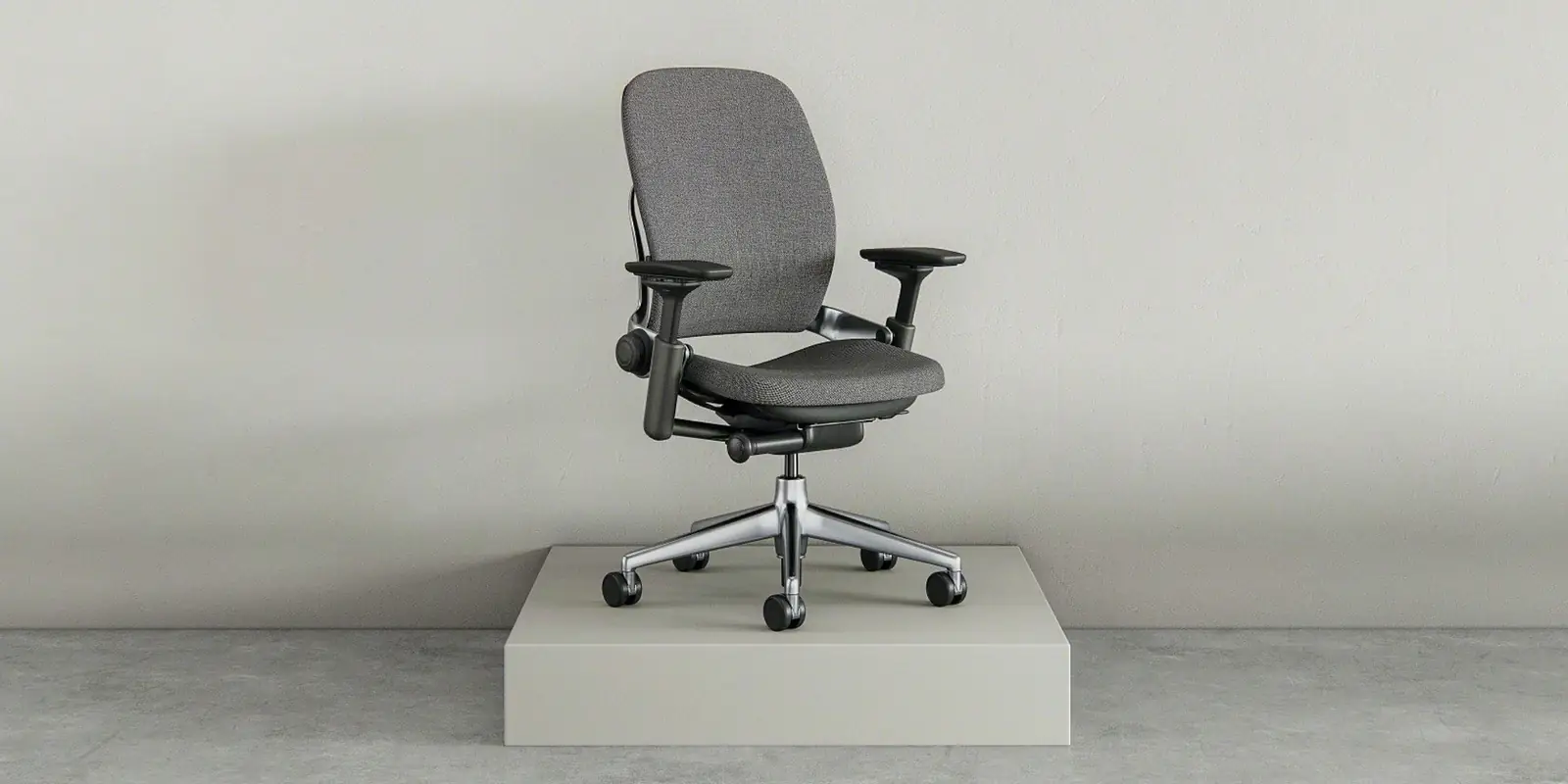
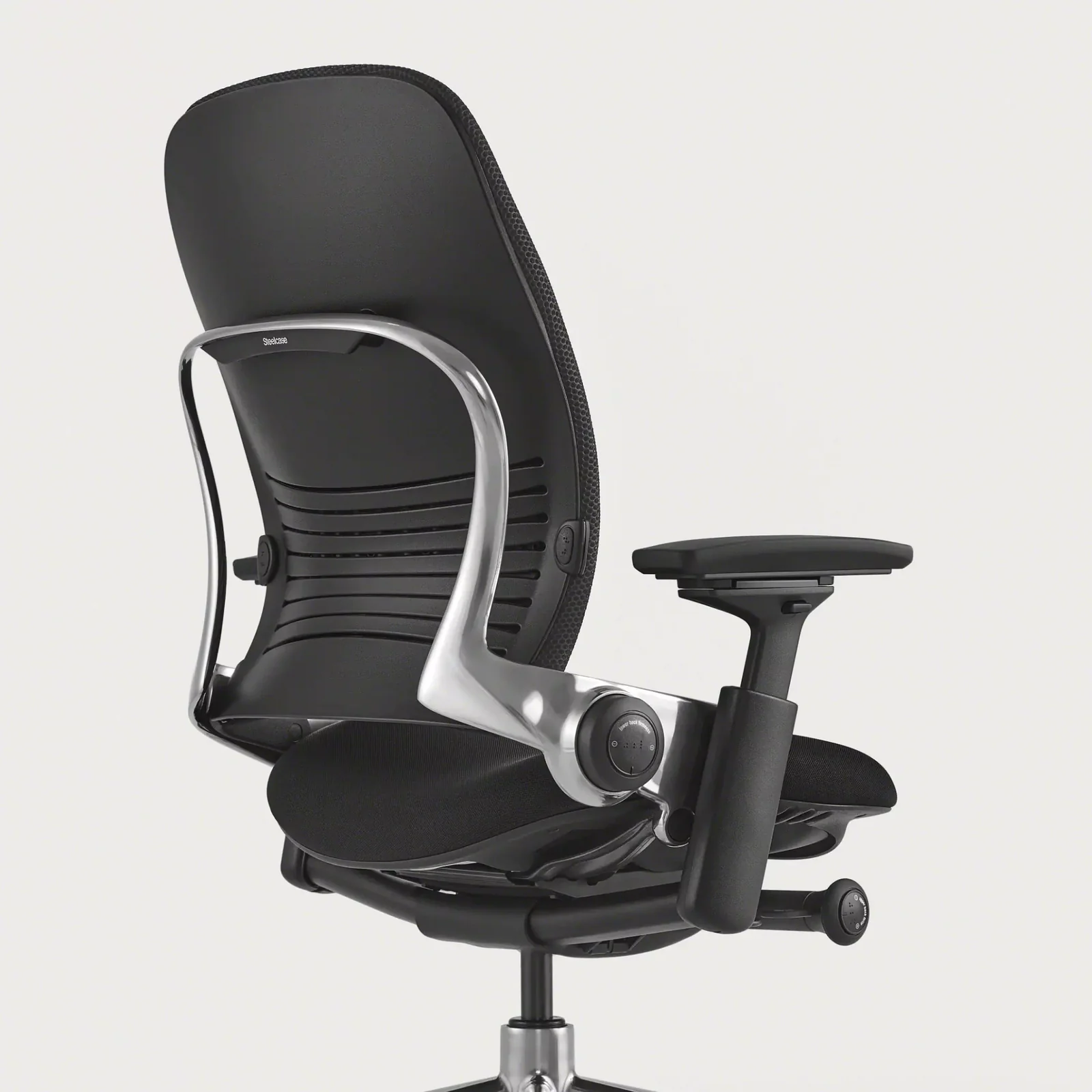
A fully manual Steelcase task chair with a flexible LiveBack back shell, four-way arms, a sliding seat pan and a five-stop recline, built for people who like to retune their chair through the day. Sit in one for an afternoon before you buy: the backrest pushes on the right side and not the left by design, and the factory seat cushion is thin.
Strengths
- The warranty is the strongest structural case for buying Steelcase, with lifetime coverage on the frame, base and back shell.
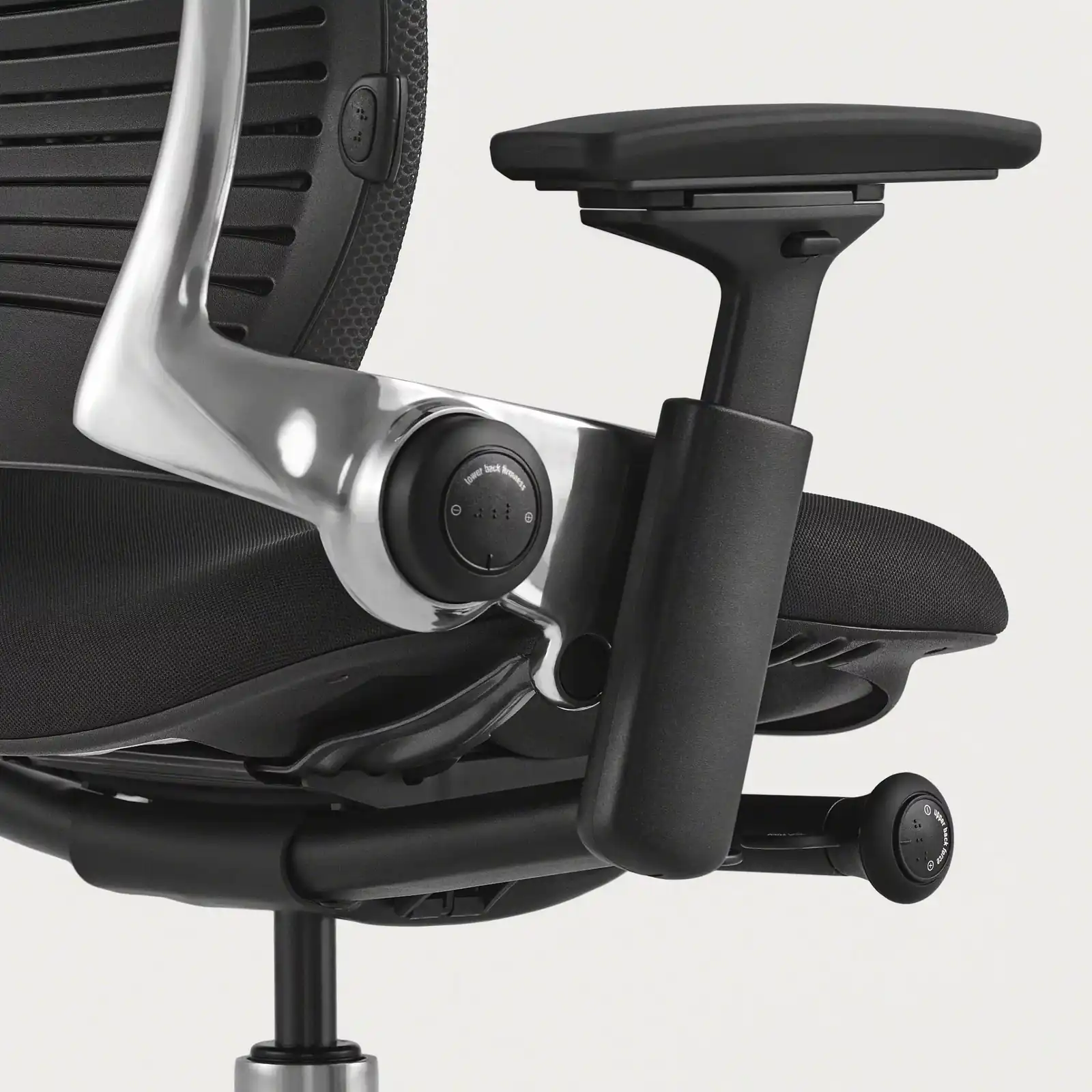
- Adjustment runs deeper than most rivals: four-way arms, lumbar height plus firmness, a sliding seat pan and five recline stops.
- TechGearLab’s panel sat 10–12 hours in it, scoring comfort 8.5 and adjustability 9.1 out of 10, and assembly 10.
- One long-term owner at 6'2" and 170 lb reports it fits him perfectly with no numbness over many 10–12 hour days.
- It arrives almost fully assembled, and used units hold together: owners report a 16-year-old chair with only minor scuffs and a polished base with no wear at all.
Weaknesses
- The backrest is asymmetric by design. The tensioner pushes on the right side and not the left, and once you notice it you keep noticing it.
- The stock seat cushion is thin, and owners above roughly 220 lb say the chair does not work for them.
- Moving the backrest is loud and lags; one long-term reviewer called it the noisiest chair he has tested.
- The headrest pushes the head forward, drops out of position, cannot be added later and costs extra at order.
- V2 swapped V1’s steel arms for plastic mouldings, which flex more under load.
- Foam is less breathable than a mesh back, so it runs warm.
Verified specifications
| Dimensions | 27 × 21.75–24.75 × 38.5–43.5 in (686 × 553–629 × 972–1099 mm). |
|---|---|
| Seat height from the floor | 15.5–20.5 in (394–521 mm). |
| Seat depth | 15.75–18.75 in (401–477 mm). Listings that quote 21.75–24.75 in as “seat depth” are quoting overall chair depth. |
| Seat width | 19.25 in (489 mm). |
| Back | 18 in wide, 25 in tall from the seat, 32 in with the headrest. |
| Lumbar | height-adjustable from 5.25–10.25 in above the seat, with a 4 in flex zone and its own firmness dial. |
| Weight limit | 400 lb for the work chair, 300 lb for the stool. |
| Chair weight | 46.7 lb; packaged weight is reported as 66–68 lb. |
| Arms | 4D standard, moving in height, width, depth and pivot; 12.75–20 in between the armrests, 7–11 in above the seat, armcap pivot ±30°. |
| Backrest | LiveBack flexible shell whose upper and lower sections flex independently. |
| Recline | full recline with four angle stops plus an upright back lock; testers counted five tilt stops. |
| Seat | upholstered with edges designed to bend under the thighs, on a pan that slides for depth; pan angle -1 to 3 degrees, seat-to-back angle 96–120 degrees. |
| Adjustment count | 8 measured adjustment points. |
| Style numbers | 46216179 with an upholstered back and seat, 46216189 with a 3D Knit back. |
| Casters | hard dual-wheel standard; soft, roll-control and glides optional. |
| Power | none. Every control is a lever, knob or wheel under the seat. |
| Warranty | 12 years, multi-shift, 24/7 parts and labor. Lifetime on the frame, seat shell, outer back, arm frame structure, base and foot ring; 12 years on the mechanism, gas lifts, arm caps, foam, casters and standard textiles. |
| In the box | the chair as configured. Arms, lumbar, headrest, casters, upholstery and frame finish are order-time choices, and headrest versions are factory-assembled. |
| Shipping | built to order and shipped fully assembled. |
Full research notes and sources
Back support and the crooked backrest
The back is why people keep this chair. Szynalski, writing after long-term ownership, called the LiveBack backrest the best he has tested, alongside Steelcase’s Please, and called the 4D arm material unimprovable. TechGearLab’s panel put the backrest and armrests at the top of an 18-chair group. The lumbar is easy to place and dial: two side sliders set height, a right-side knob sets lower-back firmness, and a separate knob sets upper-back tension, which takes about five full turns to set. The one control that felt finicky was the lumbar height slider, and one owner simply pulled the insert out.
Then the catch. The same reviewer documented that Leap’s backrest tensioner was designed to push on the right side and not the left, went two years without noticing, and concluded that every Leap, old or new, has a slightly crooked back. Owner threads report the same feeling in less specific terms: a chair that just does not fit right with nothing to point at. Not every unit shows it equally. The later Gesture does not have the flaw, because its bottom back edge is supported in the middle.
This is not a defect and nothing has failed. Nobody has published a failure rate, so treat it as a permanent asymmetry in how the chair holds you rather than a fault. How much it bothers you depends on your shape, and it is the single most repeated finding in owner threads.
The seat cushion over a long day
The cushion is the limit most likely to end a purchase. Owners describe the stock pad as thin with little cushion at all, name the tailbone area specifically as the trouble spot, and one owner says the chair does not work for people over roughly 220 lb. Adjustment does not rescue it: an owner who sold an Aeron to buy a Leap V2 wrote that it is impossible to stay comfortable in it for long periods even with everything dialled in, while their partner likes the same chair. Others needed weeks, or a couple of months, to adapt.
Nobody has quantified how common that is, and long-term owner reports are genuinely split. What is documented is the fix. Crandall remanufactures chairs with thicker replacement seat and back pads, and BTOD offers a half-inch added-foam seat pad. Foam also holds more heat than a mesh back, which was the standing complaint in a review based on more than a month of sitting.
Arms, noise and how it moves
V2 replaced V1’s steel arms with plastic mouldings. A refurbisher describes more visible flex under load and plastic that is not as solid as what it replaced, and has seen a 2006-built V2 with one arm bracket’s plastic broken off. Some owners find the arm pads far too hard, and one put roughly $15 of aftermarket cushions on a 16-year-old chair, while other reviewers rate the 4D arm material the best in the category.
Movement is where the noise lives. Szynalski found worse backrest lag than on any other Steelcase chair he had tested, and called the Leap the noisiest office chair he had tested, with mechanical noise likely whenever the backrest moves. He also said he expected the lag and was pleasantly surprised once the chair arrived. At least one long-term owner reports no noise on his unit, so it varies unit to unit.
Steelcase’s adjustment guide is worth following: set the seat depth first and leave 2–2.75 in of space behind your knees, then work the seat-to-back angle between 96 and 120 degrees.
New, refurbished and used
The strongest documented value is a refurbisher’s chair with written terms close to new. BTOD listed a refurbished Leap V2 at $735.99 (October 2026) with a 12-year 24/7 warranty it describes as the same as buying new, a 60-day money-back guarantee, a new seat pad and a steam-cleaned backrest. Upcharges were $44 for a Platinum frame, $25 for hard-surface casters and $40 for a new cylinder and arm pads, and white-glove delivery was $39. Crandall remanufactures original Steelcase chairs at $749 with free US shipping. An earlier BTOD figure for the same chair was $640.99, so read $640.99 and $735.99 as one band at two dates rather than a contradiction.
New is much wider and configuration-dependent. TechGearLab’s 2018 test put the list price at $1,440. UPLIFT listed $1,499 (October 2026) with 4-way arms and the five-position back stop standard, charging $199 more for the headrest, $77 less to downgrade the arms and $698 for leather. Steelcase’s own store listed $2,167 (October 2026) on a Cafe Leather configuration with a black frame and carpet wheels. Above roughly $1,500 the arithmetic stops working: Wirecutter’s current guide does not pick the Leap at all, it picks Steelcase’s own Gesture at $1,599, which is also the chair that fixed the crooked back edge.
The used market runs from about $140 to $750 and the range is honest. Owners report $300–$400 as typical for a used V2, a 2005-built chair bought for $140 on a marketplace, and a 2011 chair retired from a corporate office for $300 in 2021. Condition grading is where buyers get hurt: a $399 chair from a liquidator, sold as “Very Good”, arrived with a 2006 build sticker, discoloured fabric on both sides of the backrest, an uneven seat surface hidden under the elastic, and sticky arm pads. The warranty travels with the seller, not the chair. One dealer offered two years on the chair and five on the gas lift; Crandall’s Grade A terms void on negligence, abuse, misuse or modification; BTOD’s cheaper option swaps in used Grade A cylinders and arm pads.
One unresolved purchasing detail: Steelcase’s cut sheet and store both say the height-adjustable lumbar is built into every Leap, while one used owner whose 2005 chair arrived without the insert says Steelcase treats it as a $41 add-on and bought an aftermarket insert for $40. Confirm the lumbar at checkout instead of budgeting for it.
There are no running costs to plan for. No electricity, no consumables, no tools. Steelcase advises against disinfectants on the Leap fabric and suggests one part clear dish detergent to 16 parts water. The documented extras are a headrest, hard-floor casters and a thicker replacement seat pad.
Which model this is
“Leap V2” is not Steelcase’s US name. The US product page calls it Leap; the India and Australia pages carry an explicit “Version: Leap V2” line in the specifications block. V2 means the 2006 style number: 46216179 for an upholstered back and seat, 46216189 with a 3D Knit back. Owners who read build stickers find 2005 and 2006 dates on used chairs, which is this generation, not a different model. V1 is the earlier back with three-way arms, steel arm components and thicker cushions; V2 added arm depth adjustment and a taller back.
Do not let three siblings blur:
- Leap Plus — same mechanism, tested and warrantied to 500 lb, and physically bigger: 18% larger seat, 12% larger back, a thicker and wider cushion, a high-pressure cylinder and a wider base.
- Leap Stool — a 300 lb stool, 46–54 in tall.
- Headrest versions are factory-assembled, so a headrest cannot be added or removed later. That choice is made once, at order.
Retailer copy that says Leap is “warrantied to 500 lbs” is describing Leap Plus. Standard Leap is 400 lb.
Sources
Manufacturer:
- Leap user guide (Steelcase Asia)
- Leap product page (Steelcase)
- Leap cut sheet, March 2025 (Steelcase)
- Leap brochure (Steelcase Asia-Pacific)
- Leap documents and brochure page (Steelcase)
- Leap V2 specifications (Steelcase Australia)
- Leap ergonomic office chair (Steelcase India)
- Leap adjustable task chair (Steelcase Store US)
- Leap specification sheet mirror (2Modern)
- Steelcase Leap (UCLA Ergonomics)
Independent reviews:
- Leap review with measured testing (TechGearLab)
- Review of the Steelcase Leap v2 chair (Hope This Helps)
- Leap review (TechRadar)
- Leap V2 review, 8 years of evidence (Autonomous)
- Leap V2 review (StandDeskLab)
- Office chair testing and recommendations (Wirecutter)
Owner reports:
- Owner experience at 6'2" and 170 lb (r/OfficeChairs)
- Warning about liquidator condition grading (r/OfficeChairs)
- Why one owner could not stay comfortable (r/OfficeChairs)
- Cushion and weight discussion on a 2024 purchase (r/OfficeChairs)
- Inspecting a used Leap V2 (r/BuyItForLife)
- Leap V2 versus Think and the warranty argument (Bogleheads)
- Used Leap V2 purchase and aftermarket lumbar insert (Sypnotix)
Refurbishers and sellers:
- Refurbished Leap V2, warranty terms and option pricing (BTOD)
- Refurbished versus new Leap V2 (BTOD)
- Leap V1 versus V2: the seven differences (BTOD)
- Remanufactured Leap V2 with free US shipping (Crandall Office Furniture)
- Used Steelcase Leap buying guide (Crandall Office Furniture)
- Leap listing with 4-way arms and option prices (UPLIFT Desk)