
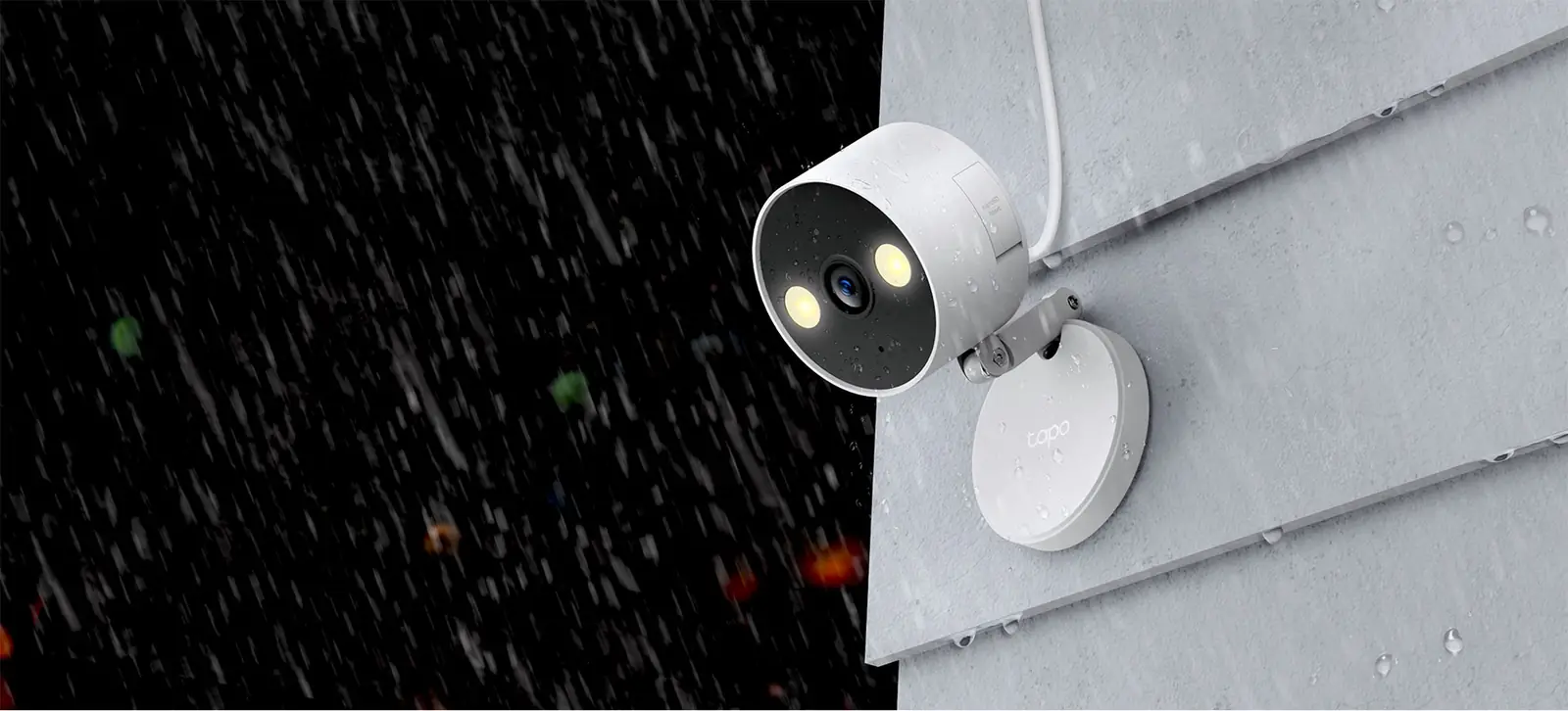
Tapo 2K+ (Black)
By Tapo · Indoor Security Cameras · Cleaning & Smart Home
- 2560 x 1440 at 20 fps
- 103 degree horizontal, 55 degree vertical field of view
- IP66 weather rating
- microSD up to 512 GB
- 96 dB siren
Lowest price seen
~$39.99 (approx.)
from $39.99 at Amazon
- Amazon ~$39.99 (approx.)View at Amazon
- TapoView at Tapo
- eBay (used) eBay: used, open-box, refurbishedView at eBay (used)
- eBayView at eBay
Prices are snapshots. Check the current price with the store.
Summary
A compact, mains-powered 2K security camera with free on-device person, pet and vehicle detection and microSD recording, with no subscription required. Check that you have a protected outlet within reach of the 3 m power lead — there is no battery, pan/tilt or Ethernet fallback.
Strengths
- 2K video at 20 fps with clear daytime detail and convincing color night vision in independent hands-on tests.
- Free on-device detection for people, pets and vehicles, with configurable activity zones and no subscription.
- microSD recording up to 512 GB, with continuous or event schedules set in the Tapo app.
- Magnetic mount plus a 3 m (9.8 ft) USB-C lead gives real placement flexibility on a porch, garage or indoor room.
- RTSP and ONVIF Profile S let you record to your own NVR or NAS without Tapo Care.
- Google Assistant, Alexa and SmartThings support, plus a two-year warranty category for wired smart-home cameras.
Weaknesses
- Independent reviews called two-way audio mediocre, and owners in r/Tapo report crackling or static on multiple units.
- 2.4 GHz Wi-Fi only — no 5 GHz, no Ethernet, no battery backup.
- Missed and delayed notifications were common enough that June 2026 firmware explicitly fixed some missing-alert scenarios.
- One owner reported cats, foxes and raccoons missed at night even while another camera in the same system detected them.
- A Tapo Care trial stopped RTSP recording for one owner, and TP-Link allows only two of three recording paths at once.
- Footage lives on the camera’s SD card, so a stolen camera takes its recordings with it.
Verified specifications
| Resolution | 2560 × 1440 (2K QHD, 4 MP) at up to 20 fps; 1/3-inch CMOS sensor, 3.1-mm f/1.6 lens. |
|---|---|
| Field of view | 115.8° diagonal, 98.5° horizontal, 53.1° vertical; 12x digital zoom; fixed, no pan or tilt. |
| Night vision | dual white spotlights for color video, dual infrared LEDs for IR mode; maker-rated coverage about 40 ft (12 m). |
| Audio | built-in microphone and speaker, two-way talk; siren rated 98 dB at 10 cm. |
| Detection | free on-device person, pet, vehicle, motion, line crossing, baby crying, barking, meowing, glass break and camera tampering alerts; configurable activity zones. |
| Storage | microSD up to 512 GB, card sold separately; continuous or event recording scheduled in the Tapo app. |
| Networking | 2.4 GHz Wi-Fi only (802.11 b/g/n), Bluetooth setup; RTSP and ONVIF Profile S on supported firmware. |
| Power | 5 V DC / 1 A via USB-C, rated 1.96 W typical; adapter and 3 m (9.8 ft) lead in box; no battery, PoE or Ethernet. |
| Environmental | IP66 rated; operating range -13°F to 113°F (-25°C to 45°C). |
| Dimensions | 2.65 × 2.26 × 1.74 in; 90 g (3.17 oz) camera only. |
| In the box | camera, USB adapter, USB-C lead, screws, anchors, metal plate, one-time adhesive, cable clips, mounting template, removal pin, setup sheet. |
| Smart ecosystems | Google Assistant, Alexa, Samsung SmartThings; no Apple HomeKit. |
| Warranty | TP-Link’s US table lists 2 years for “Smart Home – Indoor/Outdoor Wired Cameras” but does not name the C120 row by row; confirm with your serial. |
Full research notes and sources
Picture quality and night vision
The 1/3-inch sensor, 3.1-mm f/1.6 lens and WDR produce a sharp 2560 × 1440 image, and the 115.8° diagonal field of view covers a porch or driveway from one fixed spot. Tom’s Guide’s outdoor test showed clearly detailed video, PCWorld praised the daytime picture and color night imaging, and Expert Reviews’ UK hands-on called the video crisp at the price. Dual white spotlights give full-color night video when you want it; dual infrared LEDs cover darker scenes, with the maker rating coverage at about 40 ft (12 m). The camera cannot pan or tilt, 20 fps is not silky motion, and 12x digital zoom cannot create detail — choose the angle at mounting time and live with it.
Audio, alerts and detection
The built-in microphone and speaker handle two-way talk, but independent reviews called the audio mediocre. Worse, an April 2026 r/Tapo owner reported all five of their C120s producing random clicks and static in live and recorded audio despite the latest firmware, and an August 2026 owner of three units described the same crackling, making sound nearly useless. No failure rate has been measured, so treat this as a real caveat for baby monitoring or intercom use.
Detection itself runs free on the device — person, pet, vehicle, motion, line crossing, baby crying, barking, meowing, glass break and camera tampering — with configurable activity zones. Notification reliability is the soft spot: an October 2025 household reported occasional multi-minute delays or missing alerts after six reliable months, and an August 2026 household found pushes missing on a shared spouse account while the owner account worked. TP-Link’s June 18, 2026 firmware for V1.60 explicitly improved detection and fixed missing notifications in some scenarios — a documented bug fix, not a guarantee.
Storage, subscriptions and running costs
Local recording is the default: a microSD card up to 512 GB (sold separately) holds continuous or event video, but TP-Link’s June 2026 manual is clear that the continuous schedule must be enabled in the app — inserting a card is not enough. A SanDisk 128 GB High Endurance card was listed at $39.49 by Newegg Official on Best Buy’s marketplace (2026); camera plus card came to $69.48 against the $29.99 eBay ask (2026). Write volume matters: 24/7 recording can wear consumer cards, so consider an endurance-rated card and check the recording timeline now and then.
TP-Link allows only two of three recording paths at once: Tapo Care cloud, SD/hub local recording, and NVR/NAS/ONVIF. A September 2025 owner reported RTSP streams stopping after starting a free Care trial, even with no SD card installed, and said support misquoted the limit. If you keep your own NVR, test the exact cloud, SD and NVR combination you intend to run before relying on it.
Running costs stay small. At the rated 1.96 W and an illustrative $0.20 per kWh, continuous use works out to about $3.43 a year in electricity. Optional Tapo Care Cloud runs $3.49 a month per camera or $34.99 a year for up to 2 devices (Tapo Care US, 2026), adding 30-day cloud history and snapshot notifications; with modeled electricity that lands near $38.42 a year on annual billing or $45.31 on monthly billing. Skip the plan and the camera costs nothing beyond power and the SD card. If you need more reach, a third-party 20-ft USB-C two-pack listed at $21.18 at Walmart (2026), but check connector fit and weatherproofing before extending an outdoor run.
Is it worth it?
At the $39–$39.99 launch price flagged by Tom’s Guide and PCWorld in 2024, the C120 packed 2K video, color night vision and no mandatory subscription into a budget camera. The 2026 asks — $29.99 from a third-party eBay seller with no returns, $47.00 in a Walmart category listing — keep it in budget territory. Under $35 from an authorized seller is good value once a microSD card is in the budget; above $45, look at the indoor Tapo C125 if you need HomeKit or a privacy shutter. If you want pan/tilt, battery power or HomeKit, this is the wrong camera: it is a fixed, wired, 2.4 GHz-only design, and rivals add features it lacks.
Which model this is
This page covers the Tapo C120. TP-Link’s US catalog now lists C120 V2, while the download center supports V1, V1.26 and V1.60 hardware; early reviews cover earlier revisions with different sensor and field-of-view specs, so match the hardware-version sticker on the box to the manual and firmware you download. TP-Link’s own US photos show a white housing with a black camera face; no manufacturer-confirmed all-black C120 US SKU was found.
Sources
Manufacturer:
- TP-Link USA — Tapo C120 V2 product specifications
- TP-Link USA — Tapo C120 user guide (V1.60)
- TP-Link USA — Tapo C120 firmware download center
- TP-Link USA — RTSP and ONVIF setup guide
- TP-Link USA — Continuous microSD recording FAQ
- Tapo USA — Tapo Care plans and pricing
- TP-Link USA — Warranty and RMA policy
Independent reviews:
- Tom’s Guide — Tapo C120 hands-on review
- PCWorld — Tapo C120 indoor/outdoor review
- Expert Reviews — Tapo C120 review
Owner reports:
- Five cameras moved from Wyze v4; audio clicking (r/Tapo)
- RTSP stopped after a Tapo Care trial (r/Tapo)
- Nighttime pet detection misses (r/Tapo)
- Audio crackling on three units (r/Tapo)
- Missing and delayed event notifications (r/Tapo)
- Notifications missing on a shared account (r/Tapo)
Parts and stores: