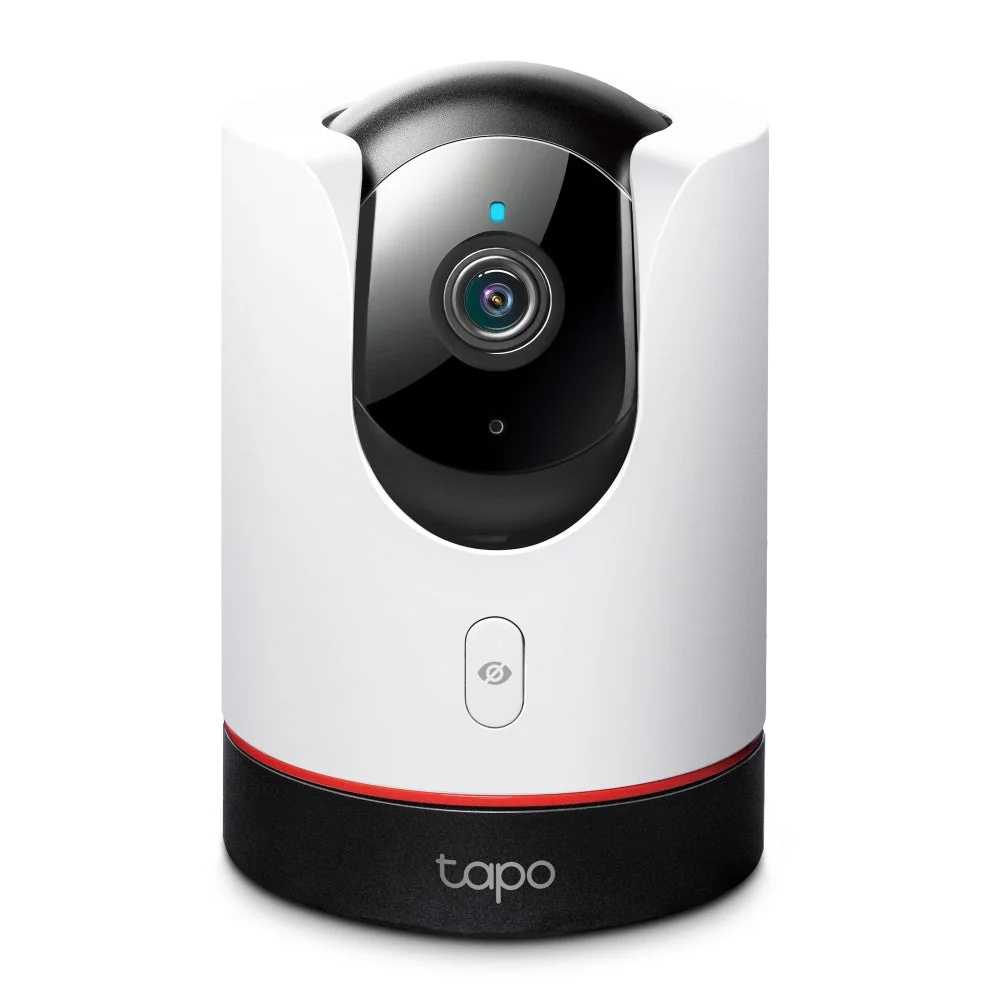
Tapo TP-Link Tapo C225
By Tapo · Indoor Security Cameras · Cleaning & Smart Home
- View Range: 360 degrees Horizontal, 149 degrees Vertical
Lowest price seen
$45.99
from $45.99 at Cyberlytics (Houston, TX) · Checked Oct 4, 2026
- Cyberlytics (Houston, TX) $45.99View at Cyberlytics (Houston, TX)
- TapoView at Tapo
- B&H PhotoView at B&H Photo
- eBayView at eBay
- eBay (used) eBay: used, open-box, refurbishedView at eBay (used)
- AmazonView at Amazon
Prices are snapshots. Check the current price with the store.
Summary
An indoor plug-in pan/tilt camera whose privacy shutter rotates the lens into the housing, with local microSD recording up to 512 GB and no required subscription. Two hardware versions exist and only one is current, so check the label before buying.
Strengths
- The physical privacy shutter rotates the lens into the housing, which an app toggle cannot match.
- Independent imaging results are strong for the price: the one full review organisation scored daytime images among the sharpest it has seen.
- The same source rates response time and smart features excellent and data security very good.
- Local microSD recording up to 512 GB means no mandatory subscription.
- Detection covers people, pets, vehicles, sound and more without extra hardware.
- V2 adds HomeKit and a starlight sensor over the older V1, and firmware was still being updated in August 2026.
Weaknesses
- Two hardware versions differ in sensor, resolution, siren volume, pan range and HomeKit, and only the V2 is current.
- The pan motor is a single point of failure with no published spare part; one exact-model owner documented complete horizontal-pan loss.
- microSD recording is the other trouble spot, with cards that stop recording or fail to format after a firmware update.
- 2.4 GHz Wi-Fi only, no Ethernet, and no wired option.
- HomeKit is not a full PTZ controller: pan, tilt and privacy mode stay in the Tapo app.
- The camera ships at 15 fps, not the advertised 30 fps, until the setting is changed.
Verified specifications
| Model | Tapo C225, current US hardware V2; the V2.60 branch received firmware 1.3.2 Build 260811 on August 25, 2026. |
|---|---|
| Resolution | 2K QHD 4MP, listed as 2688 × 1520 by TP-Link’s US page and datasheet but as 2560 × 1440 by B&H for the exact V2. |
| Frame rate | 15, 20, 25 or 30 fps, with 15 fps as the default. |
| Sensor | 1/2.9-inch progressive-scan CMOS, starlight. Lens 4.3 mm, F1.6, 100° diagonal, 83° horizontal and 43° vertical field of view. |
| Night vision | one 850 nm and two 940 nm IR LEDs, reaching 30 ft / about 9 m; the 940 nm mode cuts the visible red glow. |
| Coverage | 360° horizontal and 149° vertical, with tracking at up to 120°/s. |
| Video | H.264 with 3D DNR, WDR and HDR. |
| Audio | microphone and speaker with two-way audio and noise cancellation. Siren rated 98 dB at 4 in / 10 cm. |
| Detection | motion, person, pet, vehicle, line crossing, tampering, baby crying, cat meow, dog bark and glass breaking. |
| Wireless | 802.11b/g/n/ax on 2.4 GHz only, with WPA/WPA2/WPA3 and 128-bit AES. No Ethernet port. |
| Storage | microSD up to 512 GB, card sold separately; only two of microSD, Tapo Care and NVR/NAS/ONVIF can run at once. Recording to card continues without Wi-Fi, but live view, playback and notifications stop. |
| Smart home | Apple HomeKit, Amazon Alexa and Google Assistant. |
| Power | 12 V DC, 1.0 A adapter with a 3 m cord and a 2.1 mm inner / 5.5 mm outer barrel connector; the datasheet lists 4 W typical and 7 W maximum draw. Indoor use only, 0–40 °C. |
| Dimensions and weight | 80 × 80 × 112 mm (3.15 × 3.15 × 4.41 in); 313.2 g (11.05 oz). |
| In the box | camera, DC power adapter, two mounting screws, two anchors, mounting template, camera base and quick start guide. |
| Warranty | 2 years on indoor wired cameras for purchases on or after September 1, 2023. |
Full research notes and sources
The V1 and V2 split
TP-Link publishes two hardware versions and only the V2 is current; the US V1 support page is marked end of life. V1 uses a 1/3-inch sensor and a 4 mm lens, is rated 2560 × 1440, has a 93 dB siren, a 340° mechanical pan and no HomeKit. V2 steps up to a 1/2.9-inch starlight sensor with a 4.3 mm F1.6 lens, 2688 × 1520, a 98 dB siren, a 360° pan, Wi-Fi 6-class 2.4 GHz and Apple HomeKit. The one full hands-on review found, from Digital Citizen, tested V1 hardware, which is why older pieces state there is no HomeKit and no WPA3.
Two documentation conflicts are open in TP-Link’s own current material. The web page and datasheet say 2688 × 1520 while B&H lists 2560 × 1440 for the exact V2, and the V2.6 datasheet says “ONVIF No” while the product page says “ONVIF Yes”. Buyers planning NVR integration should verify the exact hardware and firmware before purchase rather than trusting either page alone. Match the version label, not just the model name.
The app, HomeKit and daily use
Set-up is easy and the Tapo app also drives other Tapo devices. The camera ships at 15 fps by default even though 30 fps is supported, so change the setting if you want the higher rate. The microSD slot sits behind the rotating head and the lens must be tilted upward to reach it, which TP-Link support confirms and which feels unintuitive at first.
HomeKit is real on V2 but partial. It covers live view and alerts, while pan, tilt and the physical privacy mode still need the Tapo app, and owners describe friction when combining HomeKit recording with Tapo controls. HomeKit reliability has not been perfect either: a 2025 V2 owner saw stale Home thumbnails until a later firmware fixed it, and a 2026 report of HomeKit Secure Video disappearing turned out to be an Apple service outage rather than a camera fault. The data-privacy rating is the one soft spot in an otherwise strong independent review, which rates technical data security very good but overall privacy below peers. Because the motor has no consumer replacement path, a pan failure is a warranty or service event rather than a repair.
Storage, subscriptions and running costs
There is no required subscription. Tapo Care is optional: the basic Cloud plan is $3.49 a month or $34.99 a year for up to two devices with 30 days of cloud history, and Cloud Advanced is $11.99 a month or $119.99 a year for unlimited devices with 180 days of storage and 24/7 cloud video (Tapo, 2026), so older advice that Tapo Care never supports continuous cloud recording is now outdated. Because 24/7 recording is only on a card or NAS, and only two storage paths run at once, a high-endurance microSD card is the practical choice. TP-Link requires at least Class 10/U1/V10 and recommends High Endurance cards for continuous recording, with no fixed replacement interval; a SanDisk 128 GB High Endurance card is listed at $36.99 at B&H as an example of that class (B&H, October 2026).
Running cost is mostly electricity. At the datasheet’s 4 W typical draw, continuous operation for a year uses about 35.0 kWh, or about $6.42 at the July 2026 US residential average of 18.31 cents/kWh; at the 7 W published maximum a full year would be about 61.3 kWh or $11.22, though real use should sit nearer the typical figure. That makes the card and any cloud plan, not power, the main recurring spend. TP-Link sells no C225 motor, lens or board parts, and firmware was updated in June and August 2026.
Is it worth it?
US listings show $41.99 at B&H for the exact V2 and $41.99 direct from the Tapo store, reduced from $49.99 and sold out when checked. At $45 or less it is an easy buy for anyone who wants HomeKit, the physical privacy shutter, local recording and motorized coverage. From about $46 to $55 it is still good value but the field closes. Above about $55, TP-Link’s 4K dual-band C260 is the stronger pick for most non-HomeKit buyers at $53.99, and above $100 the C225 is poor value next to the eufy Indoor Cam S350 at $139.99 with a 4K wide camera, a 2K telephoto, 8× hybrid zoom and 360° tracking. If the privacy shutter and HomeKit are not needs, the same-brand Tapo C220 is $32.99. Ignore the older $149.29 aggregator listing, which is out of stock and carries V1-era specs.
Which model this is
This page covers the Tapo C225, an indoor-only plug-in pan/tilt camera, listed under ASIN B0CHM81YY4. It is not a C210, C220, C222, C230 or C260, nor a Kasa KC410S by the same brand. Owners describe the C225 as essentially a C220 plus the physical privacy shutter and the invisible 940 nm IR, and TP-Link has shipped two hardware versions, V1 and V2, with only V2 current in the US.
Sources
Manufacturer:
- Tapo C225 product page (US)
- Tapo C225 V2 product page (US)
- Tapo C225 V1 product page (US, end of life)
- Tapo C225 V2.20 datasheet (PDF)
- Tapo C225 V2.6 official US datasheet
- TP-Link US C225 download, firmware and support page
- Tapo C225 V2.6 product page (US)
- Tapo Care plans and US pricing
- TP-Link US replacement and warranty terms
- TP-Link: microSD card compatibility for Tapo and Kasa cameras
- How to fix Tapo or Kasa SD card not formatting or recognised
- Tapo cameras: setup, features and settings
- General questions about Tapo Care
Independent reviews:
- Consumer Reports: Tapo C225 review
- Consumer Reports: indoor camera comparison
- Digital Citizen: TP-Link Tapo C225 review
Owner reports:
- C225 horizontal pan not working (TP-Link community)
- C225 stopped recording after a firmware update (TP-Link community)
- Recording loss around privacy mode and reboot (TP-Link community)
- C225 HomeKit Secure Video outage traced to Apple (TP-Link community)
- How to insert the C225 microSD card (TP-Link community)
- C225 V2 HomeKit and Tapo-app control limits (r/Tapo)
- C225 HomeKit thumbnail issue fixed after firmware (r/Tapo)
- Tapo C225 with HomeKit (r/smarthome)
- Tapo C225 vs C220 (r/TpLink)
Retailers, parts and alternatives: