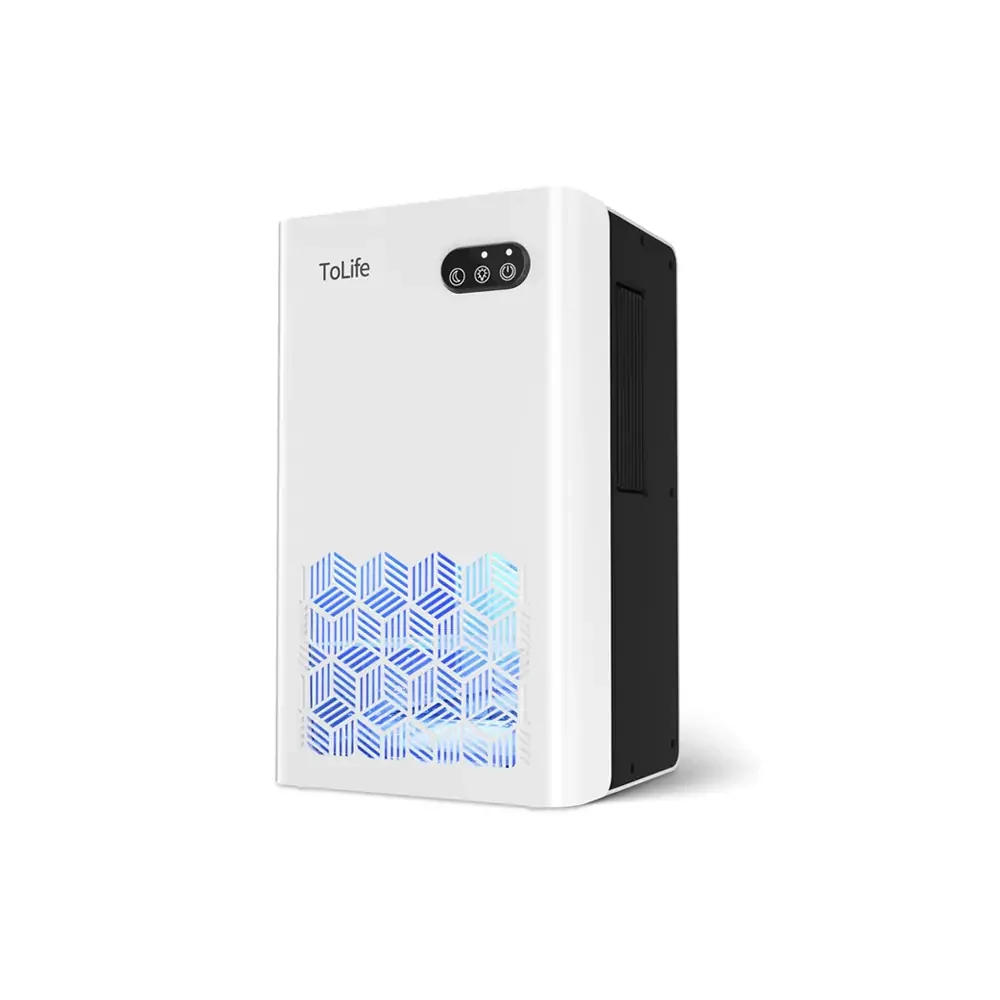
ToLife 1000 sq.ft 95oz (Grey)
By ToLife · Dehumidifiers · Home & Workspace
- 95 oz water tank
- Rated for spaces up to 1000 sq.ft
Lowest price seen
~$59.99 (approx.)
from $59.99 at Amazon
- Amazon ~$59.99 (approx.)View at Amazon
- eBayView at eBay
- eBay (used) eBay: used, open-box, refurbishedView at eBay (used)
Prices are snapshots. Check the current price with the store.
Summary
A 13.78-inch-tall semiconductor dehumidifier with a 95 oz tank, rated at about 1000 ml (1.06 pints) a day and meant for one small closed room rather than a floor. Check where you plan to put it: output drops outside 59 °F–104 °F, and it holds humidity steady instead of drying out a damp space.
Strengths
- A 95 oz tank in a body just under 14 inches tall, so it runs longer between emptyings than most small units.
- Plug it in, choose a fan speed and it runs; the hands-on test gave ease of use full marks.
- Auto shut-off stops it when the tank is full or not seated, so it will not overflow.
- Sleep mode is the quiet setting, and ToLife rates it under 30 dB.
- Light enough, with a built-in handle, to move between a bathroom, a closet and an RV.
- Draws 76.5–93.5 W, cheap enough to leave running in a small room.
Weaknesses
- Rated at about 1.06 pints a day, roughly 20 to 50 times less extraction than the compressor units it shares a shelf with.
- Slow at the job that matters: the hands-on test called moisture removal slow and suited it to holding humidity steady rather than drying a room after rain or flooding.
- No humidistat, no humidity display, no drain hose and no documented timer.
- Louder than expected on the higher fan speeds, which scored it lowest on noise in that test program.
- Weakens below 59 °F, and the manual says the effect can be decreased or zero outside 59 °F–104 °F.
- You empty the tank by hand, and the one-year warranty covers authorized orders only.
Verified specifications
| Model | TZ-C2. |
|---|---|
| Type | semiconductor condensation (Peltier), no compressor. |
| Rated extraction | approx. 1000 ml/day at 86 °F and 80 % RH — about 1.06 pints a day. |
| Tank | 95 oz (approx. 2.8 L) in test and retail listings; the manual states 2000 ml. |
| Coverage | 1,000 sq ft in ToLife’s marketing; up to 950 sq ft in ToLife’s own FAQ and several other sources. |
| Modes | normal and sleep. The manual says sleep mode switches the lights off, runs quieter and has a weaker dehumidifying effect. |
| Light | 7-color LED that cycles, locks to a single color on a second press, and can be switched off. |
| Controls | power, light and sleep mode only. No humidistat, no humidity display, no timer, no continuous drain. |
| Full tank | the unit stops, the warning sounds three times and the red light flashes; empty and reseat the tank to restart. |
| Power | AC 100–240 V, 60 Hz; rated 76.5–93.5 W. |
| Operating range | 59 °F–104 °F, above 45 % RH. |
| Dimensions | 8.27 × 5.59 × 13.78 in, with a built-in handle and a body just under 14 in tall. |
| Weight | 5.8 lb in hands-on testing; the manual lists 3.4 lb net. |
| Energy Star | not certified. |
| In the box | dehumidifier, power adapter, user manual. |
Full research notes and sources
What the coverage number means
The 1,000 sq ft on the box describes a room the unit can sit in. It is not a claim that the machine will hold a thousand-square-foot space at a useful humidity, because the same manufacturer rates extraction at about 1000 ml/day and an RV roundup restates that as up to 1 liter per day. ToLife’s own pages hedge the coverage figure: the site FAQ calls it up to 950–1,000 sq ft and advises closing doors and windows, and the manual-guide page describes it as a unit for spaces up to 950 square feet. A retailer listing for identical hardware, Homes & Gardens and aircare.best all say 950 sq ft. Plan on 950.
The rooms that fit are the ones the manual names: dressing rooms, bedrooms, basements and bathrooms. The same operating limits decide where it works. The manual restricts the unit to 59 °F–104 °F above 45 % RH and states that outside that band it will not completely cease operation but may show decreased or zero dehumidification. Bob Vila’s explanation of the technology is the plain version: refrigerant units work best above roughly 65 °F, because condensation falls off as the coil gets cold. For an unheated garage or a damp crawl space, this is the wrong category of machine.
How it tested
Exactly one hands-on program covers this model. Bob Vila tested 15 products over six weeks, pulled 2,500 pints of water out of the air and ran each unit for seven days in a large open basement where humidity sat between 40 and 70 %. The TZ-C2 came out as their value pick at 4.4 on a 5-point scale, with full marks for ease of use and value, 3.7 for effectiveness and 3 for noise.
Read the verdict as a pair, because it praises and criticizes the same machine. Setup was easy, and the unit “steadily collected moisture in smaller rooms”, but it “worked much more slowly than full-size compressor dehumidifiers” and was “best suited to maintaining comfortable humidity levels rather than quickly drying out a damp space after heavy rain or flooding”. Noise is the other half. The lowest fan setting was reasonably quiet, while higher speeds produced more fan noise than the tester expected and made sleeping nearby difficult. Nobody has published a dB figure for any setting other than sleep mode, so treat the under 30 dB number as a sleep-mode-only claim and expect more noise on a normal setting.
Two outlets with instrumented dehumidifier programs have not tested ToLife. Wirecutter’s guide is led by a 50-pint Midea measured at 51 dB from 6 feet, and Consumer Reports’ 2026 guide covers 20–50 pint/day compressor models. Be skeptical of the ranking pages as well: one site lists this same product first for portable dehumidifiers, first for apartments, and also in second, fourth and seventh place on its under-$150 list with a different composite score each time, and another says in its own methodology that because “extensive physical testing of every model isn’t feasible” it relies on specification analysis.
Running costs, upkeep and warranty
Electricity is the only running cost. At the manual’s 76.5–93.5 W rating, continuous 24/7 operation is about 0.59–0.75 kWh a day, or 18–22 kWh per 30 days. There are no consumable filters, no descaling chemicals, no replacement parts and no drain hardware to buy, and no filter is documented for this model. ToLife’s FAQ says to rinse the tank with warm soapy water every 1–2 weeks.
Tank emptying is the real chore. ToLife’s FAQ puts it at every 2–3 days in a typical bedroom, and says a very damp space such as a basement can fill the tank within 24 hours, which matches the rated output.
Support is thin. The warranty is one year, refund or replacement, and both the manual and the site FAQ agree on that. The manual limits it to orders from ToLife’s own store and authorized sellers and states that other distribution channels are not covered, which matters if you buy from a third-party marketplace. There is no parts catalog and no repair channel: the manual’s troubleshooting table stops at a full tank, a jammed float, a loose plug or socket and a blocked air outlet, and the warranty mechanism is refund or resend rather than repair.
Is it worth it?
For a bedroom, bathroom, closet or RV, a large tank in a small body with genuinely low sleep-mode noise is a reasonable package. For a finished basement, a whole floor, or any space where mold is already present, no price makes a 1 pint/day unit adequate.
Prices outside the big marketplace, as dated snapshots: a Walmart listing for the same hardware showed the black colorway at $83.99, RV and camper roundups list $59.96, and Homes & Gardens recorded $59.98 against a $79.99 reference. One editorial source expects $80 to $120 for this model, and at that level a 20–50 pint/day compressor unit with a drain hose and an adjustable humidity setting becomes the better tool. Check the store panel above for current prices.
Which model this is
This page covers the grey 95 oz / “1000 sq ft” unit, hardware model TZ-C2. ToLife sells the same body in white, black and silver. Do not confuse it with the TZ-C1, the 30 oz unit for spaces up to 500 sq ft, or with the C5, a 32 pint/day compressor model with a drain hose for areas up to 3,000 sq ft. The listing behind this page is ASIN B0HGB9NKG6.
Sources
Manufacturer:
- ToLife TZ-C2 dehumidifier user manual (PDF)
- ToLife dehumidifier store page and FAQ
- ToLife dehumidifier official site and FAQ
- ToLife dehumidifier manual guide page
- ToLife product family page
Independent reviews:
- The Best Dehumidifiers We Tested for Basements, Bedrooms, and More (Bob Vila)
- The 3 Best Dehumidifiers of 2026 (Wirecutter)
- 6 Best Dehumidifiers of 2026, Tested by Our Experts (Consumer Reports)
- These dehumidifiers zap moisture from your muggy basement (CNET)
- A dehumidifier made my bedroom condensation disappear (Homes & Gardens)
- Top Portable Dehumidifiers for RV Comfort and Dry Cushions
- Best Dehumidifier For Camper (homespe.com)
- ToLife Dehumidifier hands-on video review (YouTube)
Retail listings:
Owner reports:
- Owner report of a unit that powers on but stops collecting water, in the comment thread on ToLife’s store page
- No independent owner thread with a detailed failure account for this model was found, so treat the single vendor-hosted report as a caution signal rather than a failure rate.