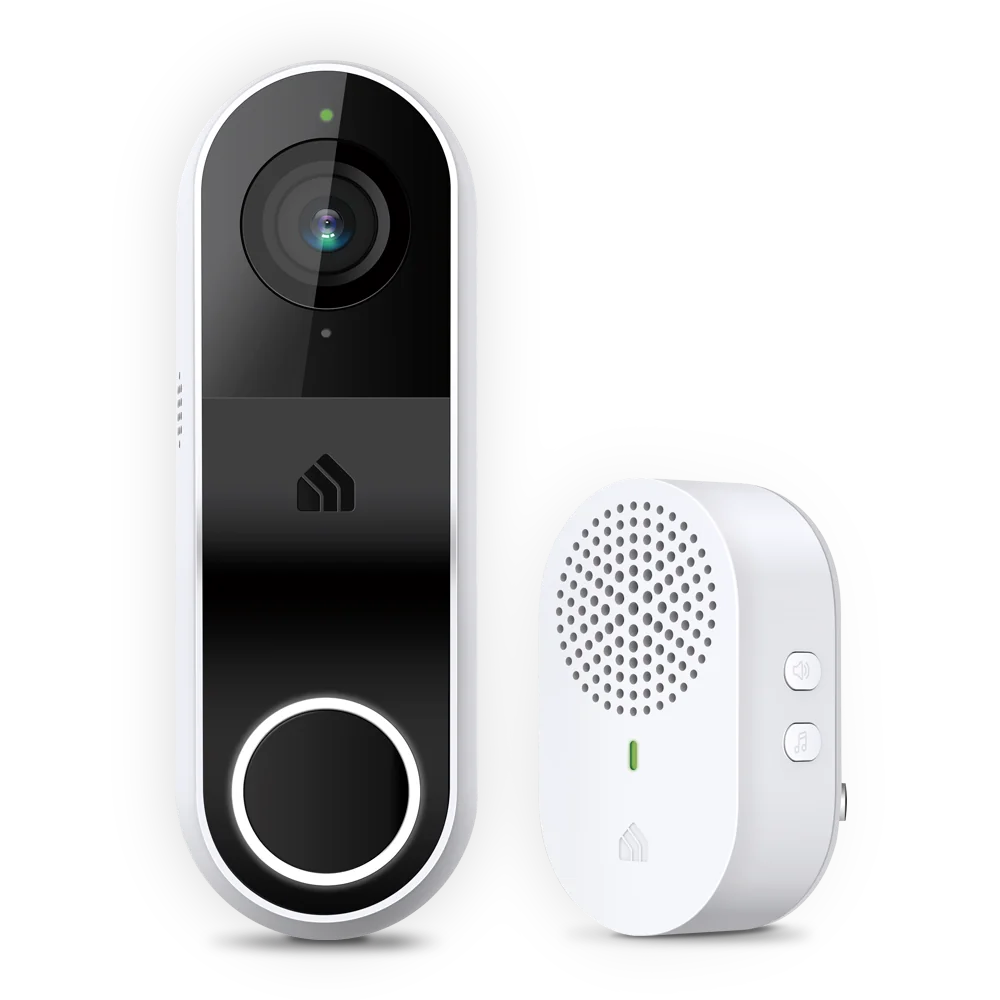
Kasa Smart Doorbell KD110
By Kasa · Video Doorbells · Cleaning & Smart Home
- 3 MP HD video, 2304 x 1296 pixels, 15 fps, H.264 compression
- Diagonal field of view 160 degrees
- 850 nm IR LED night vision, up to 15 ft (datasheet for v3.0/4.0 states 30 ft / 9 m)
- Hardwire only, 16-24 VAC, 10 VA minimum, 50/60Hz
- microSD slot up to 256 GB (version 1 up to 128 GB) plus optional Kasa Care cloud
Lowest price seen
~$39.25 (approx.)
from $39.25 at Amazon
- Amazon ~$39.25 (approx.)View at Amazon
- KasaView at Kasa
- NeweggView at Newegg
- eBayView at eBay
- eBay (used) eBay: used, open-box, refurbishedView at eBay (used)
Prices are snapshots. Check the current price with the store.
Summary
A hardwired 3 MP Wi-Fi doorbell with a plug-in chime in the box, for homes that already have AC doorbell wiring and want local SD recording without a subscription. Check your transformer before you buy: it needs 16-24 VAC with at least 10 VA, and there is no battery to fall back on.
Strengths
- Local microSD recording is supported, so the Kasa Care subscription is genuinely optional.
- Consumer Reports measured alerts reaching the app in 4.7 seconds on average.
- Daytime video came out “fairly sharp and clear” in Consumer Reports’ test.
- The plug-in indoor chime with 8 ringtones ships in the box, which most rivals charge extra for.
- Person detection and activity zones run on the device, not in the cloud.
- TP-Link still ships firmware: the newest V4 build is 2.3.28, from 2025.
Weaknesses
- No battery and no battery backup, so a power cut takes the camera down with it.
- Consumer Reports called night video “below par: not very viewable, and not as bright or clear as the better models.”
- Consumer Reports rated data privacy “sub-standard” and found no two-factor authentication.
- Setup fails outright on a small transformer, thin wire, a missing chime bypass jumper or a load device on the line, and TP-Link documents every one of those as a common cause.
- The chime is proprietary: Eufy and Ring chimes will not pair with it, and the radio link is capped at 30 meters.
- The image is vertical only, with no setting to rotate it 90 degrees.
Verified specifications
| Camera | 3 MP, 2304 × 1296, H.264 at 15 fps. |
|---|---|
| Sensor and lens | 1/2.8-inch sensor, F/2.1, 2.1 mm focal length. |
| Field of view | 160° diagonal, 16:9 frame. Consumer Reports records the same numbers and files it in the 2K resolution class. |
| Night vision | 850 nm IR LED, rated up to 15 ft on the product page. The V3 and V4 datasheets claim 30 ft / 9 m. |
| Audio | two-way audio through a built-in microphone and speaker, G.711 codec. The chime has its own speaker and 8 ringtones, chosen with a Music button on its side. |
| Storage | microSD up to 256 GB on later hardware revisions, 128 GB on version 1, card not included. Kasa Care cloud storage is optional. |
| Detection | person detection and activity zones, and recording starts 3 to 5 seconds before a motion alert. No vehicle, animal or package detection. |
| Wi-Fi | 2.4 GHz only, 802.11b/g/n, WPA/WPA2-PSK with 128-bit AES over SSL/TLS. Minimum 2 Mbps upload speed. |
| Weather | IP64, rated from -20 to 45 °C and 10-90% humidity. |
| Power | wired only, no battery and no backup. 16-24 VAC, 50/60 Hz, from a transformer of at least 10 VA. |
| Install limits | 25 AWG wire or heavier, under 10 ohms total resistance, no load device between transformer and doorbell, and the old chime must be bypassed with the supplied jumpers. |
| Smart home | Alexa and Google Assistant, Kasa app required. No Apple Home, and no PC or desktop viewing. |
| Dimensions | doorbell 1.78 × 1.08 × 5.12 in (45 × 27.5 × 130 mm); chime 1.71 × 1.85 × 2.87 in (43.5 × 46.9 × 73 mm). |
| In the box | doorbell, chime, positioning card, mounting bracket, 15-degree mounting wedge, 2 extension wires, 2 wire nuts, 2 jumpers for the existing chime, 2 screws and anchors, quick start guide. |
Full research notes and sources
Installation and wiring
This is where most of your time goes, and where most of the failures come from. The doorbell has no battery of its own, so it needs existing low-voltage AC doorbell wiring and a transformer putting out 16-24 VAC with at least 10 VA. TP-Link warns that an undersized transformer can cause problems for the doorbell or damage it.
TP-Link’s own troubleshooting pages list the recurring setup failures: no power, a red flashing light, or the doorbell never broadcasting its setup Wi-Fi network. The causes are an undersized transformer, exposed wire ends touching behind the doorbell, a missing jumper that leaves the old mechanical chime in circuit, wire thinner than 25 AWG or with 10 ohms or more of run resistance, and a load device such as another device on the same transformer.
That last one matters more than it sounds: no load device may sit between the transformer and the doorbell. The existing chime must be shorted out with the supplied jumpers, which install on the transformer’s front and rear terminals. You can pull the old chime off the wall, but keep its wires and screws. TP-Link publishes a compatibility checker for exactly this transformer-and-wire check, and a transformer is not included in the box.
Two more constraints before you order. The chime is proprietary and pairs only with a KD110 doorbell, within 30 meters, with walls and obstacles cutting that range. One doorbell can drive at least 20 chimes, but a chime serves a single doorbell. And if your entrance runs on an integrated intercom, gate system or entry control rather than a standalone momentary push button, this doorbell will not work on it.
Day and night picture
Consumer Reports is the only instrumented test of this exact model, and its record is mixed. Daytime video it calls “fairly sharp and clear, though not as much as the better models,” meaning you see most but not all of the detail. Alerts reached the app in 4.7 seconds on average, which it describes as very quick.
Nighttime is the weak spot. Consumer Reports rates it “below par: not very viewable, and not as bright or clear as the better models.” TP-Link’s product page rates the 850 nm IR at up to 15 ft, and B&H’s listing says the same 15 ft / 5 m, while the V3 and V4 datasheets claim 30 ft / 9 m. Treat 15 ft as the confirmed figure and plan for a lit porch if the camera has to see anything further out. If a face is what you are buying the doorbell for, this is the number to weigh.
Storage, app and privacy
Recording goes to a microSD card or, if you want it, to the optional Kasa Care cloud plan. Continuous local recording is supported and TP-Link’s FAQ calls it 24/7 recording, so you can run this doorbell for years without paying a subscription. Recording starts 3 to 5 seconds before a motion alert, which is what catches someone already at the door. Consumer Reports put local storage at 128 GB maximum for the unit they tested, and TP-Link says version 1 hardware tops out there while later revisions take 256 GB.
The privacy picture is the part to read twice. Consumer Reports rated data security “very good,” with most of the important protections for recordings and personal data in place, but rated data privacy “sub-standard” against peers on data collection, use control and data sharing. Its feature table also records no two-factor authentication, no geofencing, and no automatic firmware updates. TP-Link says video is encrypted with your account and stored on the doorbell; the product page separately claims 128-bit AES with SSL/TLS on the stream. Nobody has published a failure rate for this model, so treat the setup problems above as the known annoyance rather than a defect.
Firmware support is alive, which matters on hardware this old. V4 firmware 2.3.20 fixed missing notifications on some doorbell presses, 2.3.24 added Tapo Care video summaries and per-detection-type activity zones, and 2.3.28 added Tapo-app device sharing. One catch: TP-Link is ending IFTTT services for Kasa and Tapo products, though dealer listings still advertise IFTTT and SmartThings support.
Is it worth it?
At the outlet that had it listed, Consumer Reports showed $49.99 on 2026-10-04, with an earlier capture of the same page showing $44.99, so treat $45 to $50 as an observed band rather than a fixed price. In that bracket you get 3 MP video, a 160° field of view, person detection, local SD recording and a chime in the box. Check the store panel above for current prices.
You give up the things buyers pay up for elsewhere: below-par night video, no package, animal or vehicle detection, no two-factor authentication, and a sub-standard privacy score. Two of those are fixable or ignorable. The night image is not.
The bigger cost risk is electrical. If your transformer is under 10 VA, your wire is thinner than 25 AWG, or something else is on the line, price that work before the doorbell, not after. A dealer listing states a limited 2-year manufacturer warranty, which is worth confirming against TP-Link’s own US terms.
Which model this is
This page covers the Kasa Smart Doorbell KD110. Inside the kit the camera unit is model KD110D and the plug-in chime is KD110C. Four US hardware revisions exist, V1 through V4, and only V4 has a current quick installation guide and user guide on TP-Link’s download center. Revision matters for one published number: version 1 tops out at a 128 GB microSD card, later revisions take 256 GB.
Do not merge it with the Tapo doorbells. Kasa and Tapo use different bodies, so Tapo mounts do not fit this one. It is also not the Kasa KE100 keypad, and it is not interchangeable with other TP-Link wired doorbells. The Amazon listing for this body is ASIN B09TG759WY.
Sources
Manufacturer:
- Kasa Smart Doorbell KD110 product page — specs and box contents
- TP-Link release page — KD110 2K Kasa Smart Doorbell
- TP-Link FAQ — Kasa Smart Doorbell (KD110), pairing, chime and compatibility
- TP-Link — fixing a KD110 that does not broadcast Wi-Fi or has power issues
- TP-Link KD110 download center — hardware versions, documents and V4 firmware notes
Independent reviews:
- Consumer Reports — TP-Link Kasa Smart KD110 home security camera review
- B&H Photo Video — TP-Link KD110 Kasa Smart Video Doorbell listing and specs
- DoorBell Mount — swivel mount for the Kasa KD110 body, which also fits no Tapo model
Owner reports:
- No owner reports were usable for this model. Searches came back rate-limited, so nothing here reflects owner sentiment, and the setup notes above come from TP-Link’s own troubleshooting pages rather than from people who own the doorbell.